Key takeaway: The normal heart rate for dogs at rest is 70 to 120 beats per minute, according to the Merck Veterinary Manual. Healthy dogs dip well below that: in a 2010 Ohio State study of 60 healthy dogs on 24-hour ECG, the median lowest rate was 42. Size matters less than most charts claim, puppies run faster, and every dog has its own normal.
Why One Number Is Never the Whole Answer
Search for a normal dog heart rate and you will find a dozen charts that disagree. Very few say where their numbers came from.
We spent a lot of time on this question while building PawPulse, a smart dog collar with contactless heart rate and breathing monitoring. The honest answer: normal depends on what the dog is doing, how old it is and, a little, how big it is. This guide shows what independent veterinary sources and studies actually found, and ends with plain guidance on when to call your vet. Ranges vary from dog to dog, so treat every number here as a starting point for a conversation with your veterinarian.

Normal Dog Heart Rate Chart: What the Sources Say
| Situation | Heart rate (beats per minute) | Source |
|---|
| Adult dog at rest, standard reference range | 70 to 120 | Merck Veterinary Manual (updated 2024) |
| Healthy dogs over 24 hours: lowest rate | median 42 | Lamb et al., Ohio State, 2010 |
| Healthy dogs over 24 hours: average rate | median 73 | Lamb et al., 2010 |
| Healthy dogs over 24 hours: highest rate | median 190 | Lamb et al., 2010 |
| Healthy 5 kg dog vs healthy 55 kg dog | about 10.5 apart on average | Hezzell et al., Royal Veterinary College, 2013 |
| Small-breed puppy asleep, 4 months old | median about 128 | Hayashi et al., 2025 |
| Same puppies asleep, 8 to 12 months old | median about 88 to 91 | Hayashi et al., 2025 |
| Healthy dog asleep | can drop into the teens | MSD Veterinary Manual (2023 review) |
| Healthy dog at maximal exercise | 250 or more | MSD Veterinary Manual (2023 review) |
If you remember one line, make it the first: the Merck Veterinary Manual (2024) lists 70 to 120 beats per minute for dogs at rest. The rest of the table explains why a healthy dog can sit outside it and still be fine.
Why Can a Healthy Dog Sit Below 70?
Because "at rest" in a reference table and "asleep on your sofa" are not the same thing. In the Ohio State study by Lamb, Meurs and Hamlin (Journal of Veterinary Cardiology, 2010), 60 apparently healthy dogs weighing 2 to 80 kg wore a 24-hour ambulatory ECG. The median lowest heart rate was 42, the median average was 73 and the median highest was 190.
So over an ordinary day, a healthy dog's heart covers a far wider range than any single chart row. The practical lesson: a calm dog on your sofa may sit well below 70, and an alert dog on an exam table may sit near 120. Neither is automatically a problem.
Do Small Dogs Have Faster Heart Rates Than Large Dogs?
A little, but by less than most charts suggest. The largest study we found, by Hezzell and colleagues at the Royal Veterinary College (Journal of Small Animal Practice, 2013), looked at heart rates recorded for 5,000 healthy dogs at first-opinion visits plus 5,849 dogs at a referral hospital. In the healthy dogs, heart rate fell as body weight rose, but the average gap between a 5 kg dog and a 55 kg dog was only 10.5 beats per minute. Chihuahuas ran higher than other healthy dogs.
The smaller Ohio State study found no correlation between body weight and heart rate at all, and the Royal Veterinary College authors concluded that body weight, age, breed and disease status together account for a relatively small proportion of the overall variability.
Many pet websites publish size charts with small dogs well above 100. We could not find a primary study behind those exact cutoffs, so we do not repeat them. Your dog's own resting pattern tells you more than its weight class does.
How Does Age Change a Dog's Heart Rate?
Puppies run faster. A Tokyo University of Agriculture and Technology study (Hayashi et al., Animals, 2025) followed eight healthy small-breed puppies with a 48-hour Holter ECG every two months. During sleep, their median heart rate was about 128 at 4 months, about 114 at 6 months and about 88 to 91 from 8 to 12 months. That is a small group, but the direction matches what veterinarians expect: puppy hearts slow as they mature, with a wide spread early on.
Seniors are less clear. In the Royal Veterinary College study, heart rate rose with age in the referral-hospital dogs, a group that included sick dogs, so age and illness are hard to separate. We did not find a strong independent study that sets a separate normal range for healthy senior dogs, so we do not invent one.
What matters more with an older dog is a change over weeks in that dog, alongside signs like tiring on walks, a new cough or faster breathing at rest. More on that slow view in why senior dogs deserve continuous monitoring.
Why Does a Dog's Heart Rate Drop During Sleep?
The MSD Veterinary Manual (Kittleson, 2023 review), written by a veterinary cardiologist at UC Davis, notes that a healthy dog can have a heart rate in the teens when asleep and 250 or more during maximal exercise. That huge natural range is why a single number taken at a random moment can mislead.
Breathing slows too. In a 2012 Research in Veterinary Science study led by Mark Rishniw with university researchers in Sweden, Italy and Israel, owners counted sleeping breaths at home for 114 healthy adult dogs. The average was 13 breaths per minute, no dog averaged above 23, and age and body weight made no difference.

Is an Irregular Heartbeat Normal in Dogs?
Often, yes. The same MSD Veterinary Manual chapter states that sinus arrhythmia is a normal finding in dogs: the heart speeds up slightly as a dog breathes in and slows as it breathes out. If your count seems to wander with each breath, that is usually this pattern. It is also why a 15-second count multiplied by four can mislead; count for a full 60 seconds.
An irregular rhythm is not always benign, and only a veterinarian with a stethoscope or ECG can tell the difference. If the beat seems to skip or race without following breathing, mention it to your vet. We covered the related topic in what heart rate variability in dogs reveals.
How to Get a Resting Heart Rate You Can Trust
A home count is only useful if it is taken the same way each time.
- Wait until your dog has been lying calmly for at least five minutes, not right after a walk, a meal or a doorbell.
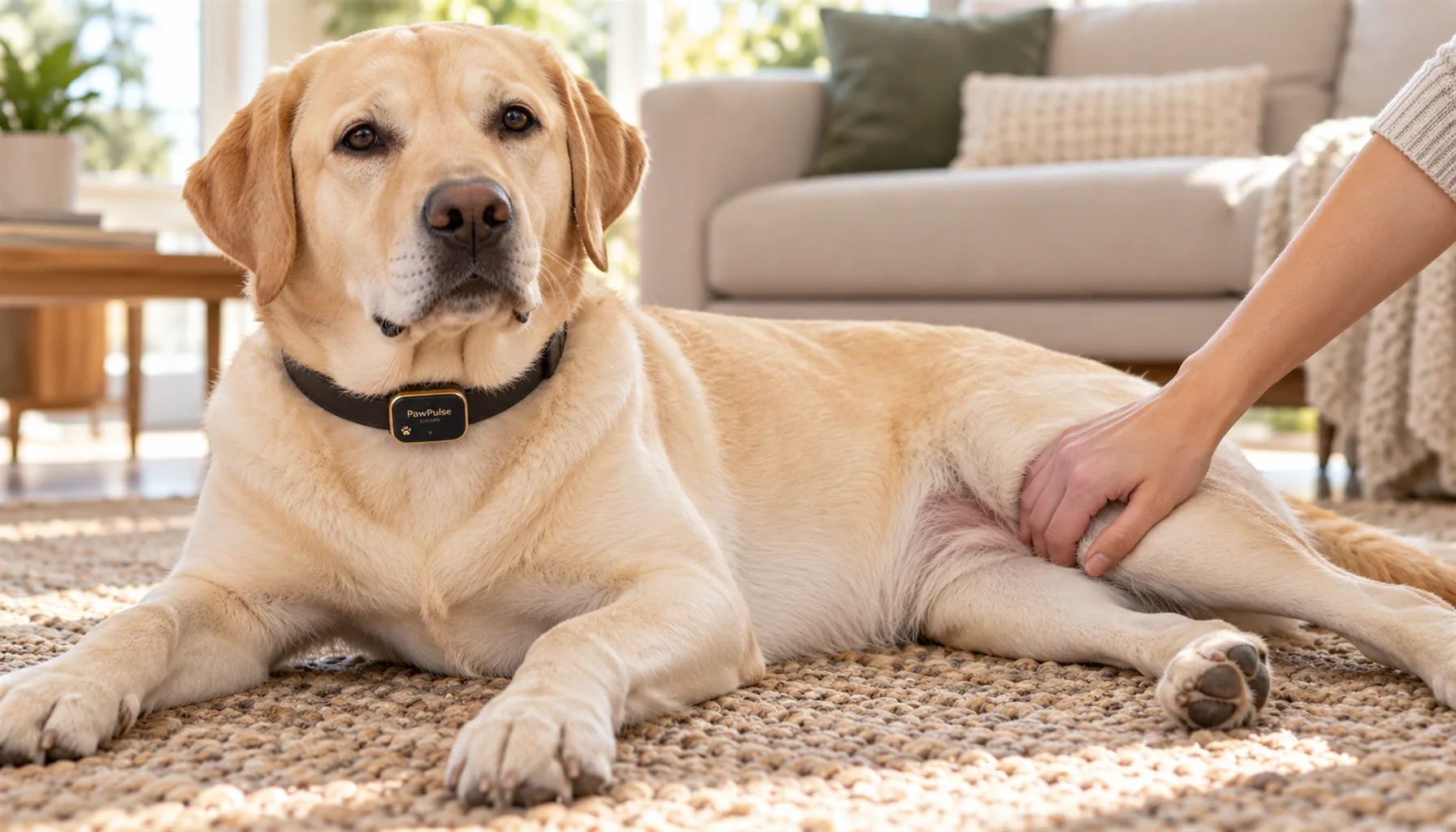
- Place your palm on the left side of the chest, just behind the elbow, or rest two fingers on the inside of the upper back leg, where the femoral pulse sits.
- Count every beat for a full 60 seconds.
- Write down the number, the time and what your dog was doing.
- Repeat at a similar calm time on several days to learn your dog's usual range.
Your dog's personal range, recorded this way, is more useful to your vet than any chart, including ours.
Where PawPulse Lucero Fits
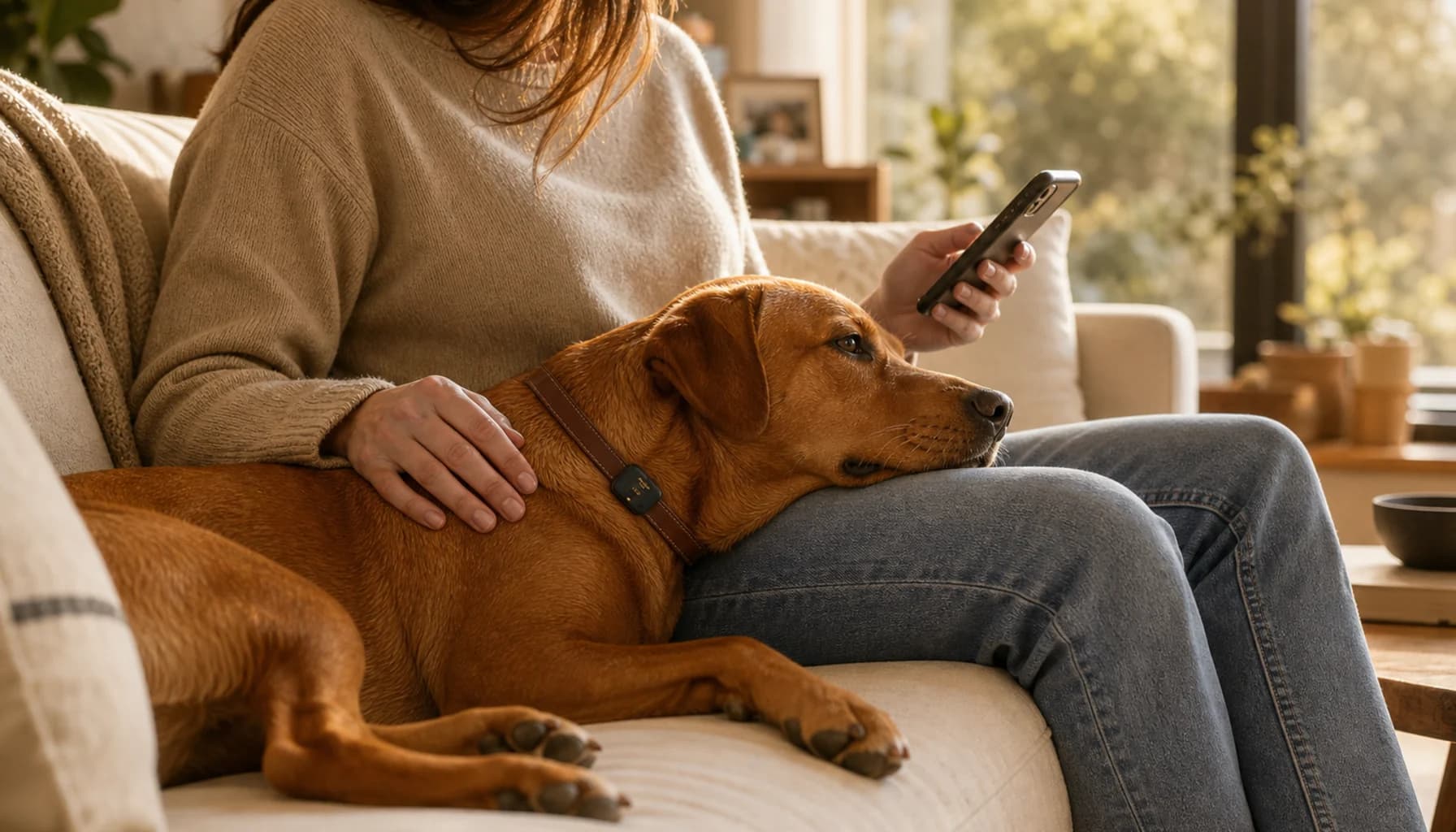
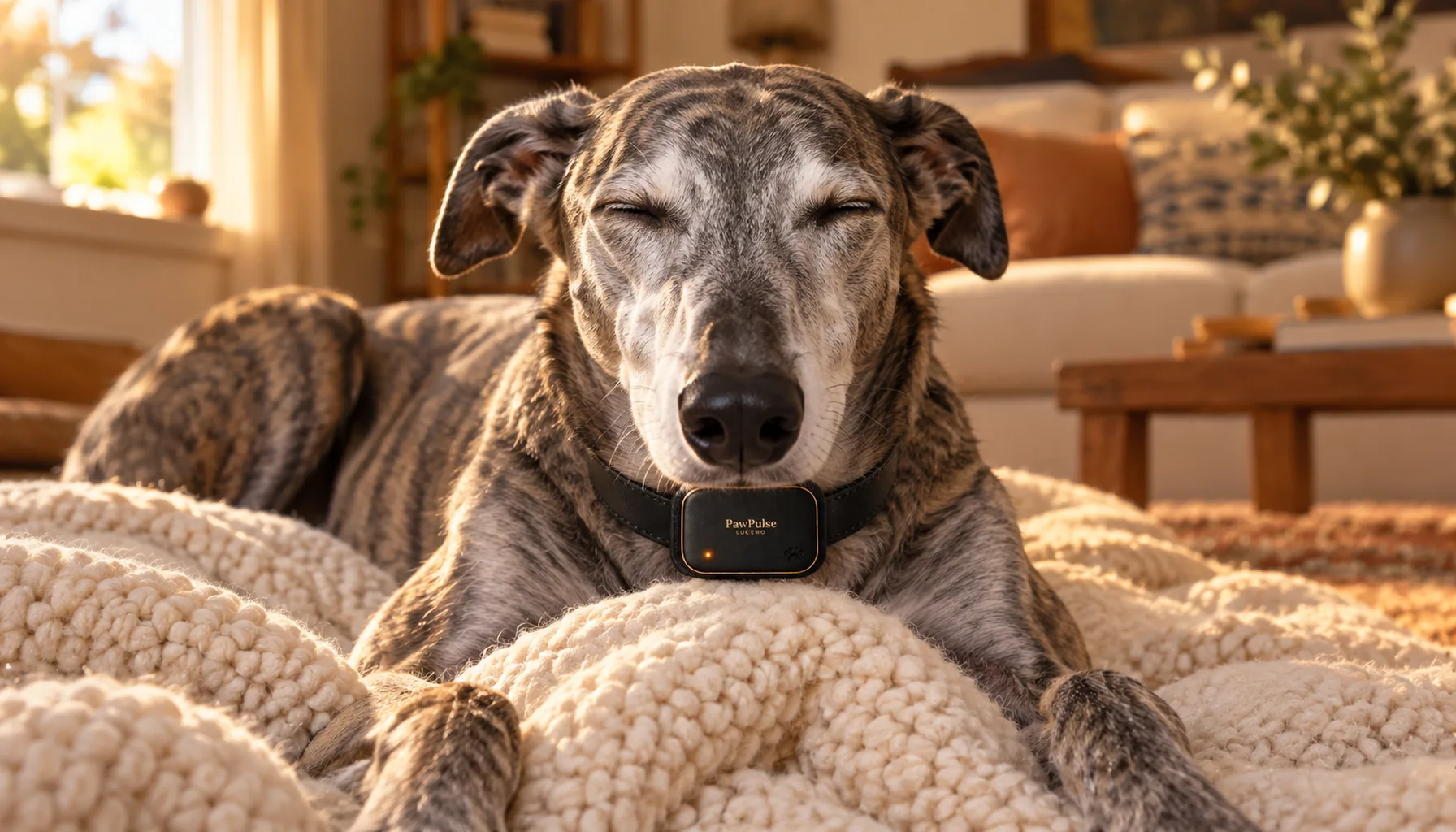
Hand counts are snapshots. That is part of why we built PawPulse Lucero, which is designed to measure heart rate and breathing through fur without touching the skin, using what we call Kinetic sensing. Instead of one count on one evening, you get trends over days and weeks, with context to share with your vet. It does not replace counting or your veterinarian. It adds a longer view of your own dog's normal, which we explain in how AI learns your dog's normal.

When Should You Call Your Vet About Your Dog's Heart Rate?
When in doubt, call.
Go to a vet now if your dog:
- faints or collapses, even if it recovers quickly
- has difficulty breathing, or breathes hard while resting
- has pale, grey or bluish gums
- has a resting heart rate near 200 while calm at home, which the MSD Veterinary Manual calls inappropriately high
Call your vet soon if:
- calm, resting counts at home are repeatedly above 120, the top of the Merck range
- a low resting rate comes with weakness or tiring easily; the MSD Veterinary Manual's owner guide lists a low heart rate, low blood pressure and collapse among signs some dogs with heart failure show
- you notice a new cough, coughing during rest or sleep, tiring on walks, or a rising resting breathing rate; VCA Animal Hospitals (2023) says a significant increase in resting breathing rate, even within the normal range, should be reported
- your dog has a known heart murmur and any of these signs appear; VCA says to notify your veterinarian immediately in that case
The MSD Veterinary Manual owner guide on heart failure in dogs (2024 update) explains why vets often ask owners to count breaths while a dog sleeps or rests: that sleeping breathing rate can be monitored for early signs of heart failure.
Want the hands-on method? Our guide to how to check a dog's pulse at home walks through it step by step.
A low number in a relaxed dog that wakes alert and enjoys its walks is usually just a calm dog. It is the unexplained, persistent change, or a number that comes with other signs, that deserves a vet's attention.
Frequently Asked Questions
What is a normal resting heart rate for a dog?
The Merck Veterinary Manual lists 70 to 120 beats per minute for a dog at rest. Healthy dogs often dip lower when relaxed or asleep; a 2010 Ohio State ECG study found a median lowest daily rate of 42. Your own dog's calm, repeated home counts are the best reference for that dog.
Do small dogs have faster heart rates than large dogs?
Slightly. A 2013 Royal Veterinary College study of 5,000 healthy dogs found heart rate fell as body weight rose, but a 5 kg dog averaged only about 10.5 beats per minute faster than a 55 kg dog. Size explains only a small part of the difference between individual dogs.
What is a normal dog heart rate while sleeping?
Lower than when awake. The MSD Veterinary Manual notes a healthy dog's heart rate can drop into the teens during sleep. Sleeping puppies run faster; one 2025 study measured a median near 128 at four months, falling to about 90 by eight months. A slow rate in a dog that wakes normally is usually expected.
Is an irregular heartbeat normal in dogs?
Often it is. The MSD Veterinary Manual describes sinus arrhythmia, where the heart speeds up when a dog breathes in and slows when it breathes out, as a normal finding in dogs. A rhythm that seems to skip or race without following breathing should still be checked by a veterinarian.
What is a dangerously high heart rate for a dog?
There is no single cutoff for every dog, and exercise can push a healthy dog past 250. At rest, though, the MSD Veterinary Manual calls 200 beats per minute in a calm dog at home inappropriately high. Repeated calm counts above 120, or any fast rate with collapse or breathing trouble, need a vet.
When should I call the vet about my dog's heart rate?
Go now for fainting, collapse, labored breathing or pale or bluish gums. Call soon if calm resting counts stay above 120, if a low rate comes with weakness, or if resting breathing rate, coughing or stamina change. If your dog has a heart murmur, report any of these right away.
Learn more about PawPulse Lucero, the smart dog collar designed to measure heart rate and breathing through fur without touching the skin, and the Kinetic sensing technology behind its trends you can share with your vet.
-- The PawPulse Team