


Key takeaway: Chronic stress in dogs doesn't just cause behavioral problems - it triggers a physiological cascade involving elevated cortisol, suppressed immune function, disrupted digestion, and cardiovascular strain. Published research has linked chronic anxiety in dogs to shortened lifespan, increased skin disorders, and higher susceptibility to infection.
Your Dog Isn't "Just Anxious." Their Body Is Keeping Score.
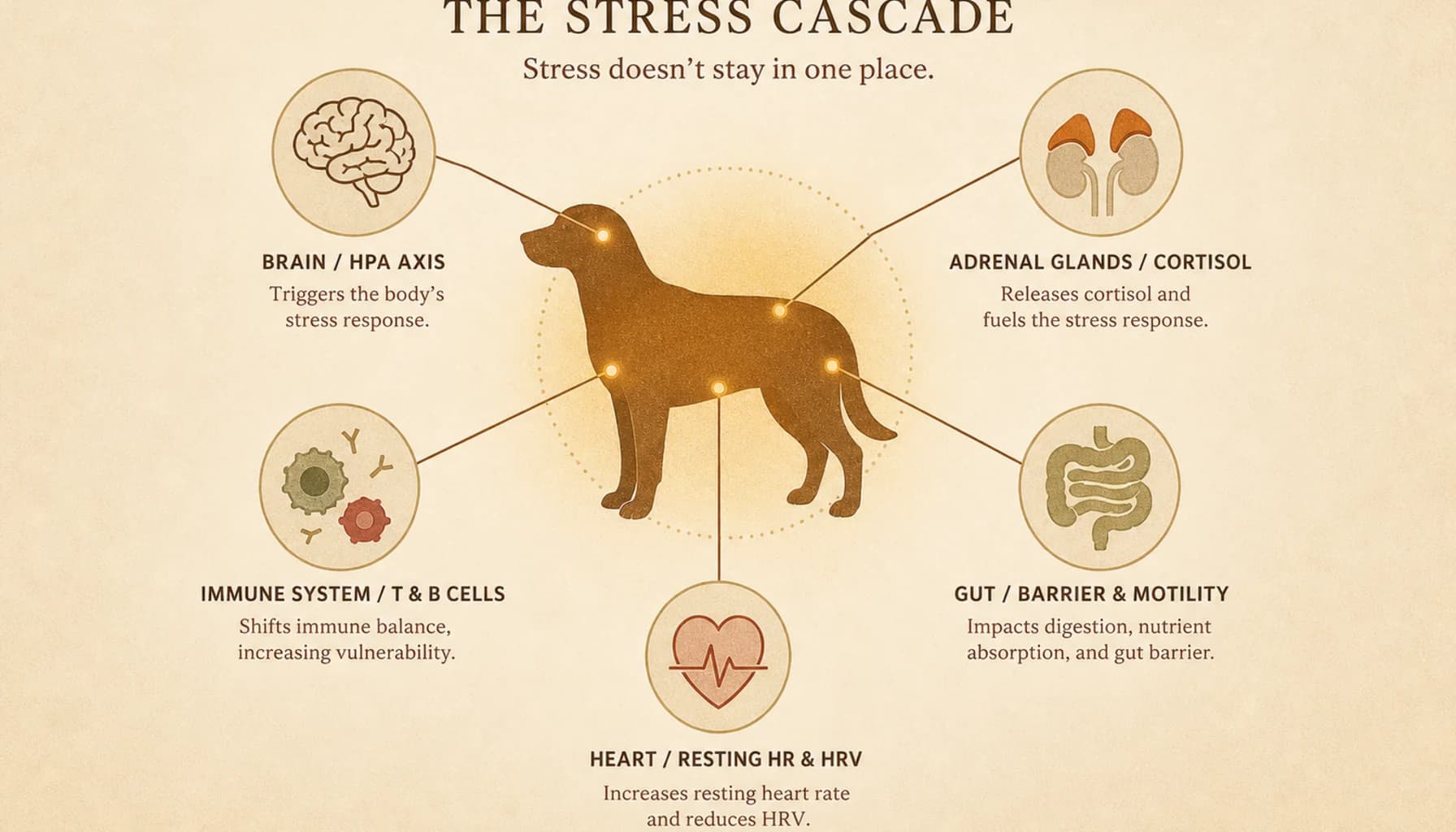
Here's something most dog owners don't think about: when your dog is stressed, it's not just an emotion. It's a full-body event. Their heart rate spikes, cortisol floods their bloodstream, their immune system dials down, their gut lining starts to break down, and their nervous system shifts into a mode it was never meant to stay in for long.
A thunderstorm passes and everything resets. That's acute stress, and it's normal. But when the stressor doesn't pass - when it's separation anxiety five days a week, a chaotic household, chronic pain they can't tell you about, or a neighbor's dog that barks eight hours a day - the stress becomes chronic. And chronic stress doesn't just make your dog unhappy. It makes them sick.
The science on this is no longer theoretical. It's published, peer-reviewed, and frankly, a little alarming.

The Cortisol Cascade: What Happens Inside a Stressed Dog
Act 1: The Alarm
When your dog perceives a threat (real or imagined), the hypothalamic-pituitary-adrenal (HPA) axis fires up. The hypothalamus signals the pituitary gland, which tells the adrenal glands to release cortisol and adrenaline. Heart rate increases. Breathing quickens. Blood flows to the muscles. Digestion pauses. The immune system temporarily shifts resources toward immediate survival.
This is fight-or-flight, and it's brilliantly designed for short bursts. Chase a squirrel, run from a coyote, survive the vacuum cleaner. The system activates, does its job, and shuts off.
Act 2: The Problem
When the stressor is chronic, the HPA axis never fully deactivates. Cortisol stays elevated. The body remains in a low-grade emergency state, burning through resources meant for maintenance, repair, and immune defense.
A comprehensive review published in Animals (MDPI) on cortisol's role in canine health found that prolonged cortisol elevation weakens immune function, disrupts metabolism, and increases susceptibility to stress-related illnesses. The review emphasized that cortisol monitoring is critical in veterinary practice because the damage from chronic elevation is cumulative and often invisible until a secondary condition appears.
Act 3: The Fallout
This is where it gets serious. Chronic stress doesn't cause one problem. It opens the door to many.
Five Ways Chronic Stress Damages Your Dog's Body
1. Immune Suppression (The One That Enables Everything Else)
Cortisol is an immunosuppressant. In short bursts, that's useful - it prevents the immune system from overreacting. But sustained elevation reduces T and B lymphocyte production, impairs adaptive immune responses, and increases vulnerability to infections, bacterial overgrowth, and slow wound healing.
A 2026 study published in the International Journal of Molecular Sciences found that chronic stress in shelter dogs modulated immune status in a time-dependent manner: the longer the stress lasted, the deeper the immune suppression went. Short-term shelter stays triggered early immune activation, but prolonged stays showed marked declines in T lymphocyte function and expansion capacity.
Your dog doesn't need to be in a shelter for this to apply. Any sustained stressor - unresolved anxiety, chronic pain, environmental chaos - keeps cortisol elevated and immunity suppressed.
2. Digestive Breakdown (The Gut Feels Everything)
Your dog's gut has its own nervous system (the enteric nervous system), and it's directly wired to the brain. When stress hits, the gut responds: motility changes, acid secretion shifts, the intestinal barrier weakens, and inflammation increases.
Published research has linked chronic stress in dogs to gastric ulceration, exacerbation of inflammatory bowel disease, and small intestinal bacterial overgrowth (SIBO). A review in PMC on psychogenic stress in dogs documented that stressful environments and anxious personality traits are associated with chronic large-bowel disease, and that dogs under significant physiological stress show increased risk of developing gastric lesions.
If your dog has recurring GI issues - intermittent diarrhea, vomiting, loss of appetite, gurgling stomach - and the vet can't find a structural cause, chronic stress may be a contributing factor worth discussing with them.
3. Cardiovascular Strain (The Heart Keeps the Receipt)
Chronic stress keeps heart rate and blood pressure elevated above their natural resting baselines. Over time, this sustained cardiovascular load can contribute to cardiac wear, increased resting heart rate, and reduced heart rate variability (HRV) - all patterns that published research associates with poorer health outcomes.
This is also one of the clearest places where continuous monitoring adds value. A single heart rate reading at the vet's office (where your dog is already stressed) tells you nothing useful. But four weeks of resting heart rate data captured at home, while your dog sleeps, reveals whether their cardiovascular baseline is stable or quietly drifting upward. That's a trend worth sharing with your veterinarian.
4. Skin and Coat Problems (Stress You Can See)
Veterinary behavioral research has found that dogs with extreme fear and chronic anxiety show increased severity and frequency of skin disorders - excessive licking, hot spots, hair loss, and poor coat quality. The mechanism is multifactorial: cortisol-driven immune suppression reduces the skin's ability to fight infection, while stress-related compulsive behaviors (licking, chewing) create physical damage.
If your dog is developing skin issues alongside behavioral changes, there may be a stress connection worth exploring with your vet.
5. Shortened Lifespan (The One Nobody Wants to Hear)
This is the hardest data point. Research published in PMC documented that chronic stress from anxiety disorders is associated with shortened lifespan in dogs. A separate behavioral study found that fear of strangers - a common anxiety trait - was linked to considerably reduced longevity.
Stress doesn't just reduce quality of life. Over time, the accumulated damage to immune, cardiovascular, and digestive systems adds up. The dog that lives in a constant low-grade stress state may look "fine" on the outside while their body is aging faster on the inside.