Key takeaway: Separation anxiety affects an estimated 14-20% of pet dogs and is one of the most commonly cited behavioral reasons dogs are surrendered to shelters. Classical conditioning paired with haptic vibration calming can train a dog to self-regulate anxiety in as little as 14 days, without medication or side effects.
The Damage You Come Home To Is Just the Surface
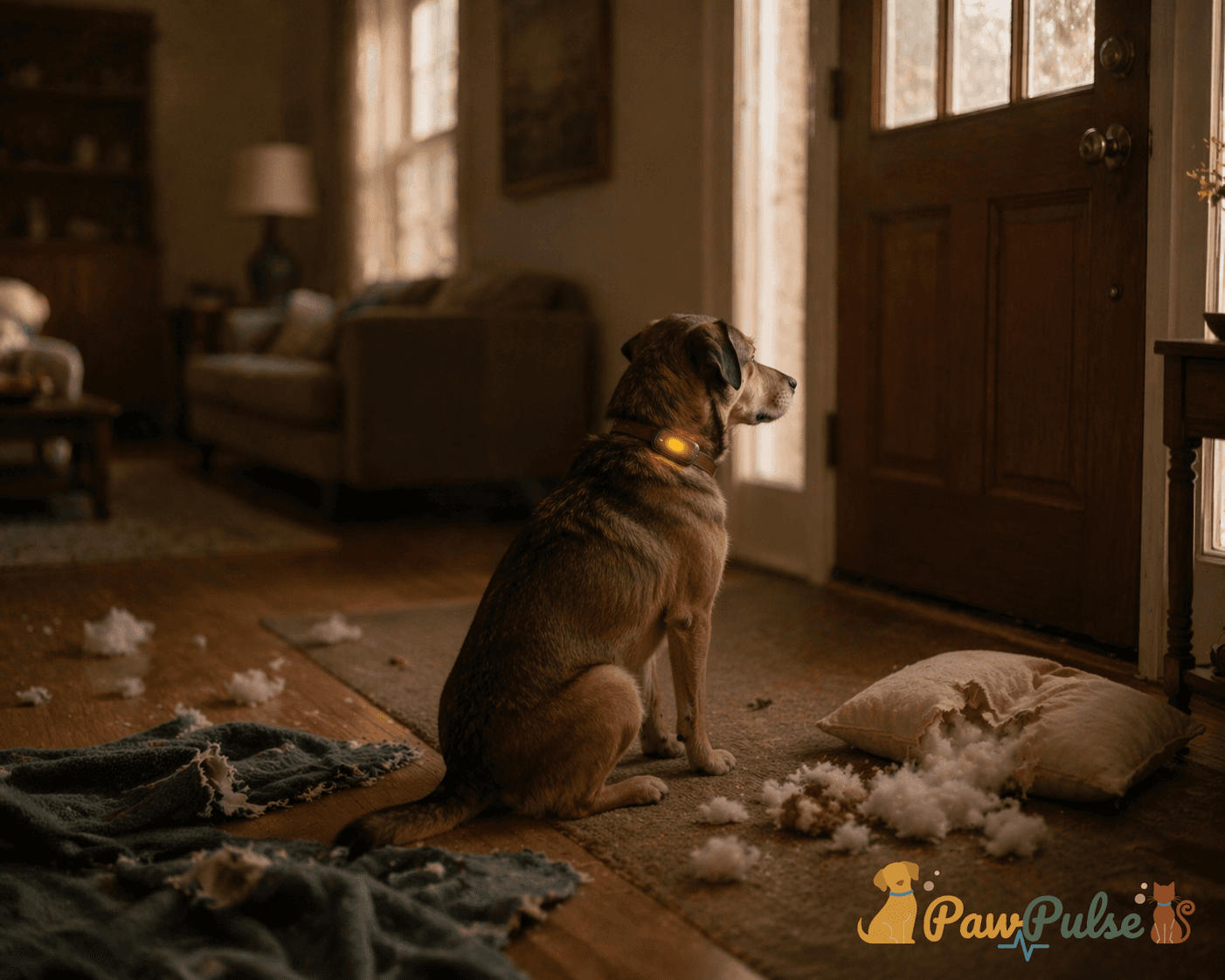
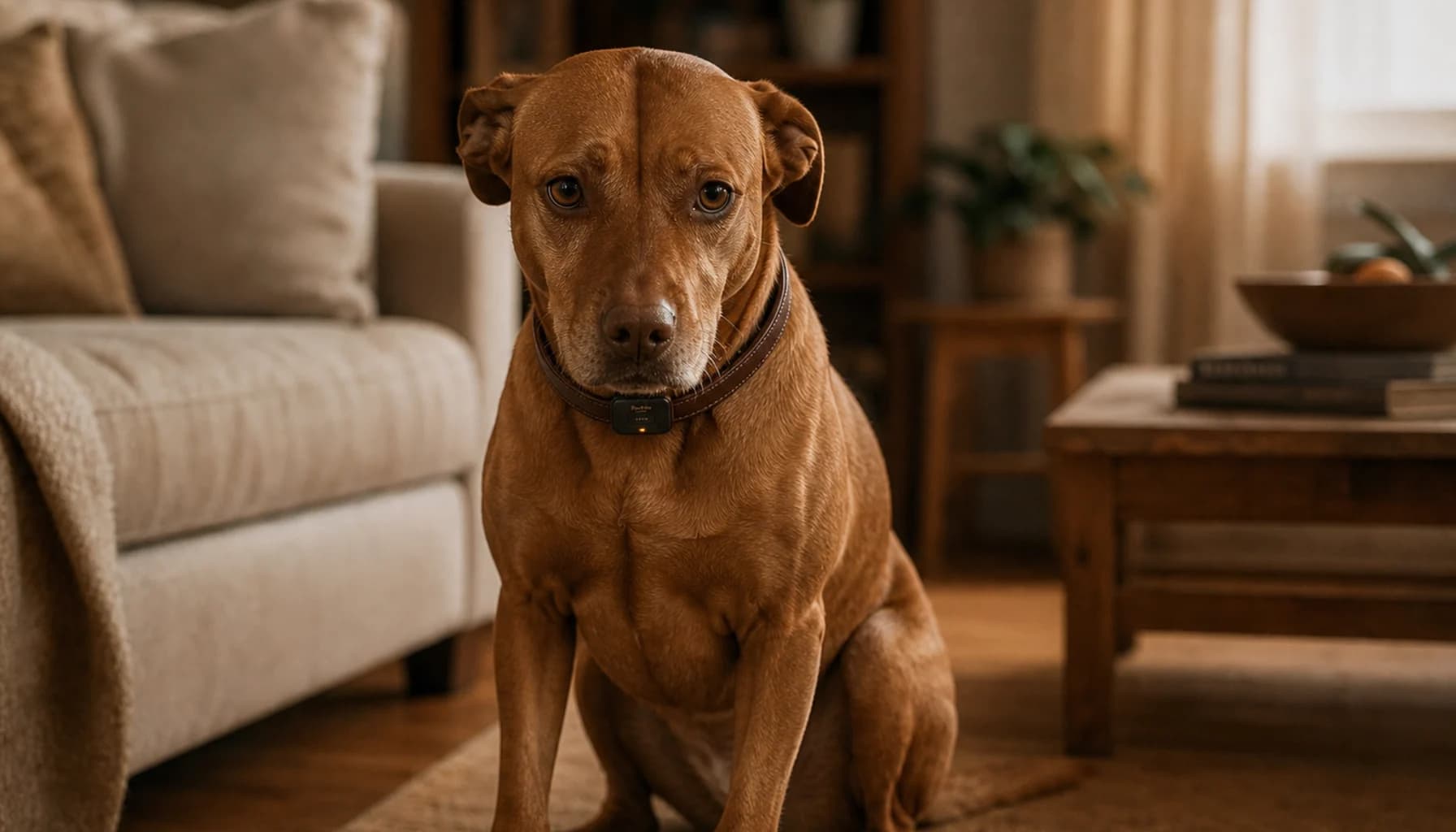
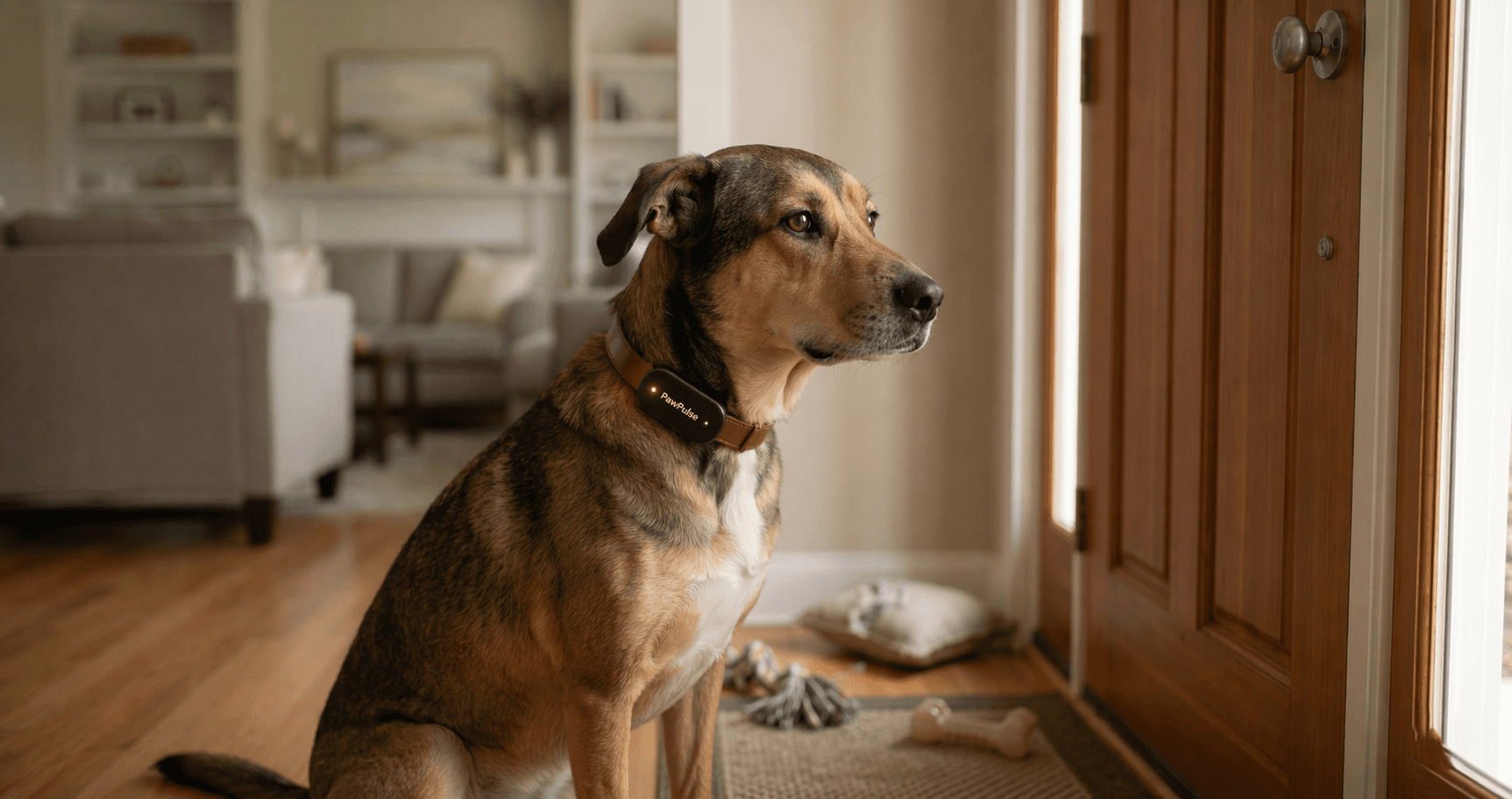
You open the front door and the scene hits you: shredded couch cushions, claw marks gouged into the door frame, a puddle by the entryway. Your dog is trembling in the corner, tail tucked, ears flat. You're frustrated. You're confused. And underneath all of it, you feel guilty, because somewhere in the back of your mind you know your dog wasn't being "bad." They were terrified.
This is what separation anxiety looks like from the outside. Destroyed furniture and noise complaints are what owners report. But what's happening inside your dog's body is far worse than what's happening to your living room.
How Common Is Separation Anxiety in Dogs?
More common than most owners realize. A prevalence study published in the Journal of Veterinary Behavior found that 17.2% of dogs exhibit separation anxiety, making it one of the top three anxiety disorders in companion dogs alongside noise sensitivity and general fearfulness. Other estimates put separation-related behavior complaints at 20-40% of all cases seen at veterinary behavior practices.
That translates to roughly 15-20 million dogs in the U.S. alone.
The consequences extend beyond torn upholstery. A comprehensive review in the Journal of the American Veterinary Medical Association (JAVMA) noted that the ASPCA reports 3.3 million dogs are relinquished to shelters annually, and behavioral problems, with separation anxiety among the most common, are a leading reason. Some estimates suggest up to 30% of dogs relinquished to shelters are surrendered specifically because of separation-related behaviors.
These aren't "bad dogs." They're suffering, and their owners don't know what to do.
The encouraging news is that separation anxiety is treatable, and current veterinary guidance is specific about how. A 2025 clinical framework in Today's Veterinary Practice lays out a stepwise plan: manage the environment, rebuild the dog's sense of safety, add calming tools, then work through systematic desensitization and counterconditioning, with medication reserved for the cases that need it. What that framework has historically lacked is objective feedback between appointments, a way to see whether the plan is genuinely lowering the dog's stress or simply masking the outward signs. Closing that gap is exactly where continuous biometric monitoring earns its place.
What's Actually Happening Inside Your Dog's Body
Separation anxiety isn't disobedience and it isn't boredom. It's a physiological panic response. When a dog with separation anxiety is left alone, their nervous system shifts into a stress state that mirrors what humans experience during a panic attack.
The Stress Cascade
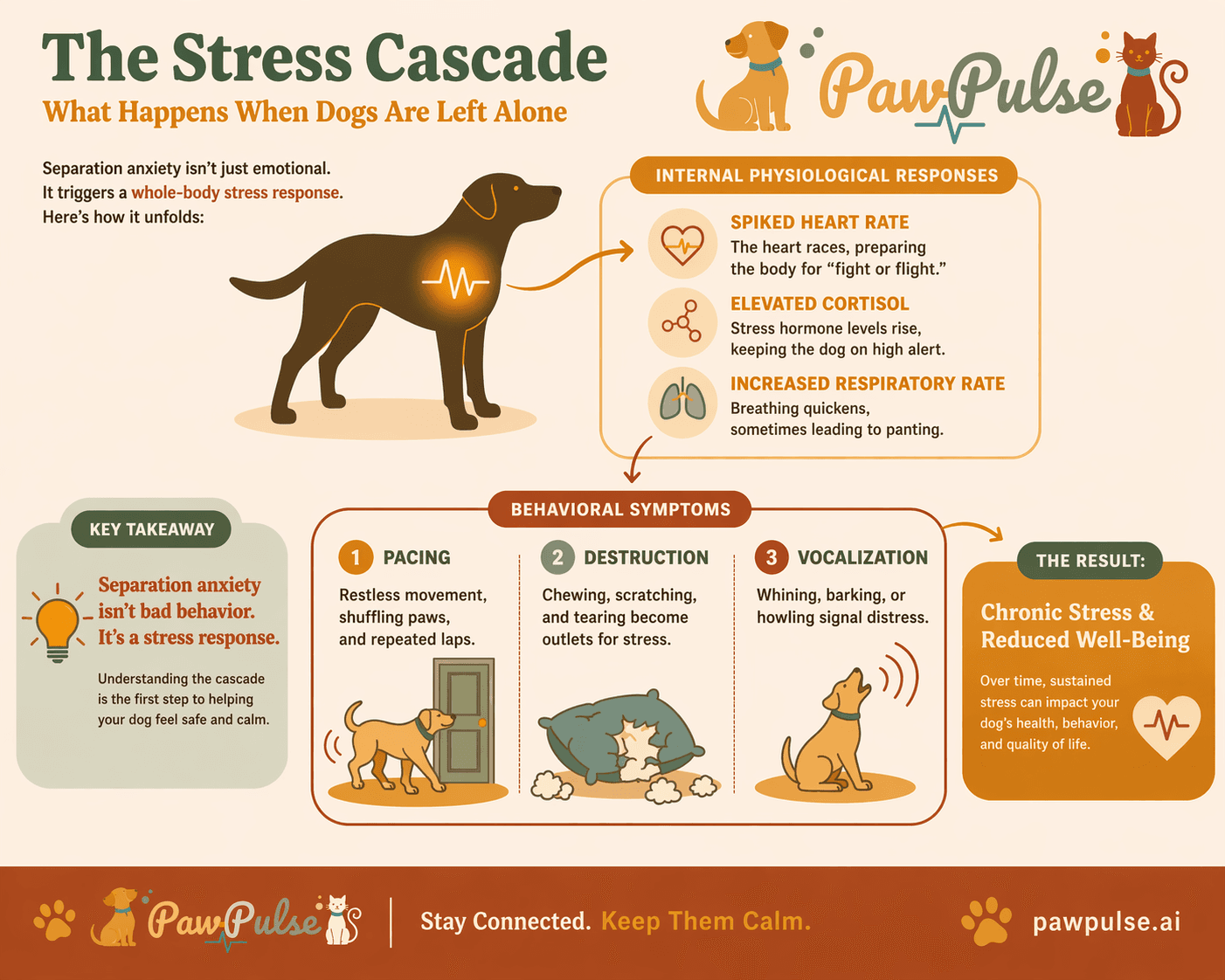
The moment you leave, your dog's hypothalamic-pituitary-adrenal (HPA) axis activates. Cortisol floods the bloodstream. Heart rate spikes. Respiratory rate increases. The dog enters fight-or-flight, but there's nothing to fight and nowhere to flee, so the energy expresses as destruction, vocalization, pacing, and escape attempts.
Research published in Scientific Reports (Nature) found that dogs with separation-related problems exhibit distinct behavioral subtypes driven by different internal states: fear, anxiety, and frustration. Some dogs whine and withdraw. Others bark and claw at doors. The outward behavior varies, but the underlying distress is the same.
Why It Gets Worse Over Time
Every time a dog experiences a separation panic episode, it reinforces the neural pathway. The dog's brain learns: owner leaves, bad things happen to my body. This is classical conditioning working against your dog. The departure itself becomes a conditioned stimulus that triggers the full stress response before you've even closed the door.
This is also why punishment never works. Scolding a dog for destruction that happened hours ago doesn't address the panic that caused it. It adds a second source of stress on top of the first.
The Current Treatment Landscape (and Its Limitations)
Medication
Veterinary behaviorists often prescribe SSRIs (fluoxetine) or TCAs (clomipramine) for separation anxiety. These can reduce symptoms, but they come with side effects like lethargy, appetite changes, and GI upset. A PMC review on canine separation anxiety treatment strategies noted that pharmacological interventions alone are unlikely to eliminate separation-related behaviors and that behavioral therapy is still needed alongside medication.
The pet anxiety medication market continues to grow, yet medications treat symptoms without teaching the dog a new emotional response.
Behavior Modification Alone
Systematic desensitization, gradually increasing the duration of absences, is the gold-standard behavioral approach. It works, but it demands extraordinary consistency from owners and can take months of daily practice. Most owners can't restructure their entire work schedule around 5-minute incremental departures.
What's missing is a bridge: something that provides real-time calming intervention during the critical moments of separation while the dog is learning a new conditioned response.
How Pulse Rhythm Uses Classical Conditioning to Help Dogs Settle During Separation Anxiety
This is where PawPulse's approach differs from anything else on the market. Pulse Rhythm doesn't mask anxiety with medication or rely solely on owner-led behavior training. It uses the same classical conditioning mechanism that creates separation anxiety to reverse it.
Three Calming Modes
PawPulse offers three distinct haptic patterns, each designed for a different anxiety context:
- Heartbeat Mode simulates a resting heartbeat rhythm at 60 BPM through gentle vibration. This is the primary mode for separation anxiety.
- Deep Calm delivers a gentle, continuous vibration for general day-to-day anxiety.
- Storm Mode uses deep, firm pulses to interrupt acute startle responses from thunderstorms or fireworks.
For separation anxiety, Heartbeat Mode is the focus. The rhythmic 60 BPM pattern was chosen because it mimics the resting cardiac rhythm that dogs associate with calm, safe proximity to their owner or littermates.
The 14-Day Conditioning Protocol
Pulse Rhythm follows a structured conditioning protocol that builds a new association between the vibration stimulus and a calm emotional state:
Days 1-3: Your dog wears the collar and experiences short Heartbeat Mode vibration sessions paired with treats and positive reinforcement. The goal is simple: vibration = good things happen.
Days 4-7: Sessions get longer. Treat rewards gradually transition to verbal praise. By the end of this phase, the auto-calm feature unlocks, meaning the collar can activate Heartbeat Mode without manual input.
Days 8-13: Generalization. The vibration is used in different rooms, during mild distractions, and during brief owner departures. The dog practices responding to the conditioned stimulus across contexts.
Day 14: Graduation. Your dog responds to the vibration with calm, settled behavior without any external reward. The conditioned response is established.
After graduation, the collar can auto-detect separation anxiety onset and trigger Heartbeat Mode automatically.
Separation Anxiety Auto-Watch: What Happens When You Leave
This is where PawPulse's radar-based health monitoring and Pulse Rhythm work as a closed loop.
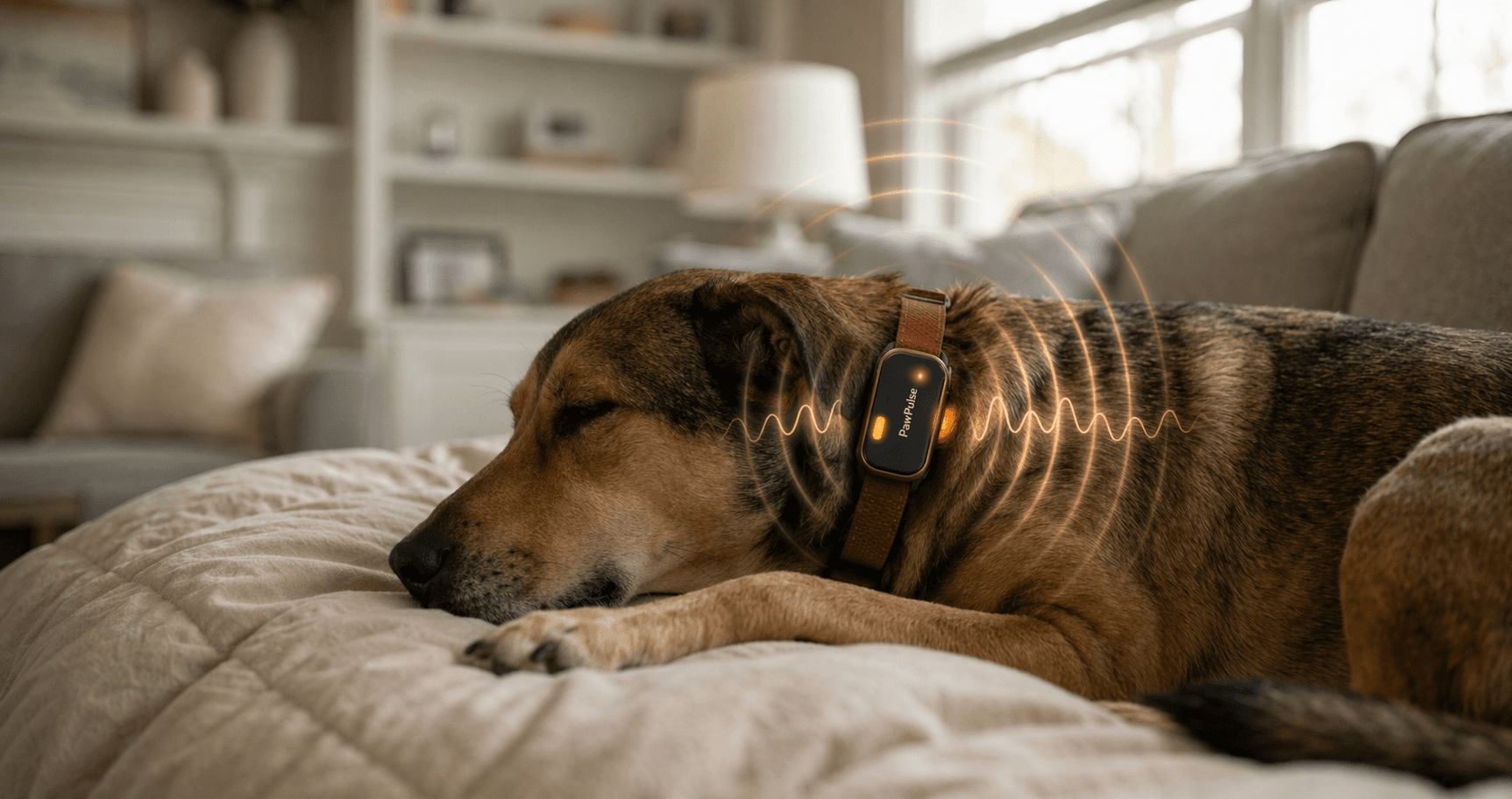
When you leave home, the app detects the departure (BLE disconnect or app backgrounding) and the collar enters monitoring mode. PawPulse's radar-based sensing continuously reads your dog's heart rate and respiratory patterns. If biometrics indicate rising anxiety, elevated heart rate, increased restlessness, panting patterns, Heartbeat Mode activates automatically.
You get a notification: "Calming session triggered while you were away."
No guesswork. No relying on a camera to spot distress after it's already escalated. The collar detects the physiological onset of anxiety and intervenes before the panic spiral reaches the point of destruction.
For dogs that experience acute spikes, PawPulse can also run Smart Sequences. The De-escalation sequence starts with 10 seconds of firm Grounding pulses to break the panic spiral, followed by 290 seconds of sustained Calming Purr to bring the dog back to baseline. Progressive Relaxation gradually decreases vibration intensity over time, teaching the dog to self-regulate.
How Separation Anxiety Differs From Boredom
Not every chewed shoe is separation anxiety. The distinction matters because the right approach is completely different.
| Sign | Separation Anxiety | Boredom |
|---|
| Timing | Starts within minutes of departure | May take hours to begin |
| Intensity | Frantic, destructive, focused on exits | Mild, exploratory, spread around |
| Physiological signs | Drooling, panting, trembling, elevated HR | None |
| Greeting behavior | Extreme excitement on return | Normal greeting |
| Occurs with other people home | Usually not | Can still occur |
| Responds to more exercise | Rarely helps | Often resolves it |
| Destruction pattern | Doors, windows, owner's items | Random objects |
PawPulse's biometric data makes this distinction objective. If your dog's heart rate elevates within minutes of departure and stays elevated, that's anxiety. If their vitals stay normal but they chew a shoe three hours in, that's boredom. Different problem, different solution. The data from Prism Insights AI removes the guesswork.
What You Can Do Right Now
If your dog shows signs of separation anxiety, start with these steps while working toward a longer-term solution:
Don't make departures dramatic. Skip the long emotional goodbyes. Pick up your keys, walk out. The less ritual around leaving, the less your dog's anticipatory anxiety builds.
Practice micro-departures. Leave the room for 10 seconds. Return without fanfare. Gradually extend the duration. This is the basic desensitization framework that Pulse Rhythm accelerates.
Increase physical and mental exercise before departures. A tired dog is a calmer dog. It won't cure separation anxiety, but it lowers the baseline arousal level.
Don't punish the destruction. Your dog was in a panic state. Punishment after the fact creates confusion and adds fear to an already anxious animal.
Frequently Asked Questions
How common is separation anxiety in dogs?
Studies estimate that 14-20% of pet dogs suffer from separation anxiety, making it one of the three most prevalent anxiety disorders in companion dogs. At behavior specialty clinics, separation-related complaints account for 20-40% of all cases. In the U.S., this translates to roughly 15-20 million affected dogs.
Can separation anxiety be treated without medication?
Yes. Behavior modification through systematic desensitization and counterconditioning is the gold-standard non-pharmacological approach. PawPulse's Pulse Rhythm accelerates this process by using haptic vibration as a conditioned calming stimulus, establishing a reliable calm response in as few as 14 days without drugs or side effects.
What are the signs of separation anxiety versus normal boredom?
Separation anxiety produces physiological stress signs like drooling, panting, trembling, and elevated heart rate, typically within minutes of the owner leaving. Boredom-driven behavior tends to start later, lacks physiological distress markers, and responds to increased exercise or enrichment. PawPulse's biometric monitoring can distinguish between the two by tracking heart rate patterns during your absence.
How does haptic calming work for dog anxiety?
Haptic calming uses gentle vibration patterns delivered through a collar to create a conditioned calming response. Through classical conditioning, the dog learns to associate the vibration with safety and relaxation. Over a 14-day protocol, this association becomes automatic, allowing the collar to trigger a calm state even when the owner is absent.
How long does the conditioning protocol take to work?
PawPulse's structured protocol takes 14 days to establish a conditioned calm response. Days 1-7 build the positive association between vibration and calm. Days 8-13 generalize the response across different environments and situations. By Day 14, the dog responds to the vibration with settled behavior without needing any external reward.
Is separation anxiety the reason dogs get surrendered to shelters?
Separation-related behaviors are one of the most commonly cited behavioral reasons for relinquishing dogs to shelters. Some estimates indicate that up to 30% of dogs surrendered for behavioral reasons are given up specifically because of separation anxiety. The destruction, vocalization, and elimination that accompany the condition erode the owner-dog bond and often lead to housing complaints.
Does PawPulse detect separation anxiety automatically?
Yes. When the owner's phone disconnects from the collar (departure detected), PawPulse enters monitoring mode. Its radar-based sensing tracks heart rate and respiratory patterns in real time. If your dog starts to get anxious, Heartbeat Mode activates automatically and the owner receives a notification that a calming session was triggered.
Learn more about PawPulse Lucero, the smart dog collar with built-in Pulse Rhythm designed to keep your dog calm during the moments they need it most.
Related reading: the science behind haptic Pulse Rhythm and how chronic stress affects your dog's body.
-- The PawPulse Team