Key takeaway: A normal resting heart rate in dogs ranges from 60 to 160 BPM depending on breed, size, age, and fitness - a span so wide that generic thresholds are meaningless for individual health monitoring. PawPulse's Prism Insights AI builds a personal baseline for each pet over weeks of continuous data, then surfaces sustained deviations from that individual's normal so owners and veterinarians can act on changes that matter.
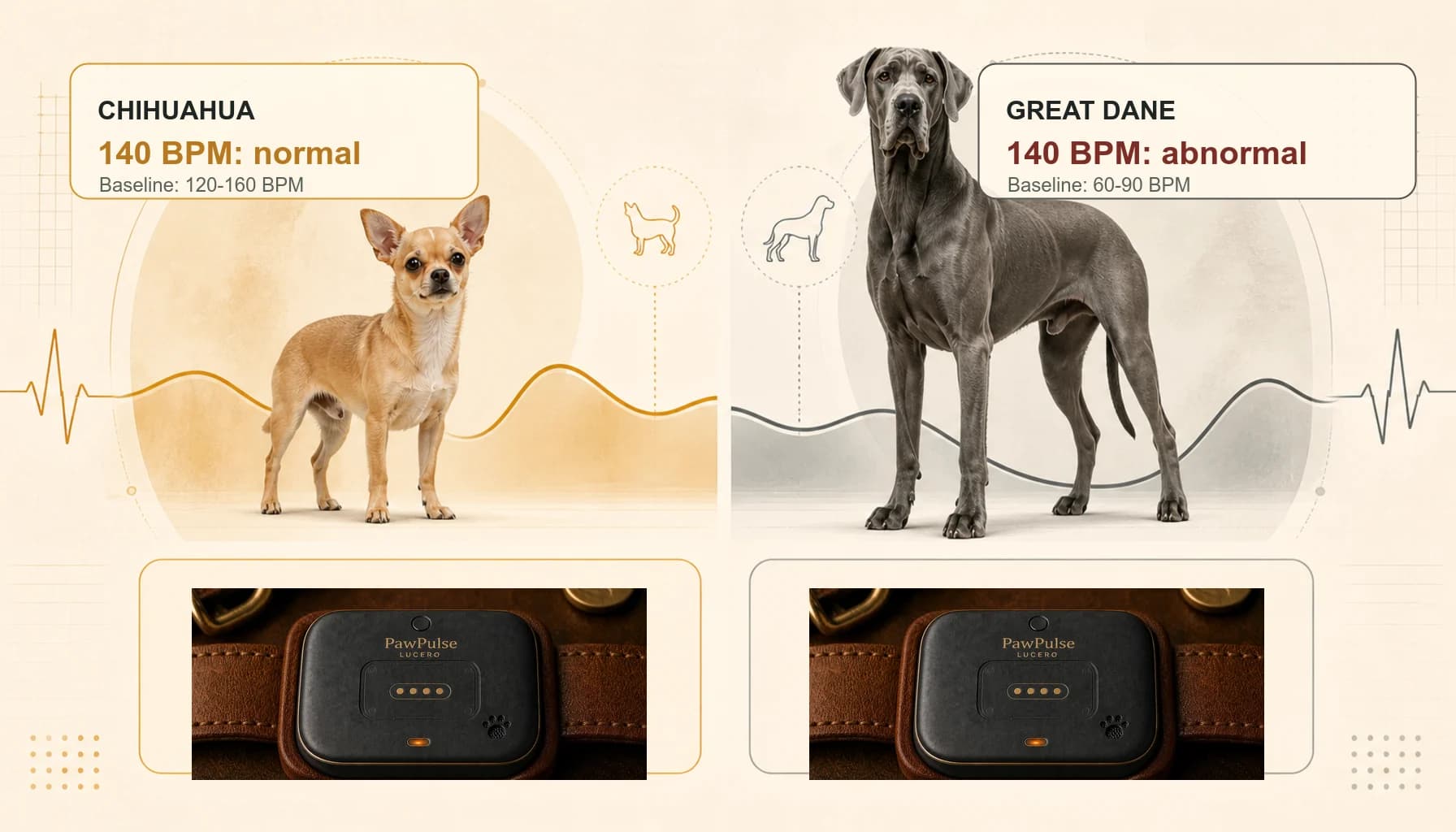
A Chihuahua at 140 BPM Is Fine. A Great Dane at 140 Is an Emergency.
This single fact explains why most AI pet health monitoring fails before it starts.
A toy breed's resting heart rate can naturally sit at 120-160 BPM. A giant breed's might cruise at 60-90 BPM. A puppy's can hit 200 BPM. A senior dog's often drifts lower over the years. Research published in the Journal of Small Animal Practice confirmed that heart rate varies significantly across breed, size, sex, and age - to the point where a single "normal range" for all dogs is clinically useless for catching subtle individual changes.
Now add context: your dog's heart rate at the vet's office is almost certainly not their real resting heart rate. A study published in the Journal of Veterinary Behavior (ScienceDirect) found that average heart rate jumped from 98 BPM in the waiting room to 124 BPM in the exam room, with a third of dogs peaking over 180 BPM during the exam. So the one time a year your dog's vitals get measured, the data is inflated by stress.
This is the problem that AI-powered personal baselines solve. Not "is this number within a normal range for dogs in general?" but "is this number normal for this specific dog, at this time of day, at this activity level, compared to the last 30 days?"
That's a fundamentally different question. And answering it requires an AI that learns.
Why Generic Thresholds Don't Work
The Range Problem
If a pet health device alerts you when heart rate goes above 160 BPM, it will cry wolf on every Chihuahua and miss a genuine problem in every Mastiff. If it alerts below 60 BPM, it will alarm on every resting Great Dane and ignore a declining Pomeranian. A static threshold treats all dogs the same, and no two dogs are the same.
Respiratory rate has the same problem. Normal ranges span 10-30 breaths per minute depending on breed, size, and environmental temperature. Even within one breed, what is normal differs from dog to dog, so a single population range is a blunt tool.
A generic alert system has two options: set wide thresholds and miss real problems, or set tight thresholds and generate false alarms. Neither is useful.
The Vet-Visit Problem
The other source of "baseline" data - your dog's annual checkup - is compromised by the measurement environment itself. One-third of dogs hit heart rates above 180 BPM during a standard exam. That's not pathology. That's a stressed dog in an unfamiliar room full of strange smells and other anxious animals.
Veterinarians know this. It's called "white coat syndrome," and it makes clinic-measured vitals unreliable as baselines for at-home monitoring. Your vet can account for it with experience and context, but a health monitoring device can't - unless it has its own baseline built from home data.
How Prism Insights AI Learns Your Dog's Normal
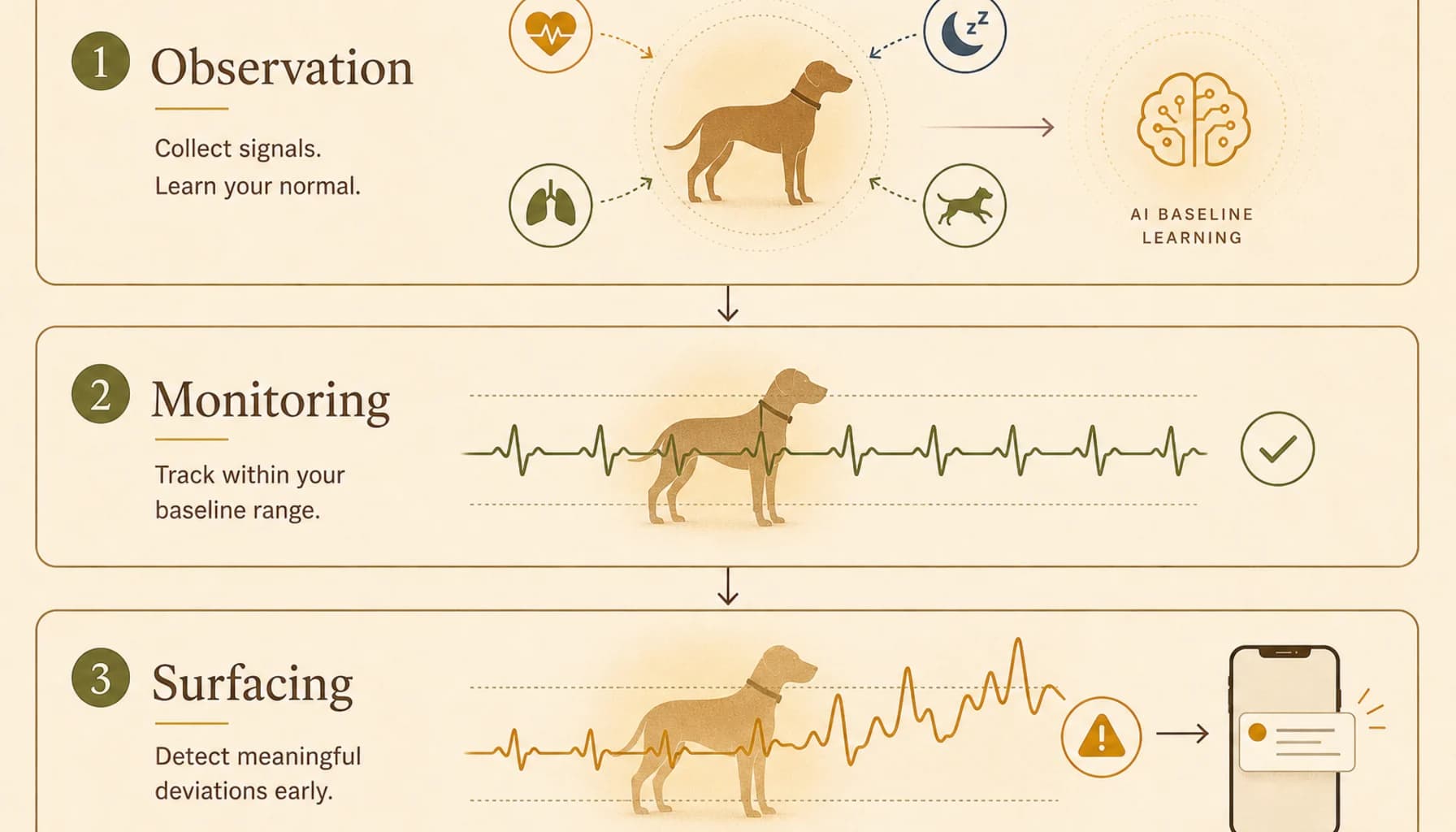
Prism Insights is PawPulse's onboard AI engine. Its job is deceptively simple: learn what's normal for your specific pet, then surface when something changes. The execution is where it gets interesting.
Phase 1: Observation (Weeks 1-3)
When you first put the collar on your dog or cat, Prism Insights enters learning mode. It isn't alerting on anything yet. It's collecting data across every metric PawPulse's radar-based sensor tracks: heart rate, respiratory rate, heart rate variability (HRV), activity patterns, sleep duration, sleep quality, and restlessness.
During this phase, the AI is building a multi-dimensional profile of your pet:
- What's their resting heart rate during sleep? Not a textbook number. Their number.
- How does it change across the day? Morning nap vs. afternoon rest vs. overnight sleep.
- What's their normal activity pattern? How much do they move on an average Tuesday vs. a weekend with a long walk?
- How do they sleep? How many hours, how many wake-resettles, how deep?
- What's their HRV rhythm? The natural ebb and flow of their autonomic nervous system.
By week 3, Prism Insights has seen enough data across enough daily cycles to establish a reliable personal baseline. Not a breed average. Not a textbook range. Your dog's actual normal.
Phase 2: Monitoring (Ongoing)
Once the baseline is set, Prism Insights compares every new day's data against it. But not with simple thresholds. The AI accounts for context:
Time of day matters. A heart rate of 100 BPM at 3 PM after a walk is normal. The same 100 BPM at 3 AM while your dog is lying still might be worth flagging.
Trends matter more than spikes. A single high reading means nothing - maybe your dog heard a squirrel. Three days of gradually rising resting heart rate during sleep is a pattern. Prism Insights looks at sustained deviation, not noise.
Multiple metrics matter. Heart rate alone tells one story. Heart rate plus decreased activity plus increased sleep plus declining HRV tells a much more complete one. The AI looks for correlated shifts across metrics, not isolated changes.
Phase 3: Surfacing (When Something Changes)
When Prism Insights identifies a sustained deviation from your pet's personal baseline - not a one-off spike, but a multi-day trend - it surfaces the information to you through the app. The alert tells you what changed, when it started, and how it compares to baseline.
It doesn't tell you what's wrong. That's your vet's job. Prism Insights gives your vet the "what changed and when" so they can focus on the "why."
Why Personal Baselines Beat Breed Averages
Here's a practical example. Say your 6-year-old Labrador has a personal resting heart rate baseline of 72 BPM during sleep, established over three months of monitoring.
| Scenario | Generic Alert (threshold: >120 BPM) | Prism Insights (personal baseline: 72 BPM) |
|---|
| Resting HR rises to 84 BPM over 10 days | No alert (84 is well below 120) | Surfaces trend: 17% above baseline, sustained |
| Resting HR spikes to 130 BPM for 20 minutes | Alerts (above threshold) | Ignores: single spike, returned to baseline |
| Activity drops 25% while HR rises 12% | No alert on either metric individually | Surfaces correlated shift: two metrics moving together |
| Sleep increases 2 hours/day for a week | No alert (not a heart rate metric) | Surfaces trend: sustained deviation in sleep pattern |
The generic system misses the slow burn and false-alarms on the noise. The personal baseline catches what matters and ignores what doesn't.
What Makes This Different From a Fitbit for Dogs
Consumer fitness trackers - both human and pet - typically show you raw numbers: steps, heart rate, calories. You're left to figure out what they mean. Is 12,000 steps good? Is 85 BPM resting heart rate okay? The device doesn't know, and most owners don't either.
Prism Insights flips that model. You don't need to interpret the data. The AI does the comparison against your pet's personal normal, accounts for context, and only surfaces information when something genuinely shifts. The goal isn't to turn you into an amateur veterinarian reading charts. It's to tell you: "Something changed. Here's when. Share this with your vet."
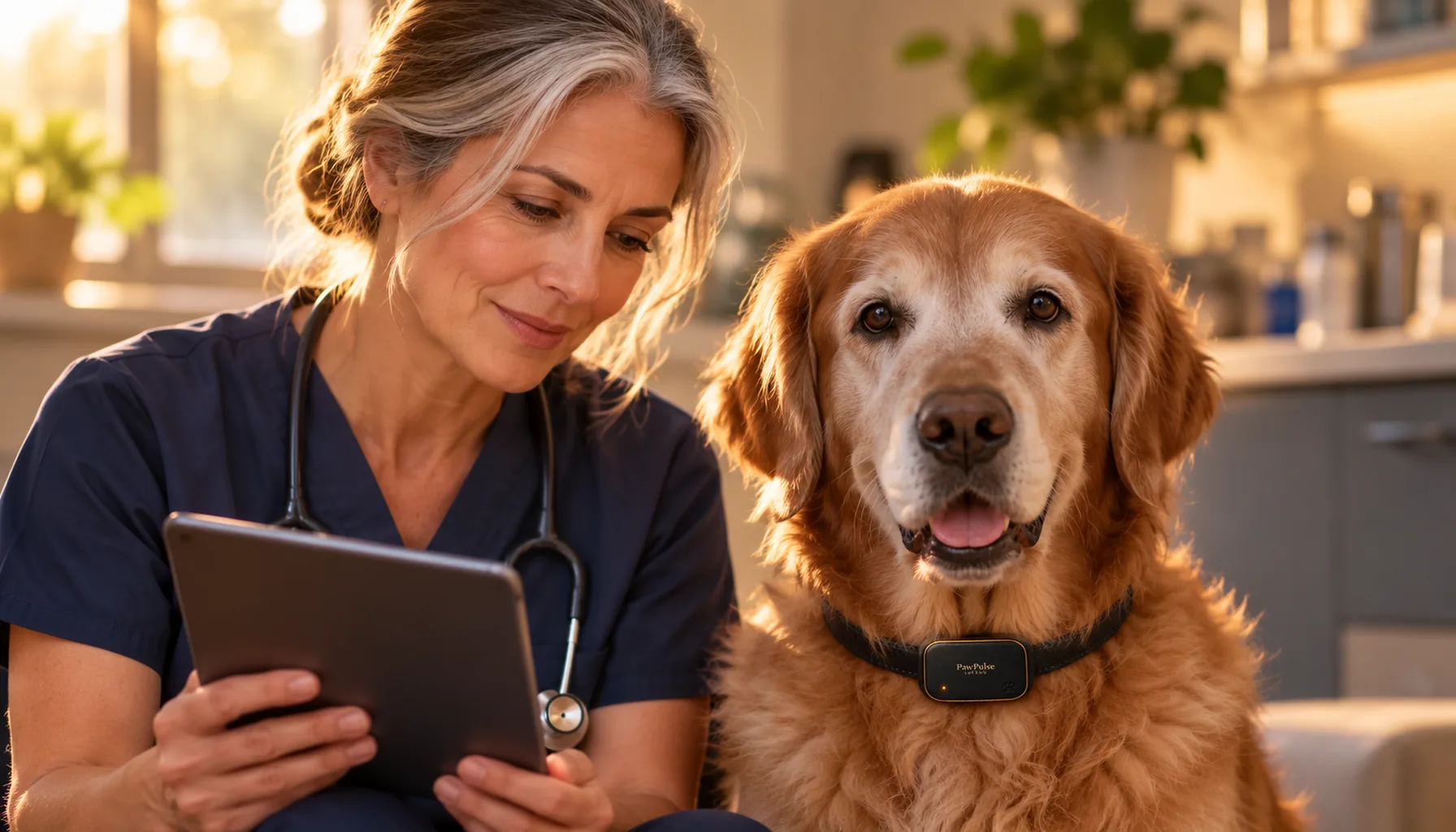
This is also why the Vet Dashboard matters. When your vet sees a PawPulse alert, they're not looking at a raw number. They're seeing: "This dog's resting heart rate during sleep has been 17% above their personal 90-day baseline for 8 consecutive days, with concurrent HRV decline of 14% and a 2-hour increase in daily sleep." That's actionable clinical information your vet can use right away.
Cats Get Personal Baselines Too
Everything above applies equally to cats - and arguably matters more. Feline resting heart rates range from 120-240 BPM depending on breed and size, an even wider span than dogs. Cats visit the vet less, hide symptoms more effectively, and experience more severe white coat syndrome during clinic visits.
PawPulse's collar builds the same personal baseline for cats, using the same millimeter-wave radar that works on every coat. Prism Insights adapts its learning to feline cardiac and respiratory norms automatically. A cat whose resting heart rate during sleep has been 160 BPM for three months and gradually rises to 180 gets the same sustained-deviation alert as a dog whose 72 becomes 84.

The Data Gets Smarter Over Time
Prism Insights doesn't stop learning after week 3. The baseline evolves as your pet ages, as seasons change, and as life circumstances shift. A dog that starts a new exercise routine will naturally show increased activity and potentially improved HRV - the baseline adjusts. A senior dog whose metrics gradually shift over years builds a longitudinal record that your vet can review like a health timeline, not a snapshot.
The longer the collar is worn, the more confident the AI becomes about what's normal and what isn't. Month 1 data is useful. Month 6 data is more useful. Month 12 data is a goldmine for your veterinarian.
Frequently Asked Questions
What is a personal health baseline for a pet?
A personal baseline is the set of vital sign patterns that are normal for your specific animal, established through weeks of continuous monitoring at home. It accounts for your pet's breed, size, age, daily rhythms, and individual physiology. Deviations from this personal baseline are far more meaningful than comparisons to generic breed-average ranges, which span too wide to catch subtle individual changes.
How long does it take for Prism Insights to learn my pet's normal?
Prism Insights typically needs 2-3 weeks of continuous collar wear to establish a reliable baseline. During this period, it collects heart rate, respiratory rate, HRV, activity, and sleep data across enough daily cycles to build your pet's individual profile. The baseline continues to refine over time as more data accumulates.
Why can't I just use the normal heart rate range for my dog's breed?
Normal resting heart rate in dogs ranges from 60-160 BPM depending on breed, size, age, and fitness. That range is so wide that a 15% change in your individual dog's resting rate would be invisible within it. Personal baselines are more sensitive and more specific than population ranges.
Does Prism Insights account for seasonal changes?
Yes. The baseline adapts over time, incorporating gradual environmental and lifestyle shifts. Published research has shown that canine resting respiratory rates are significantly higher in summer months and lower in winter. Prism Insights learns these seasonal patterns for your individual pet, so it doesn't flag a normal summer increase as an anomaly.
What happens if my pet's routine changes (new home, new family member)?
Major lifestyle changes may temporarily shift your pet's vitals. Prism Insights is designed to distinguish between a short-term adjustment period and a sustained deviation that warrants attention. If your pet's metrics shift after a move but stabilize within a week or two, the baseline incorporates the new normal. If they remain elevated, you'll receive an alert to share with your vet.
Does the AI work the same way for cats?
Yes. Prism Insights builds cat-specific baselines using the same continuous monitoring data. It adapts its learning to feline cardiac and respiratory norms, which differ from canine norms. Because cats have an even wider normal heart rate range (120-240 BPM) and are more effective at hiding symptoms, personal baselines are arguably more valuable for cats than dogs.
Learn more about PawPulse Lucero, the smart dog collar that learns your dog's individual baseline from day one through Prism Insights AI and breed-aware modeling.
Related reading: why annual checkups are not enough and why dog owners are turning to data-driven care.
-- The PawPulse Team