Key takeaway: There is no single age when a dog becomes a senior. The 2023 AAHA Senior Care Guidelines define senior as the last 25% of a dog's estimated lifespan, so size and breed matter. A 2024 study of 584,734 UK dogs found median lifespans of 12.7 years for small breeds and 11.9 for large breeds, which puts the senior years roughly around age 9.
Why Is There No Single Senior Age for Dogs?
Ask ten people when a dog becomes a senior and you will hear "seven," "eight," "ten" and "it depends." The last answer is the right one.
The 2023 AAHA Senior Care Guidelines say it directly: because aging varies so much by species and breed, there is no specific age for senior status. AAHA uses the definition from its 2019 Canine Life Stage Guidelines instead: senior is "the last 25% of estimated lifespan through end of life." The same guidelines note that seniors make up 44% of the pet population, so this is not a niche question.
That definition is useful because it follows the dog, not the calendar. A breed expected to live 14 years is a senior from about 10.5. A dog expected to live 9 years gets there at about 6.75. Same rule, very different birthdays.
We are the team behind PawPulse, a smart dog collar with contactless heart rate and breathing monitoring, and older dogs are a big part of why we built it. This guide is owner education, not veterinary advice. Your vet, who knows your dog's breed, history and body, is the best person to say when your dog's senior years have started.
Do Large Dogs Become Seniors Sooner?
Yes, on average, because large dogs tend to have shorter lives. The strongest recent data comes from a study in Scientific Reports (McMillan et al., Dogs Trust, 2024), which analyzed records for 584,734 dogs in the UK, including 284,734 that had died. Among purebred dogs, median lifespan was 12.7 years for small breeds, 12.5 years for medium breeds and 11.9 years for large breeds. The study received no external funding, and the authors declared no competing interests.
Why do big dogs live shorter lives? A study in The American Naturalist (Kraus, Pavard and Promislow, 2013) modeled death data from 74 breeds and concluded that large dogs die young mainly because they age quickly. They did not find a clear link between body size and when aging begins; the rate of aging is what differs.
Here is what the AAHA rule looks like when applied to those medians. The last column is our own arithmetic, not a published cut-off.
| Breed size (UK purebreds) | Median lifespan | Last 25% of that lifespan begins around |
|---|
| Small breeds | 12.7 years | about 9.5 years |
| Medium breeds | 12.5 years | about 9.4 years |
| Large breeds | 11.9 years | about 8.9 years |
| Any dog (AAHA rule) | your dog's estimated lifespan | 75% of that estimate |
Read this table with three cautions. First, a median is a middle point: half of dogs in each group lived longer, half shorter, so individual dogs spread widely around it. Second, the study grouped dogs into small, medium and large only, so giant breeds sit inside "large" and many of them have shorter typical lifespans than that median. Third, these are UK purebred records; mixed-breed dogs were not given a size class. Use the table to understand the pattern, then ask your vet to estimate your own dog's lifespan and senior start.
What Are the Real Signs a Dog Is Getting Old?
A grey muzzle is the sign everyone notices, and it tells you very little. The changes that matter are the ones that affect comfort and health. AAHA lists the common signs of chronic disease in senior pets as malaise, progressive lethargy, behavior changes, reduced appetite, an altered thirst pattern, weight loss over time, mobility changes and wounds that do not heal. For canine cognitive dysfunction, the most common signs in dogs are daytime sleeping with nighttime restlessness, decreased interaction, disorientation at home and anxiety.
| What you notice | Why it is worth mentioning to your vet | Source |
|---|
| Slow to rise, stiff after rest, avoids stairs or jumping | Mobility changes; osteoarthritis is a common cause in older dogs | AAHA 2023 |
| Drinking more or less than usual | An altered thirst pattern is a common sign of chronic disease | AAHA 2023 |
| Gradual weight loss, or loss of muscle | Seniors can lose lean body mass with age or disease | AAHA 2023 |
| Sleeping more in the day and restless at night | Among the most common signs of cognitive dysfunction | AAHA 2023 |
| Seems lost at home, stares, gets stuck behind furniture | Disorientation is a cognitive dysfunction sign | AAHA 2023 |
| Less interested in family, food or walks | Behavior and appetite changes can reflect pain or illness | AAHA 2023 |
| Restless nights or sleeping more in the day | Common signs of cognitive decline in senior dogs | AAHA 2023; Taylor et al. 2026 |
None of these signs names a cause on its own. Together, and especially when they appear or change over weeks, they are a good reason to book a visit. AAHA also recommends a medical workup for senior pets once or twice a year, and it encourages owners to bring photos and videos of how their dog moves at home, because some problems do not show up on an exam table.

Why Do Senior Dogs Sleep So Much?
Partly because aging bodies tire more easily, and partly because some health problems add to it. The AAHA 2023 Senior Care Guidelines list daytime sleeping with nighttime restlessness among the common signs of canine cognitive dysfunction, and a 2026 study (Taylor et al., University of Adelaide) found that dogs with worse cognitive decline slept less at night and more by day. Pain and other illnesses can also change how much a dog sleeps, which is one reason a change deserves a vet visit.
How Much Should a Senior Dog Sleep?
We did not find an hour count for senior dogs from a veterinary college, a guideline body or a peer-reviewed study, so we do not give one. Pages that do quote numbers disagree, and size, breed and activity all matter. The better test is change from your own dog's usual pattern: sleeping much more than before, restless nights, or a shift between night and day sleep are worth raising with your vet.
That second part matters more than any hour count. A dog that has always slept 16 hours is not suddenly ill because a chart says 15. A dog whose nights were quiet and are now broken, or who used to greet you at the door and now sleeps through your arrival, is telling you something changed.
Research on cognitive decline points the same way. A 2026 survey of 205 owners of dogs aged 8 and over, published in The Veterinary Journal (Taylor, Tuke and Hazel, University of Adelaide), found that poorer sleep quality, meaning trouble falling and staying asleep plus more toileting at night, was linked to more severe cognitive dysfunction. Total sleep time did not differ by cognitive level, but dogs with more severe impairment slept less at night and more during the day. More than half of the dogs were most unsettled between 2 and 5 in the morning.
So the question to ask is not only "how many hours" but "when, and how well." We looked at what sleep patterns can reveal in 5 things your dog's sleep pattern reveals about their health.
What Changes When Your Dog Becomes a Senior?
Mostly, attention. A few habits make the senior years easier to manage:
- Book the senior workup. AAHA recommends a medical workup once or twice a year for senior pets, which may include blood and urine tests.
- Keep a baseline. Note your dog's usual sleep, appetite, thirst, walks and resting breathing on a calm week, so later changes have something to compare against. Our dog vital signs chart explains what to check and how.
- Film the odd moments. A short video of a stiff morning or a restless night shows your vet what a description cannot.
- Make the house easier. AAHA suggests rugs or mats on slippery floors, ramps, well-padded beds and keeping resting areas easy to reach.
- Watch for change, not age. The birthday matters less than whether something is different from last month.
November is also Adopt a Senior Pet Month, as the ASPCA noted in 2017, when it pointed out that older animals are often already house-trained and that their personality is already clear. If you have room for one, a senior dog is a very good roommate.
When Should You Call Your Vet About a Senior Dog?
These are conservative, owner-level lines taken from the sources above. Your vet's advice for your dog comes first.
Call your vet soon if your senior dog:
- sleeps much more than usual, or shows a clear change in sleep pattern, such as restless nights
- is less interested in meals, less active, or seems to ignore you, per AAHA
- drinks noticeably more or less than usual, or is losing weight
- is restless at night, wanders, or seems confused at home
- is slow to rise, stiff, or avoiding stairs or jumps
Seek care right away for collapse, trouble breathing, or any sudden change that worries you. Senior dogs are allowed to slow down. Sudden is different from slow.
Where PawPulse Lucero Fits
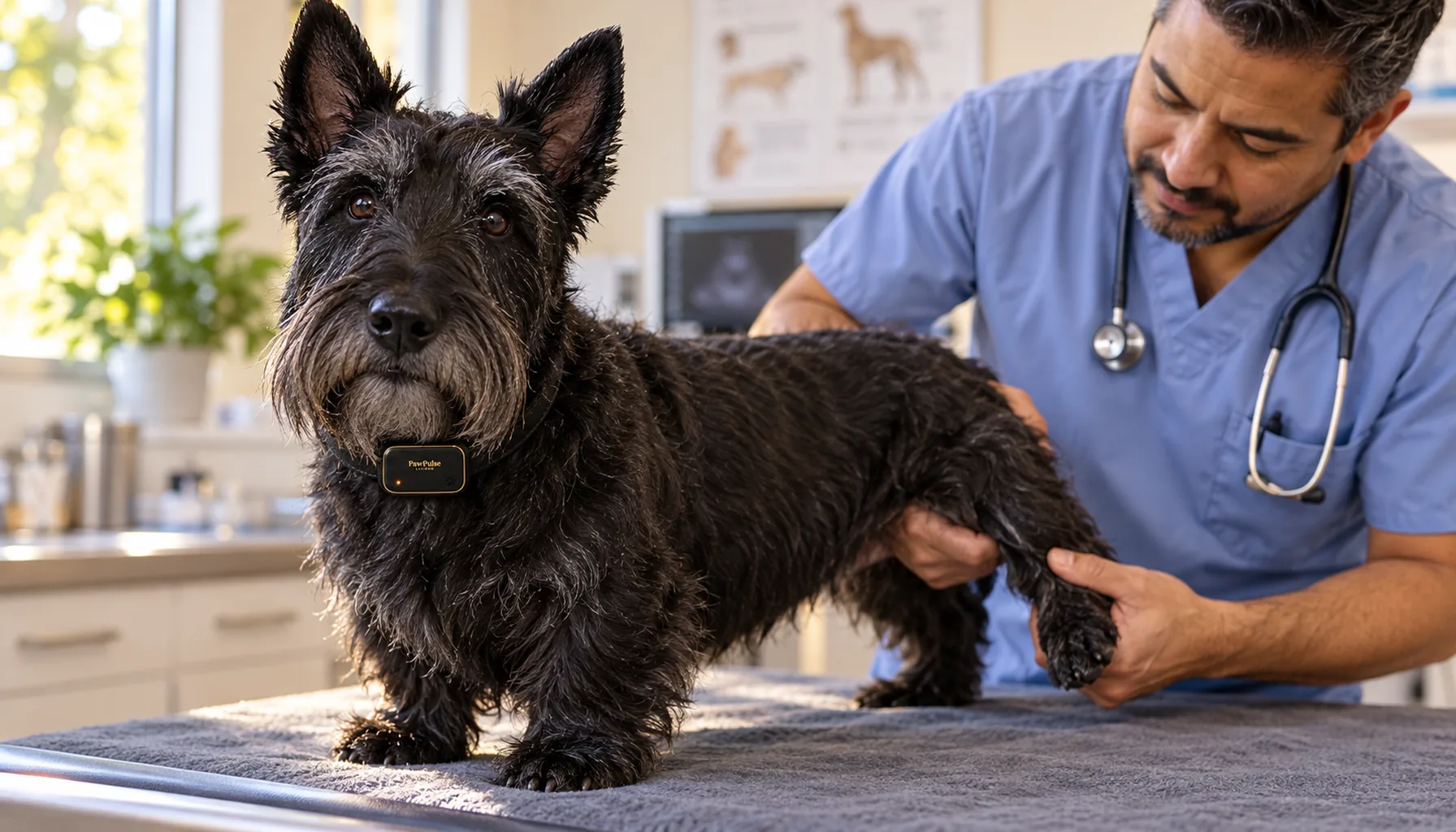
The hard part of the senior years is that most changes are slow. Each day looks like yesterday, so a month of drift is easy to miss. That is the gap we designed PawPulse Lucero for. It is designed to measure heart rate and breathing through fur without touching the skin (Kinetic sensing), alongside activity and rest, so you can see trends over weeks instead of guessing.
PawPulse Lucero does not decide when your dog is a senior, and it does not replace your vet or the senior workup. It gives you trends and context to share with your vet, which is the same idea behind our longer piece on why senior dogs deserve continuous monitoring.
Frequently Asked Questions
At what age is a dog considered a senior?
There is no fixed age. The 2023 AAHA Senior Care Guidelines define a senior dog as one in the last 25% of its estimated lifespan. A dog expected to live 12 years is a senior from about 9, while a dog expected to live 9 years gets there at about 6 and three-quarters. Ask your vet to estimate your dog's.
Do large dogs become seniors sooner than small dogs?
On average, yes. A 2024 study of 584,734 UK dogs found median lifespans of 12.7 years for small purebreds and 11.9 for large ones, and a 2013 study concluded that large dogs die younger mainly because they age faster. Under AAHA's 25% rule, shorter-lived dogs reach senior status earlier.
How many hours should a senior dog sleep?
There is no single number we can source. Sleeping much more than your dog usually does, restless nights, or a clear change in the usual sleep pattern are worth raising with your vet, because pain, cognitive decline and several illnesses can change sleep.
Why does my senior dog sleep all day and pace at night?
AAHA lists daytime sleeping with nighttime restlessness among the most common signs of canine cognitive dysfunction. A 2026 study found dogs with more severe cognitive decline slept less at night and more by day. Pain and other conditions can also disturb sleep, so a vet visit is the right first step.
How often should a senior dog see the vet?
AAHA's 2023 guidelines recommend a medical workup for senior pets once or twice a year, which may include blood and urine tests. Book sooner if you notice changes in appetite, thirst, weight, sleep or mobility. Bringing notes and short videos of how your dog moves at home makes each visit more useful.
What are the first signs a dog is getting old?
Common early signs include slowing down on walks, stiffness after rest, more daytime sleep, changes in appetite or thirst, and less interest in play or people. A grey muzzle on its own tells you little. Any change that appears over weeks, rather than one off day, is worth mentioning to your vet.
Learn more about PawPulse Lucero, the smart dog collar designed to measure heart rate and breathing through fur without touching the skin, so you and your vet can follow your senior dog's trends over weeks and months.
-- The PawPulse Team