

Jun 2, 20268 min read
Satellite Connectivity for Pets: How NTN Changes Everything
NTN lets a dog collar talk to satellites using the same chip as cellular. Here is how this standard makes satellite pet tracking affordable and automatic.
Read articleMost GPS collars work fine until the moment you need them. Coverage maps are drawn for phones held by people standing on roads, not for a dog half a mile into a treeline. These posts work through the failure modes honestly: what happens to a location fix when LTE drops, why update intervals and battery budgets trade against each other, how terrain and canopy degrade accuracy, and what satellite-ready backup adds when there is no tower in range.
Lucero carries GPS with LTE and a satellite-ready backup path, which is a different design goal from a tracker that assumes a city. The archive also covers what the data says about lost dogs, how recovery time changes outcomes, and what a location trail is worth when it is paired with health context rather than sitting on its own map.
NTN lets a dog collar talk to satellites using the same chip as cellular. Here is how this standard makes satellite pet tracking affordable and automatic.
Read article
GPS dog collars fail without cell service. Learn why cellular tracking breaks off-grid and how satellite backup keeps your dog connected.
Read article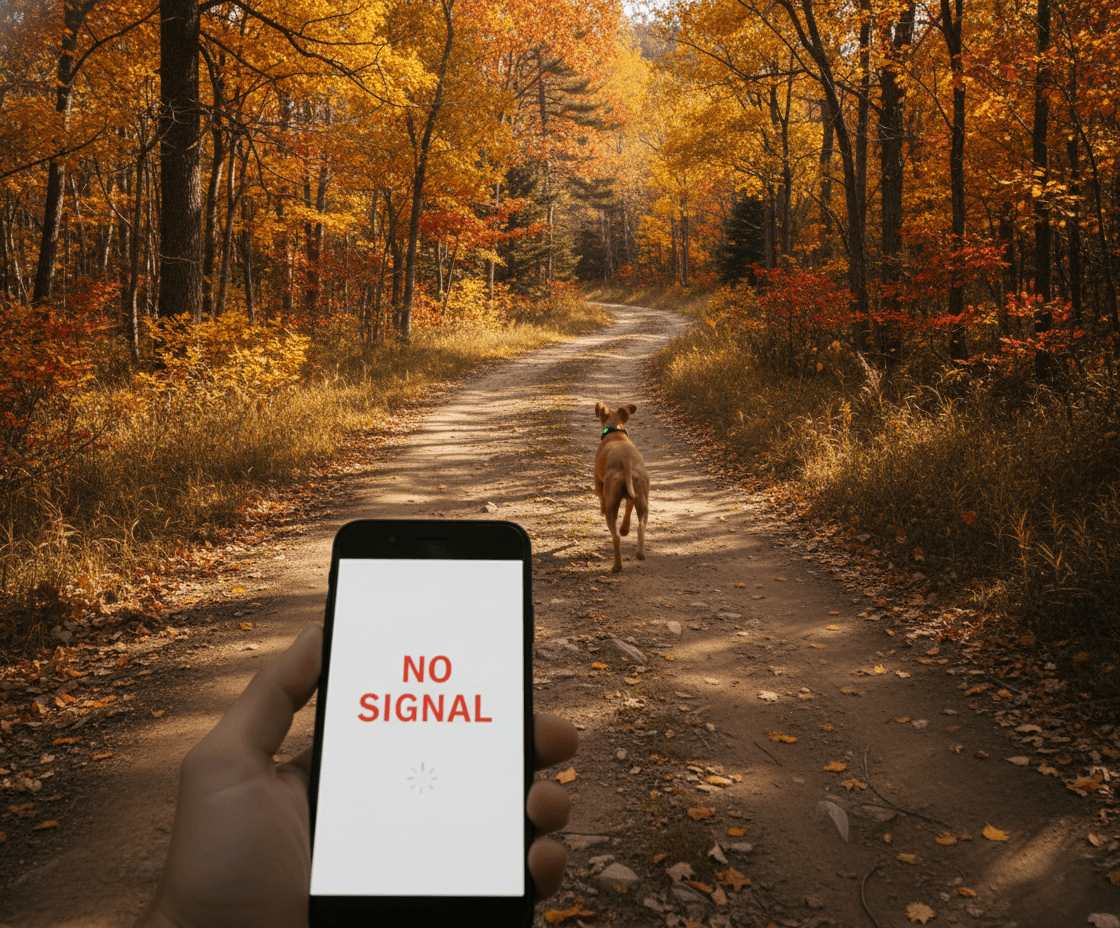
Most GPS dog collars rely on cellular networks that cover only 70% of US land. Satellite-enabled trackers are the reliable option for rural dogs.
Read articleTopic questions
Short answers to the questions readers ask most about this topic. PawPulse is a consumer wellness product and does not diagnose, treat, or predict illness.
A GPS receiver can often still compute a position without cell service, but the collar needs a network to send that position to your phone. Outside LTE coverage the fix exists and nobody can see it, which is the gap satellite-ready backup is designed to close.
It means the collar is built to fall back to a satellite path for location messaging when terrestrial coverage is unavailable, rather than going silent. Availability details and coverage specifics are published as certification and carrier work completes.
Open sky gives the best result; heavy canopy, canyons, and dense urban reflections degrade it. That is true of every consumer GPS device. What separates collars in practice is how often they report, how gracefully they handle a weak fix, and whether they keep working when the network does not.
Location reporting is the most power-hungry thing a collar does, so every tracker balances update frequency against runtime. Lucero manages that budget adaptively rather than reporting at a fixed rate regardless of context. Specific runtime figures are published at launch.
It answers where, not how. PawPulse builds location alongside continuous health signals because the two together describe a dog far better than a dot on a map. A tracker tells you your dog is in the next field; health context tells you how that dog is doing.
Keep reading
AI & Technology
7 min read
Health Science
7 min read

Vet Insights
7 min read
GPS Technology
8 min read
GPS Technology
8 min read
GPS Technology
11 min read

Health Monitoring
7 min read

AI & Technology
8 min read