Key takeaway: Most GPS dog collars rely on cellular networks to transmit location data, which means they stop working entirely in areas without cell coverage. With roughly 85% of Earth's surface lacking terrestrial cellular infrastructure, any dog owner who hikes, hunts, camps, or lives rurally needs satellite backup built into their collar, not a separate device.
Three Miles In, Your Dog's Collar Becomes Expensive Plastic
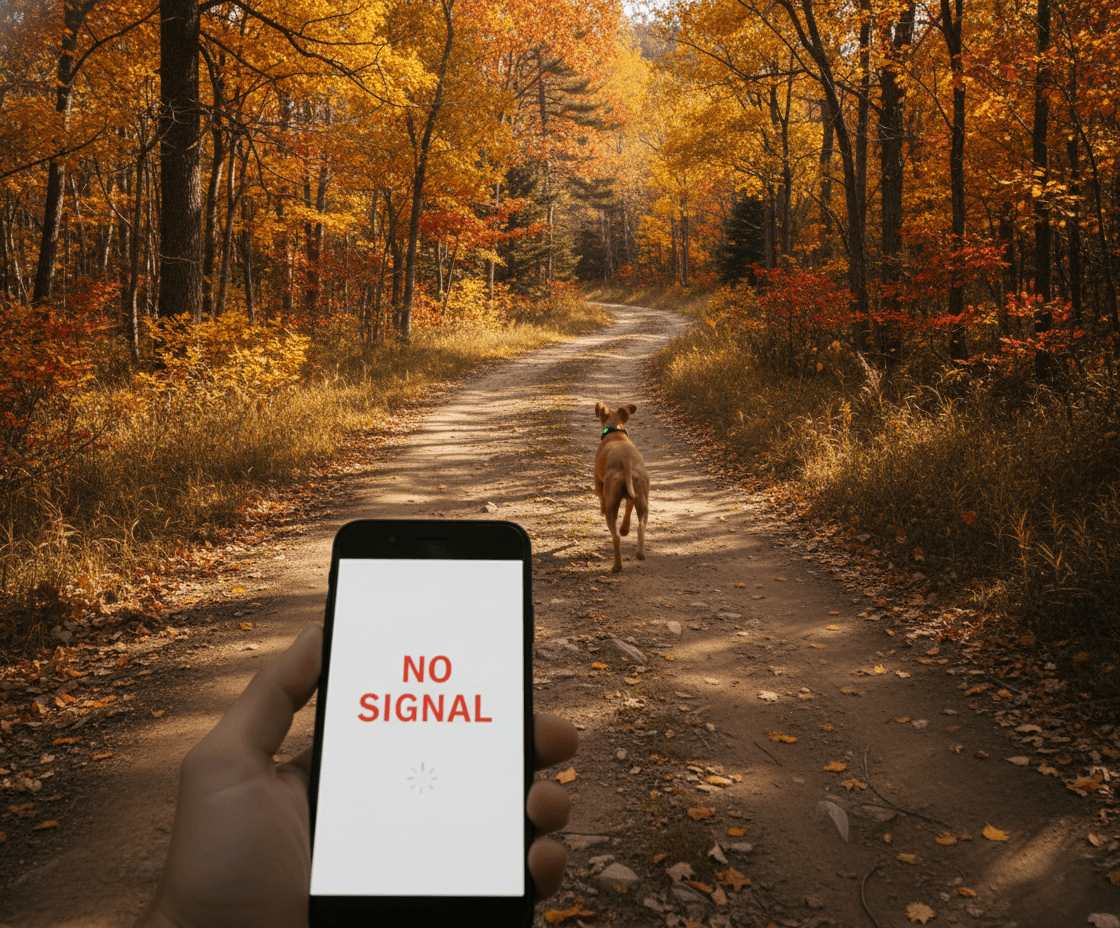
You're three miles into a backcountry trail. Your dog is off-leash, doing what dogs do: nose to the ground, zigzagging through the brush. Then a deer bolts across the path and your dog vanishes into the tree line.
You reach for your phone. Open the collar app. And there it is:
"Last known location: 47 minutes ago."
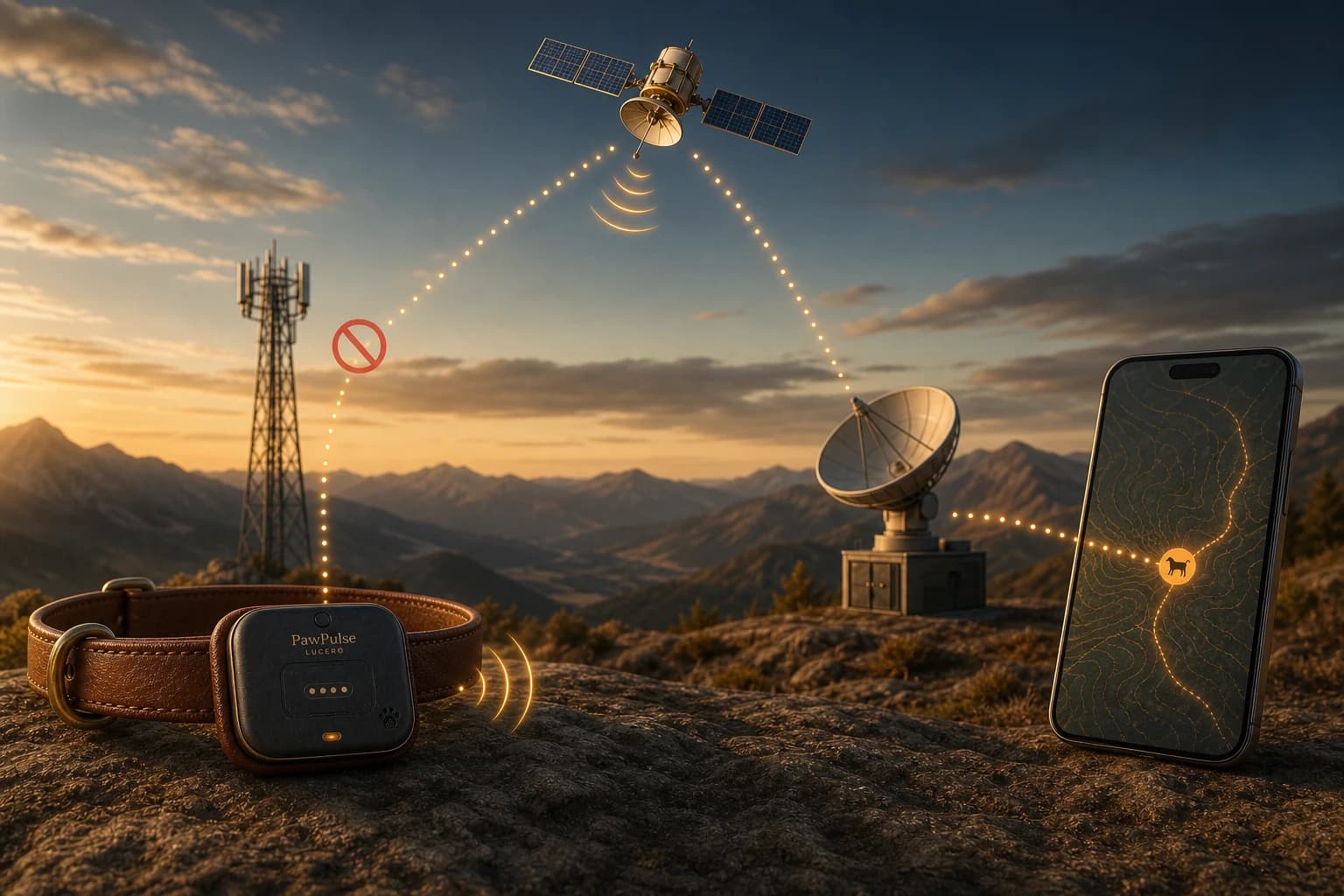
No live tracking. No geofence alert. No way to know which direction your dog went. The GPS chip on the collar is still getting a satellite fix, calculating your dog's exact coordinates every few seconds. But that data is trapped on the collar with no way to reach your phone, because there's no cellular signal to carry it.
Your $300 GPS collar just became a piece of plastic.
This isn't a hardware failure. It's a design limitation built into every cellular-only GPS tracker on the market. And for the 15 million Americans who hike with their dogs, the 10 million hunters with working dogs, and the millions more who live in rural areas, it's the reality every time they leave cell coverage.
Why Cellular GPS Collars Are Fundamentally Broken Off-Grid
The problem isn't GPS itself. GPS satellites orbit at roughly 20,200 km and cover the entire planet. Your dog's collar can calculate its position from nearly anywhere on Earth.
The problem is what happens after that calculation. The collar needs a way to send that position to your phone. On every cellular-only collar, that transmission path requires a nearby cell tower. No tower, no transmission. The location data just accumulates on the collar, waiting for a signal that may not come for hours or days.
What This Breaks in Practice
Live tracking disappears. The collar knows where your dog is. You don't. The information gap between the device and the owner is the whole problem.
Geofence alerts never arrive. You set a 200-yard boundary around your campsite. Your dog crosses it. The collar registers the breach, generates an alert, and... nothing. Without cellular connectivity, that alert sits in a queue. You don't find out until you're back in coverage, by which point your dog could be miles away.
Store-and-forward is a false comfort. Some collars store location pings and upload them when connectivity returns. That means you get a breadcrumb trail of where your dog was, not where they are. If you're searching in real time, historical data doesn't help.
Health data goes stale. For collars that monitor vitals, the same connectivity gap applies. If your dog's heart rate trends well above his normal on a summer hike, you'll see the data hours later instead of in the moment.
The Battery Problem Nobody Talks About
There's a second failure hiding inside the cellular GPS model: battery life. Constantly scanning for cell towers, acquiring GPS fixes, and attempting to transmit location data is enormously power-hungry. Collars from Halo, SpotOn, and SATELLAI max out at roughly 1-5 days of battery life before they need to be recharged. That means on a multi-day camping trip, your collar may die before you're back at the trailhead.
This isn't a minor inconvenience. It means nightly charging rituals in the backcountry, carrying extra cables, and the very real risk of a dead collar on the morning your dog decides to chase something into the woods. Owners learn to work around it, but the root cause is architectural: cellular GPS collars are burning through power because they were designed for constant connectivity, not for efficiency.
PawPulse takes a fundamentally different approach to power. Because our 60GHz radar sensor draws a fraction of the power that cellular GPS polling demands, and because satellite transmissions are small, infrequent messages timed to pass windows rather than continuous cellular pings, PawPulse is designed around power efficiency from day one. We'll share real battery numbers once certification and production testing are done.
85% of Earth Has No Cell Service
This isn't a niche problem. According to 3GPP's overview of Non-Terrestrial Networks, the standards body behind global cellular specifications, roughly 85% of Earth's surface lacks terrestrial cellular infrastructure. In the United States specifically, we've covered the broader GPS failure problem with FCC data showing that approximately 30% of U.S. land area has no reliable cellular coverage.
For outdoor dog owners, these aren't abstract percentages. They're every trailhead, every hunting lease, every national park campsite, and every rural property more than a few miles from a highway. A 2024 analysis of lost pet data found that 75% of all lost dog cases occur in rural states, where the combination of open terrain and absent connectivity makes recovery dramatically harder.
The places where dogs are most likely to run are the exact places where cellular GPS collars stop working.
When most people hear "satellite tracking," they picture an Iridium handheld the size of a brick, a separate collar, a separate subscription, and $800 in gear before you've even left the driveway. That's the old model.
PawPulse takes a fundamentally different approach. Satellite connectivity is built into the collar's existing modem. Same collar, same app, one subscription. Nothing extra to carry, pair, or charge.
The Seamless Failover
Here's what happens when you hike out of cell range with a PawPulse collar:
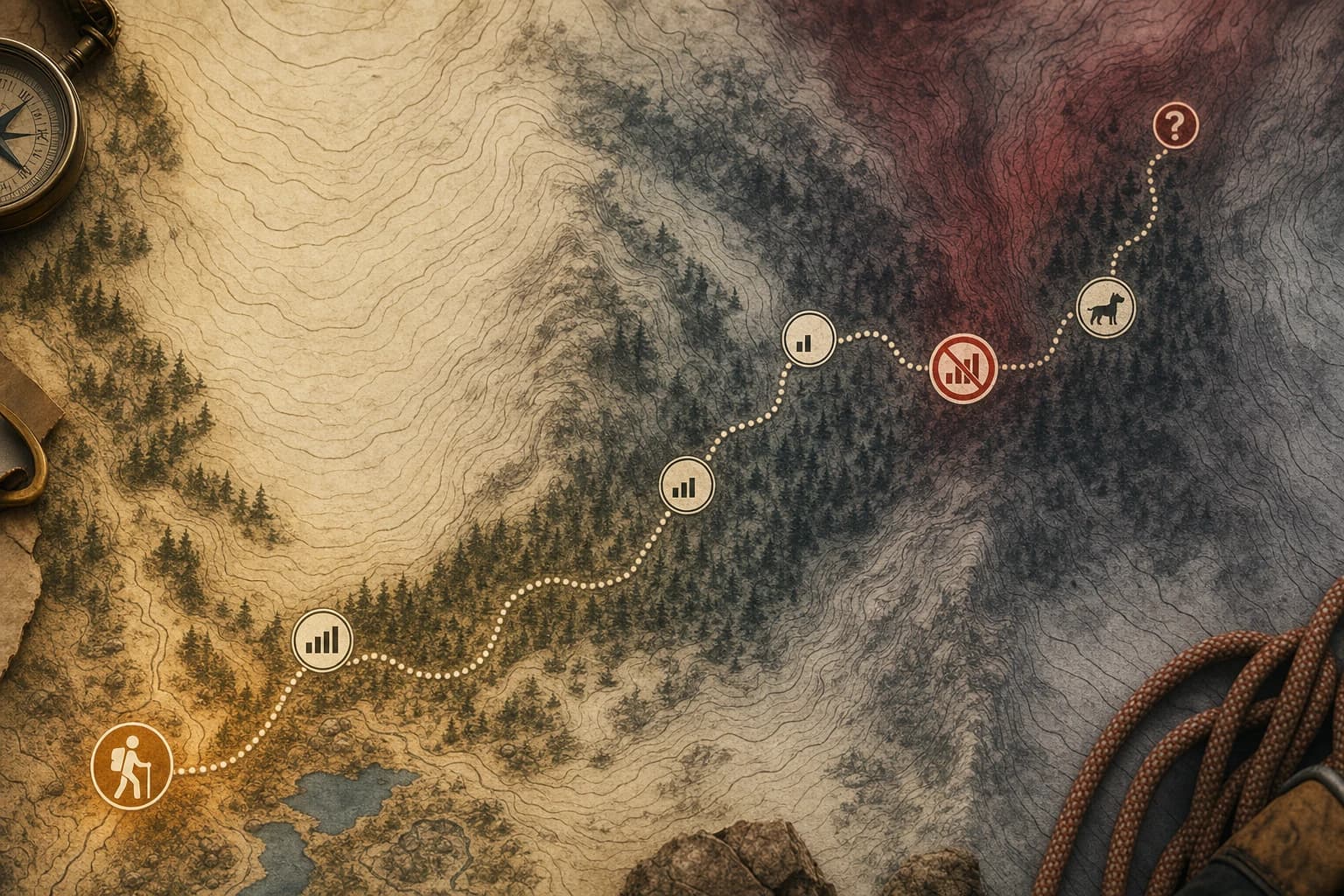
- The collar detects cellular dropout.
- It automatically switches to LEO (Low Earth Orbit) satellite communication.
- Your dog's location and health status are transmitted via satellite to your phone.
- Geofence alerts work over satellite. If your dog crosses a boundary in the wilderness, you get notified.
- No manual switching. No settings to change. The failover is transparent.
The experience for the owner doesn't change. The app still shows your dog's location. Alerts still arrive. The only difference is the signal path, and you don't need to know or care about that.
LEO Satellites vs. What You're Imagining
Traditional satellite services use geostationary satellites parked 35,786 km above the equator. They're far away, require bulky antennas, and cost a premium. LEO satellites orbit at roughly 600 km, pass overhead every 15-90 minutes, and can communicate with small, low-power devices like a dog collar.
The 3GPP Release 17 standard formalized how IoT devices connect to these LEO satellite networks using the same NB-IoT protocols that power terrestrial cellular connectivity. That means satellite support can be integrated into the same chipset as cellular, not bolted on as a separate system. PawPulse's hybrid connectivity architecture is built on this standard.
Four Scenarios Where Satellite Changes Everything
The Hunter
Your bird dog ranges over a mile into thick timber. You're working a tract with zero cellular infrastructure. With a cellular-only collar, you're blind the moment your dog leaves visual range. With satellite, you get location updates on each overhead pass. Your dog's position, distance, and heading are in your app even when the nearest cell tower is 20 miles away.
The Ranch
Your working dog covers hundreds of acres daily. The nearest cell tower is 12 miles out. Traditional smart collars have never worked on your property, period. Satellite makes smart collar ownership possible for the first time, keeping health data flowing and geofence boundaries active across the entire spread.
The National Park Camper
You're camping off-leash in a dispersed site. No cell service for 50 miles in any direction. Your dog wanders past the boundary you set around camp. A geofence alert triggers over satellite and arrives on your phone. You redirect before your dog is out of earshot. Without satellite, you wouldn't have known until you noticed your dog was gone.
The Rural Homestead
Your property is in a permanent cellular dead zone. Every GPS collar you've tried has been useless from day one. Satellite turns a perpetually offline device into a functioning smart collar, giving you the same features that suburban dog owners take for granted.
The Real Cost Comparison: Simplicity vs. Complexity
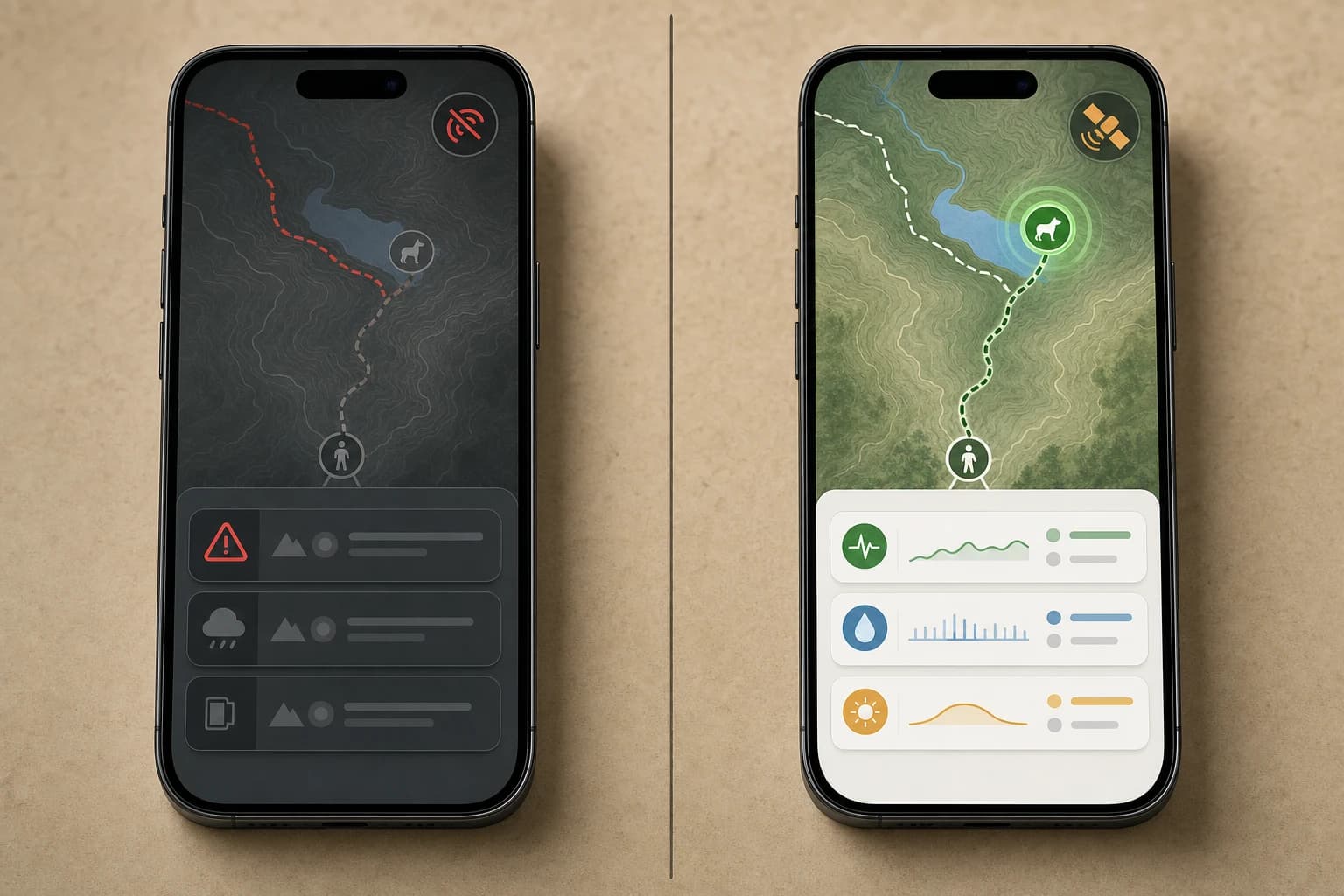
The old way to get satellite tracking for a dog meant assembling a kit: a standalone satellite communicator (several hundred dollars), a separate GPS collar, a separate subscription for each device, and the hassle of carrying, charging, and pairing two systems that were never designed to talk to each other.
| Factor | Traditional Satellite Setup | PawPulse |
|---|
| Devices to carry | 2+ (collar + handheld) | 1 collar |
| Apps to manage | 2+ | 1 |
| Subscriptions | 2+ (collar + satellite) | 1 |
| Automatic failover | No (manual switching) | Yes |
| Health monitoring included | No | Yes (heart rate, respiratory, HRV) |
| Geofence alerts over satellite | Rarely | Yes |
| Setup complexity | High (pairing, configuration) | None (works out of the box) |
| Battery life | 1-5 days (constant recharging) | Shared after certification |
The comparison isn't just about price. It's about whether the system actually works in the moment you need it, without requiring you to think about connectivity at all.
What Happens When You Can't Find Your Dog
Research published by the ASPCA found that approximately 14% of dog owners lose their pet at least once in a five-year period, and 7% of lost dogs are never reunited with their owners. While 93% of lost dogs are eventually recovered, the methods that work, searching the neighborhood, checking shelters, relying on ID tags, all assume an urban or suburban environment where people are nearby to spot your dog.
In rural and wilderness settings, those methods collapse. There are no neighbors to knock on doors. No nearby shelters. No one passing by who might read a tag. The search radius expands exponentially while the available resources shrink to zero. The only thing that changes this equation is real-time location data, which requires connectivity, which requires satellite.
Frequently Asked Questions
Do GPS dog collars work without cell service?
GPS collars can calculate your dog's position without cell service because GPS uses dedicated satellites. However, the collar cannot transmit that position to your phone without a cellular connection. The result is a collar that knows where your dog is but can't tell you. PawPulse solves this by failing over to LEO satellite communication when cellular drops out.
How does satellite tracking work in a dog collar?
PawPulse's collar includes satellite connectivity built into the same modem as its cellular radio. When the collar detects no cellular signal, it automatically switches to LEO satellite communication using 3GPP NTN standards. Your dog's location and health data are transmitted to an overhead satellite, relayed to a ground station, and delivered to your phone through the PawPulse app.
Is satellite dog tracking expensive?
Traditional satellite tracking required a separate handheld device and a separate monthly subscription. PawPulse integrates satellite into one collar with one subscription. The cost is a fraction of traditional satellite services because LEO NTN uses standardized, mass-market chipsets rather than proprietary satellite hardware.
How often does the satellite update my dog's location?
LEO satellites orbit at roughly 600 km and pass overhead every 15-90 minutes. Your dog's location is transmitted on each available pass. This isn't real-time second-by-second tracking like cellular, but it's the difference between knowing your dog's position every hour versus having zero data for an entire weekend camping trip.
Does the satellite backup drain the battery faster?
Satellite transmission uses more power per message than cellular, but PawPulse compensates by using small, infrequent satellite messages timed to pass windows rather than continuous cellular polling. For comparison, cellular GPS collars from brands like Halo, SpotOn, and SATELLAI last 1-5 days before needing a recharge. The difference is architectural: PawPulse was designed for efficiency from the ground up, not for constant connectivity that drains power.
Can I use PawPulse satellite tracking while hiking?
Yes. Satellite failover is automatic. When you hike out of cellular range, the collar switches to satellite without any action from you. Geofence alerts, location updates, and health monitoring all continue to function over satellite. You'll see your dog's position in the same app interface you use at home.
What percentage of Earth has no cell coverage?
Approximately 85% of Earth's surface lacks terrestrial cellular infrastructure, according to 3GPP. In the U.S., roughly 30% of land area has no reliable cellular service. For outdoor dog owners, this means any trail, hunting ground, or rural property beyond a few miles from a highway is likely a dead zone for cellular-only collars.
Learn more about PawPulse Lucero, the smart dog collar built with cellular plus satellite-ready backup for the trails, hunts, and rural homes where every other GPS collar fails. See how Lucero stacks up against Fi, Tractive, Halo, and SpotOn on the collar comparison page.
Related reading: lost dog statistics every owner should see and how NTN satellite connectivity changes pet tracking.
-- The PawPulse Team