Key takeaway: 3GPP's Non-Terrestrial Network (NTN) standard allows IoT devices like pet collars to connect to LEO satellites using the same modem chipset as cellular, eliminating the need for separate satellite hardware. This means satellite connectivity can be built into a pet collar at a fraction of historical satellite costs, with automatic failover when cellular drops out.
Your Dog's Collar Can Now Talk to Space. Here's How.
Until recently, satellite connectivity for consumer devices meant one thing: expensive, bulky, and separate. A satellite communicator was a dedicated device you carried alongside your phone, your GPS, and your pet's collar. Three gadgets, three subscriptions, and a cargo pocket's worth of hardware just to stay connected in the backcountry.
That era is ending. A global standard called NTN (Non-Terrestrial Networks), developed by the same organization that defines how your phone connects to cell towers, has made it possible for a device as small as a dog collar to talk to satellites using the same chip it uses for cellular. No separate hardware. No manual switching. No second subscription for a device you only use on weekends.
We've already covered what happens when GPS collars lose cellular signal - the short version is "nothing good." This post is about the technology that fixes it, how it actually works, and why it matters that it's a standard rather than a proprietary system.
What Is NTN (and Why Should a Dog Owner Care)?
NTN stands for Non-Terrestrial Networks. It's a set of specifications within the 3GPP standards framework - the same body that defines 4G, 5G, and the NB-IoT protocols used by billions of connected devices worldwide. In Release 17 (finalized in 2022), 3GPP formally brought satellite connectivity into the same technical framework as cellular.
In plain terms: before NTN, cellular and satellite were two completely separate worlds with different hardware, different protocols, and different supply chains. After NTN, they share the same air interface. A single modem chip can speak both languages.
For pet owners, this matters for one reason: it's what makes satellite connectivity possible in a collar-sized device at a consumer price point, rather than requiring a separate $400-800 satellite communicator.
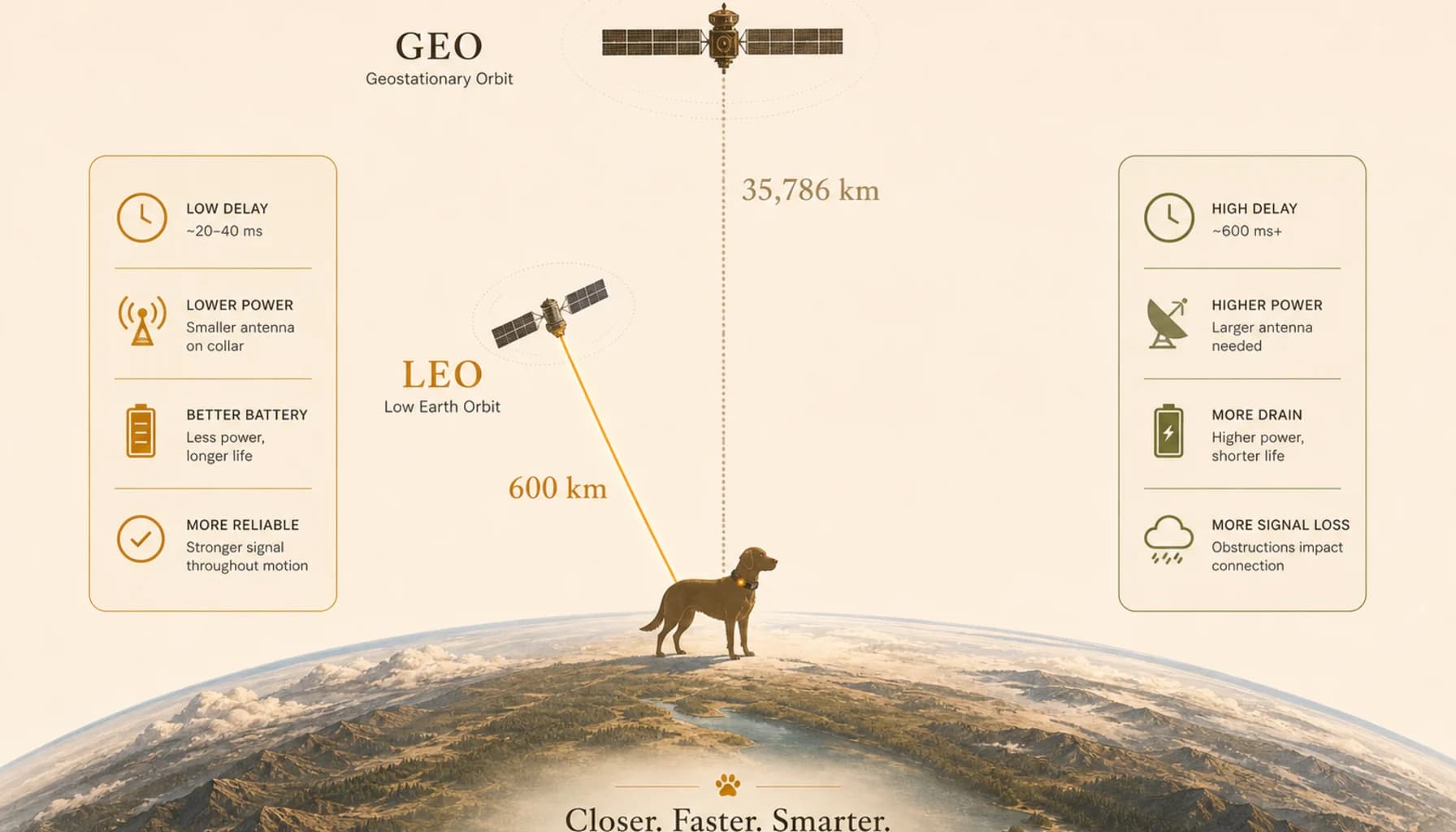
LEO Satellites: Closer, Faster, Cheaper
Not Your Grandfather's Satellite
When most people think "satellite," they picture the geostationary kind - massive spacecraft parked 35,786 km above the equator, where they hover over one spot indefinitely. These are the satellites that deliver satellite TV, and they work well for broadcasting. They're terrible for IoT. The round-trip signal delay is roughly 540 milliseconds, the antennas need to be large, and the power requirements are high.
LEO (Low Earth Orbit) satellites are a fundamentally different architecture. They orbit at 300-1,200 km altitude - roughly 30-100x closer than geostationary satellites. That proximity changes every practical constraint:
| Factor | Geostationary (GEO) | Low Earth Orbit (LEO) |
|---|
| Altitude | 35,786 km | 300-1,200 km |
| Signal round-trip delay | ~540 ms | 4-40 ms |
| Device antenna size | Large (dish or high-gain) | Small (fits in a collar module) |
| Power requirement | High | Low (compatible with battery devices) |
| Coverage per satellite | Fixed region (hemisphere-scale) | Moves, covers a swath per pass |
| Overhead pass frequency | Always visible (stationary) | Every 15-90 minutes (constellation) |
The trade-off is that LEO satellites move. They're not parked above one spot - they orbit the Earth roughly every 90 minutes, which means any single satellite is overhead for only a few minutes at a time. To get continuous-ish coverage, you need a constellation of many satellites. Companies like AST SpaceMobile, Iridium, and others are building or expanding LEO constellations specifically for direct-to-device NTN connectivity.
Why LEO + NB-IoT Is Perfect for Pet Wearables
A pet collar doesn't need to stream video from space. It needs to send small packets of data - a GPS fix (a few hundred bytes), vital signs (a few hundred more), and maybe a geofence alert (a few bytes) - at intervals measured in minutes, not milliseconds.
NB-IoT over NTN, as defined in 3GPP Release 17, is designed exactly for this use case. Data rates of 20-60 kbps are more than enough for telemetry. The protocol is optimized for low-power devices with small antennas. And because it shares the same air interface as terrestrial NB-IoT, the modem doesn't need separate satellite silicon - it's the same chip, speaking the same protocol, just pointed up instead of sideways.
As Ericsson's NTN technology review puts it, the practical shift is that IoT devices can now add satellite as a coverage extension rather than running a completely separate satellite stack. That's the difference between a collar that costs hundreds more for satellite capability and one that includes it as a standard feature.
How PawPulse Uses NTN
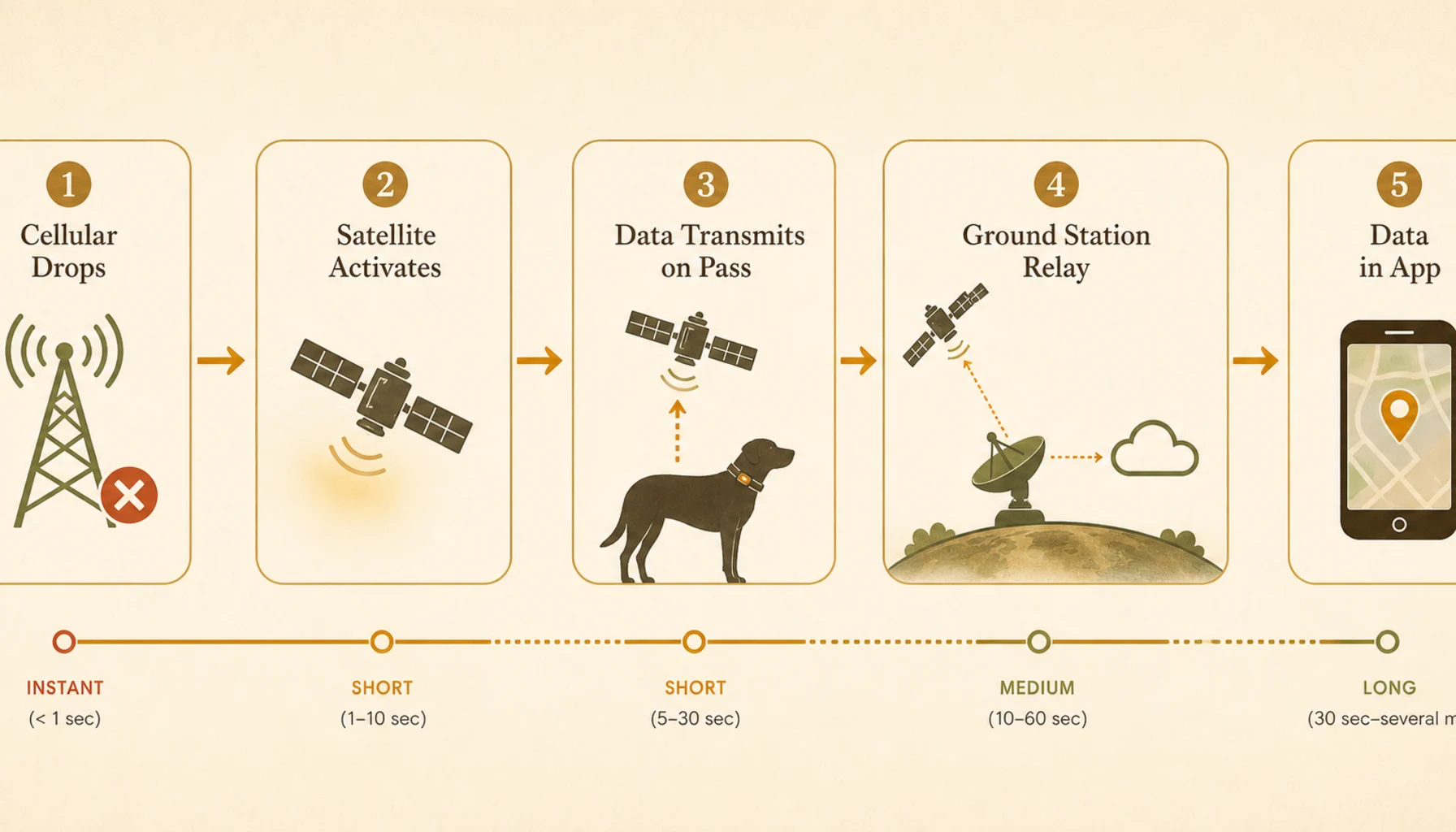
PawPulse's hybrid connectivity architecture is built on this standard. Here's what actually happens inside the collar when you hike out of cell range:
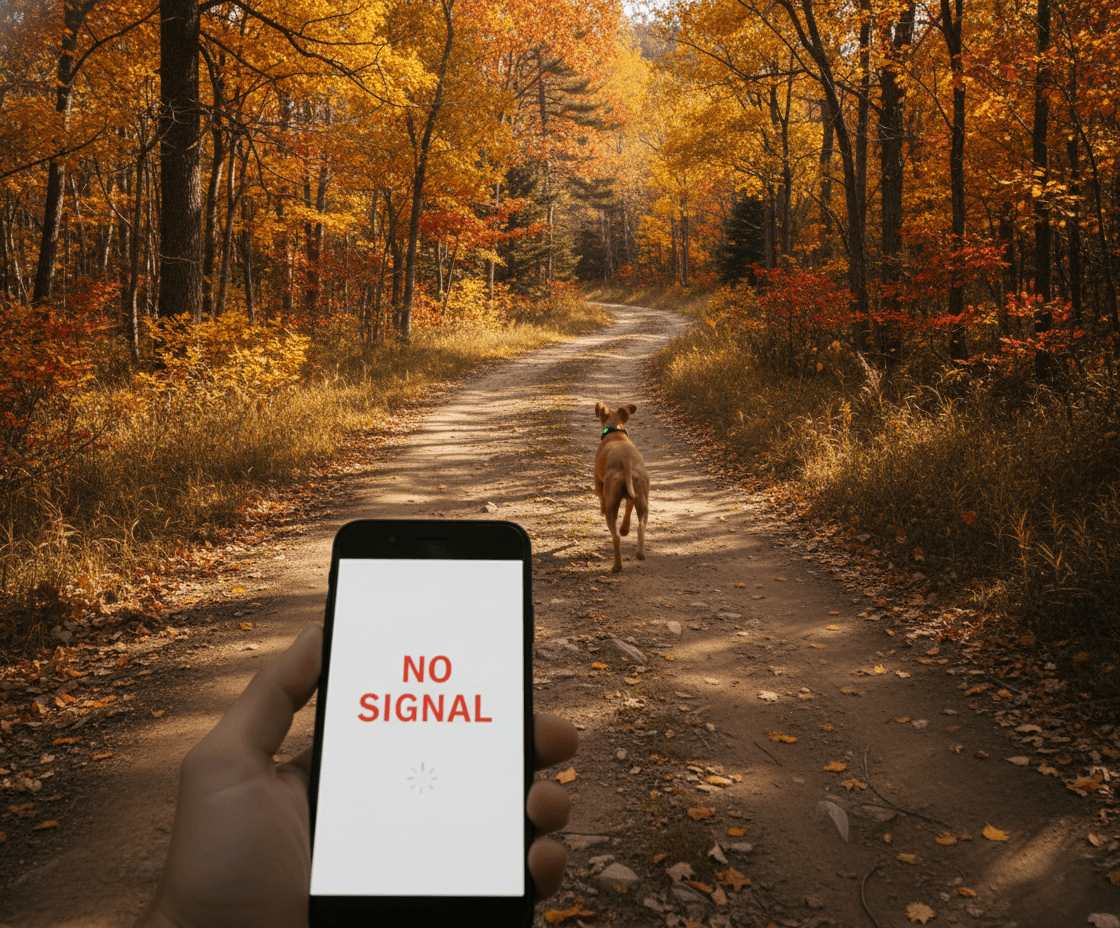
Step 1: Cellular drops out. The collar's modem detects that it can no longer reach a terrestrial cell tower. This happens automatically - no user action required.
Step 2: Satellite mode activates. The same modem switches to NTN mode, using the same NB-IoT protocol but directed at LEO satellite infrastructure. No separate radio, no separate antenna, no mode toggle in the app.
Step 3: Data transmits on satellite pass. When a LEO satellite passes overhead (every 15-90 minutes depending on constellation density and latitude), the collar transmits a compact data packet containing your pet's GPS position, health vitals (heart rate, respiratory rate, HRV), and any pending alerts (geofence breaches, biometric anomalies).
Step 4: Data reaches your phone. The satellite relays the packet to a ground station, which routes it through standard internet infrastructure to PawPulse's cloud, which pushes it to your app. From your perspective, the experience is identical to cellular - you see your pet's location and health data on the same map, in the same interface.
Step 5: Cellular returns. When you're back in coverage, the collar seamlessly switches back to cellular for higher-frequency updates. No restart, no resync.
The entire failover process is invisible to the owner. The only indication that satellite was involved might be a small satellite icon in the app status bar. The data just... arrives.
What NTN Can and Can't Do (Honest Version)
We believe in being transparent about the technology's current capabilities rather than overselling what satellite connectivity delivers today.
What It Can Do
Location updates every satellite pass. Your pet's GPS position, transmitted every 15-90 minutes depending on satellite availability. Enough to know your dog's general area, direction of travel, and whether they've crossed a geofence boundary.
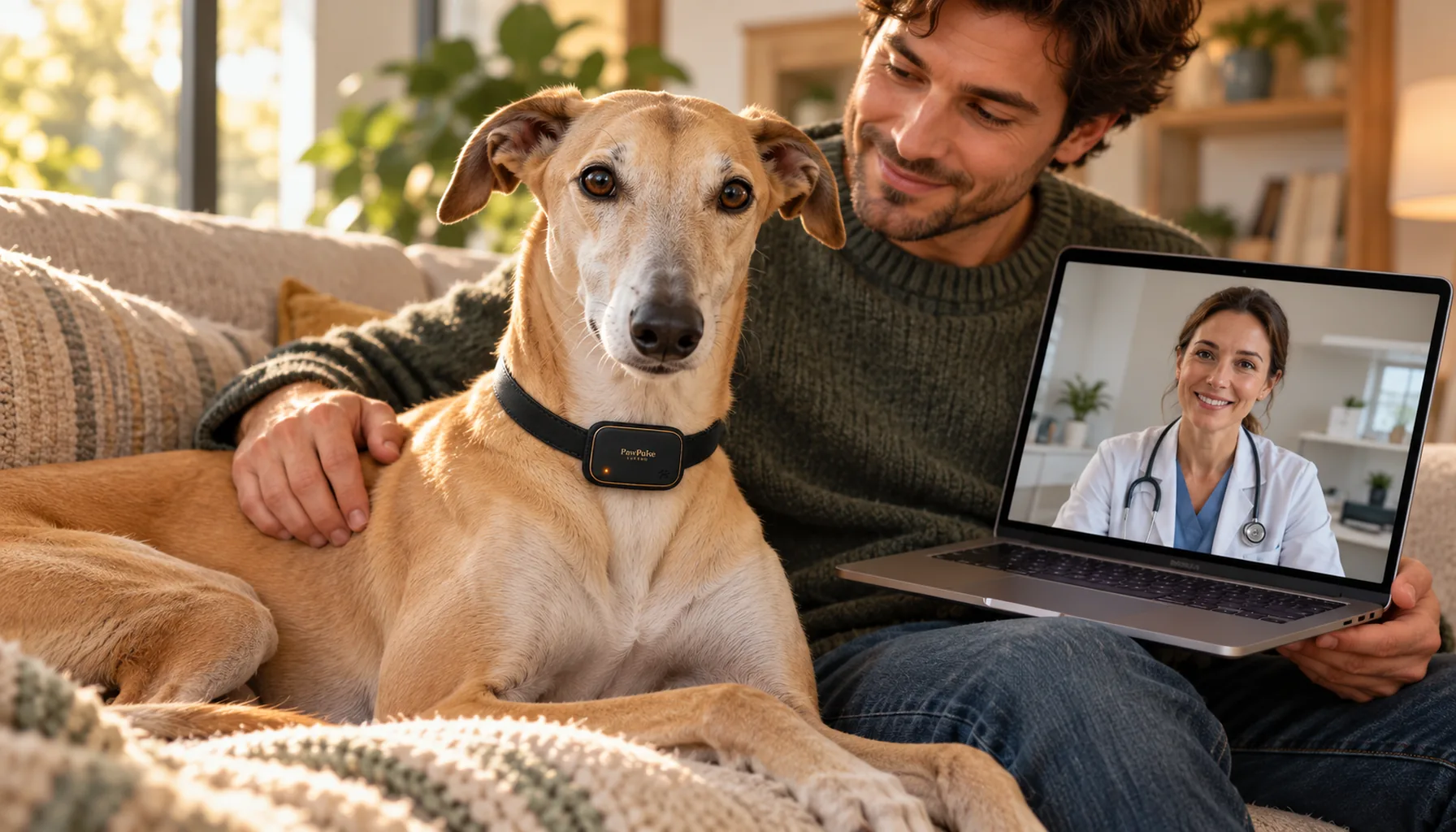
Health data transmission. Heart rate, respiratory rate, HRV, and activity summaries sent alongside location data. Your vet can still see trends through the Vet Dashboard even if your pet was off-grid for a weekend.
Geofence alerts over satellite. If your dog crosses a boundary in the wilderness, the alert reaches your phone on the next satellite pass. It's not instant, but it's the difference between knowing within the hour and not knowing until you're back in cell range (which could be days).
Automatic, seamless operation. No configuration, no manual switching, no separate app. The collar handles it.
What It Can't Do (Yet)
Real-time, second-by-second tracking. LEO NTN is a telemetry technology, not a streaming technology. Data rates of 20-60 kbps with satellite passes every 15-90 minutes mean your tracking resolution is measured in minutes, not seconds. This is dramatically better than zero connectivity, but it's not the same as cellular.
Two-way communication. Current NTN implementations are primarily uplink-focused for IoT devices. The collar sends data up. It doesn't receive commands from space (yet). Remote Pulse Rhythm activation, for example, still requires cellular.
Indoor or dense-canopy coverage. Satellite signals need a reasonable view of the sky. Deep inside a cave or under extremely thick forest canopy, signal may be attenuated. Open terrain, ridgelines, and clearings work well.
Why "Standard" Matters More Than "Satellite"
The most important word in NTN isn't "satellite." It's "standard."
Before NTN, satellite IoT meant proprietary systems. Each satellite operator had its own protocol, its own chipset requirements, its own pricing, and its own hardware ecosystem. If your satellite provider shut down (as happened with SpaceX's Swarm Technologies in 2025), your device became a paperweight.
A published deep-dive in IEEE ComSoc on NTN's trajectory noted that standardization through 3GPP allows satellite connectivity to be integrated as part of a unified service rather than sold as a standalone or niche product. That means chipset vendors build NTN into mass-market silicon. Module costs drop. The supply chain scales. And devices built on the standard aren't locked to a single satellite operator.
PawPulse is built on this standard because we believe satellite connectivity for pets should be a feature, not a product. It should be included in the collar, not sold as a separate accessory. And it should work without the owner knowing or caring how the bits got from the collar to the cloud.
The Road Ahead: Release 18, 19, and Beyond
NTN in Release 17 is the floor, not the ceiling. The standard is evolving rapidly:
Release 18 (frozen) adds coverage enhancements, better mobility handover between terrestrial and satellite networks, and higher-frequency Ka-band support.
Release 19 (in progress) introduces store-and-forward satellite operation - meaning the satellite itself can hold data temporarily when no ground station is in view - and brings NB-IoT NTN into the 5G core architecture.
Release 20 and beyond will bundle advanced NTN features with early 6G specifications, with satellite integrated from day one rather than bolted on after the fact.
For PawPulse, this roadmap means satellite performance will improve over time without requiring new collar hardware. Software updates can take advantage of new standard features as satellite constellations grow and ground infrastructure expands.

Your Collar Doesn't Care Where You Are. That's the Point.
The promise of NTN for pet owners is simple: your collar works everywhere. Not "everywhere with cell service." Everywhere.
On the trail. On the ranch. At the campsite. In the national park. On the property that's been in a cellular dead zone since you bought it. The PawPulse Lucero connects to whatever infrastructure is available - cellular when it can, satellite when it must - and delivers the same data either way.
That's what a global standard makes possible. Not satellite as a luxury add-on for backcountry enthusiasts, but satellite as invisible infrastructure that's simply there when you need it.
Frequently Asked Questions
What is NTN in the context of a pet collar?
NTN (Non-Terrestrial Networks) is a 3GPP standard that allows IoT devices to connect to LEO satellites using the same NB-IoT protocol and modem chipset as terrestrial cellular. For a pet collar, this means satellite connectivity is built into the same module as cellular - no separate hardware, no manual switching, and no second subscription.
How often does a satellite-connected collar update my dog's location?
LEO satellites pass overhead every 15-90 minutes depending on the constellation's density and your latitude. Your pet's location and health data are transmitted on each available pass. This is not real-time second-by-second tracking, but it provides regular position updates that are dramatically better than zero data when cellular is unavailable.
Does satellite connectivity drain the battery faster?
Satellite transmission uses more power per message than cellular, but the messages are small (GPS fix + vitals summary = a few hundred bytes) and transmissions are timed to brief satellite pass windows. PawPulse's power management compensates by adjusting transmission frequency in satellite mode.
How is this different from a dedicated satellite tracker like a Garmin inReach?
Dedicated satellite communicators are standalone devices with proprietary hardware, separate subscriptions, and manual operation. PawPulse's Lucero collar integrates satellite into the same collar and modem as cellular, with automatic failover and a single subscription. You don't carry a second device, pair two systems, or switch modes manually.
What happens when cellular comes back?
The collar seamlessly switches back to cellular for higher-frequency updates. No restart, no resync, no user action. The transition between satellite and cellular is handled automatically by the modem.
Is satellite available everywhere on Earth?
LEO satellite constellations are designed for global coverage, but signal quality depends on having a reasonable view of the sky. Open terrain, ridgelines, and clearings work well. Dense indoor environments or extremely thick forest canopy may attenuate the signal. Ocean, desert, rural, and wilderness environments - the places where cellular fails - are exactly where satellite works best.
Will satellite performance improve over time?
Yes. 3GPP Releases 18 and 19 add coverage enhancements, store-and-forward capability, and tighter integration with 5G core networks. As LEO constellations grow and ground station infrastructure expands, satellite pass frequency and data throughput will improve. PawPulse is built on this standard so future improvements can be delivered through software updates without new collar hardware.
Learn more about PawPulse Lucero, the smart dog collar with NTN satellite-ready backup built in, no second device required.
Related reading: the dead zone problem with cellular-only collars and the lost-dog statistics that change how you think about safety.
-- The PawPulse Team