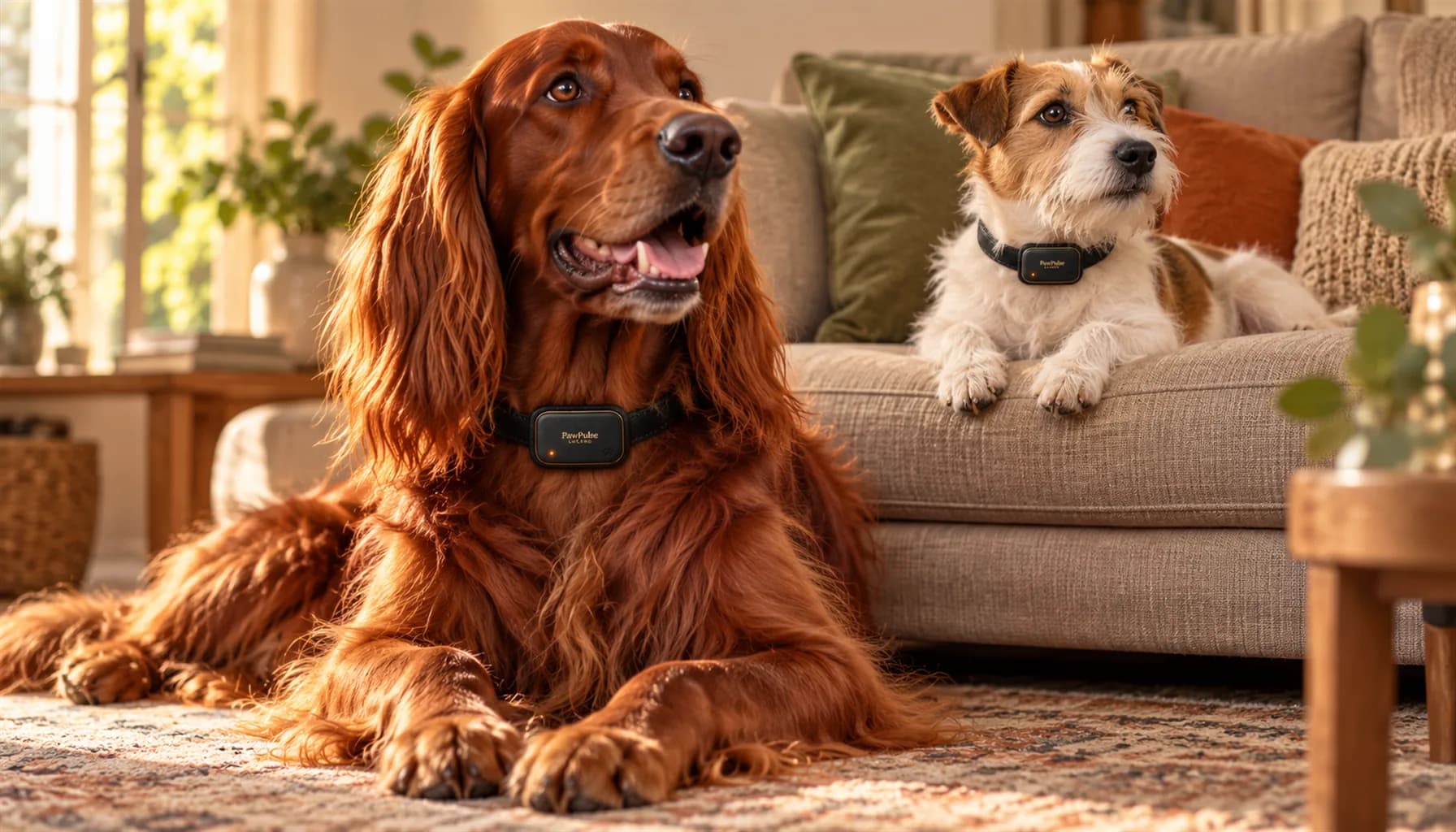
Key takeaway: In a multi-dog household, every dog has its own normal for heart rate, breathing, sleep, and activity, so one shared threshold fails. A 2013 Royal Veterinary College study of 10,849 dogs found that body weight, age, and breed explain only a small share of why heart rates differ between dogs. Useful monitoring compares each dog against its own baseline, not its housemate's.
Why Does Every Dog in the House Have a Different Normal?
If you live with more than one dog, you already know this. The young Lab shrugs off a five-mile run and wants to go again. The senior Pug needs a nap after the mailbox. The rescue who arrived six months ago still sleeps with one eye open and treats the doorbell as a personal insult.
Same house. Same food. Same couch privileges, more or less. Completely different bodies.
That is not just an impression. The Merck Veterinary Manual (2024) gives a resting heart rate range of 70 to 120 beats per minute for dogs. That is a 50-beat spread, wide enough for two perfectly healthy housemates to sit at opposite ends of it.
The research says those differences are mostly individual. In Hezzell and colleagues at the Royal Veterinary College (Journal of Small Animal Practice, 2013), heart rates from 10,849 dog records were compared against body weight, age, and breed. All three mattered, but together they accounted for a relatively small proportion of the overall variability. In plain terms: knowing a dog's size, age, and breed still leaves you guessing about that dog's own number.
PawPulse makes a smart dog collar with contactless heart rate and breathing monitoring, and this is the problem we think about most in multi-dog homes. The question is not whether to pay attention. It is how to pay attention meaningfully when "normal" means something different for every dog under the roof.

Why Does One-Size-Fits-All Monitoring Fail Multi-Dog Homes?
A single alert line has to sit somewhere. Set it low and it nags about a healthy dog whose resting rate naturally runs near the top of the range. Set it high and it stays quiet while a calm dog drifts well above its own usual rate. As we covered in our post on how Prism Insights learns your dog's normal, the spread between dogs is so wide that population ranges tell you very little about the individual in front of you.
In a multi-dog household, that problem multiplies. You are not juggling one set of norms. You are juggling two, three, or five separate profiles. Each dog needs its own baseline, its own trend line, and alerts tuned to its own normal, not a house average.
That is how we built the PawPulse Lucero smart collar. Each collar builds an independent profile for the dog wearing it. The puppy's restless sleep does not leak into the senior's sleep trend. The rescue's jumpy evenings do not get averaged into the Lab's calm ones.
Five Situations Multi-Dog Owners Actually Run Into
1. The Puppy and the Senior
Your 4-month-old and your 12-year-old are both "fine." Fine just means very different things. The puppy's resting heart rate is naturally higher and still moving; a 2025 Tokyo University of Agriculture and Technology Holter study of healthy puppies found their sleeping heart rate fell by nearly 30% between 4 and 8 months of age. Activity is off the charts, and sleep comes in chaotic bursts. The senior's resting rate is lower than the puppy's, activity has eased off gradually, and sleep may have shifted toward longer naps with a restless stretch at night.
Now imagine both dogs show the same 15% rise in resting heart rate over a week. On the puppy, that might track with a growth spurt, a new routine, or a sore mouth. On the senior, the same number is worth a conversation with your vet. Same percentage, different context. A per-dog baseline is what lets you see the difference instead of guessing.
2. The Rescue With No Paperwork
Rescue dogs often arrive with a thin or missing history. You may not know the real breed mix, previous health issues, or what normal looked like before they came home.
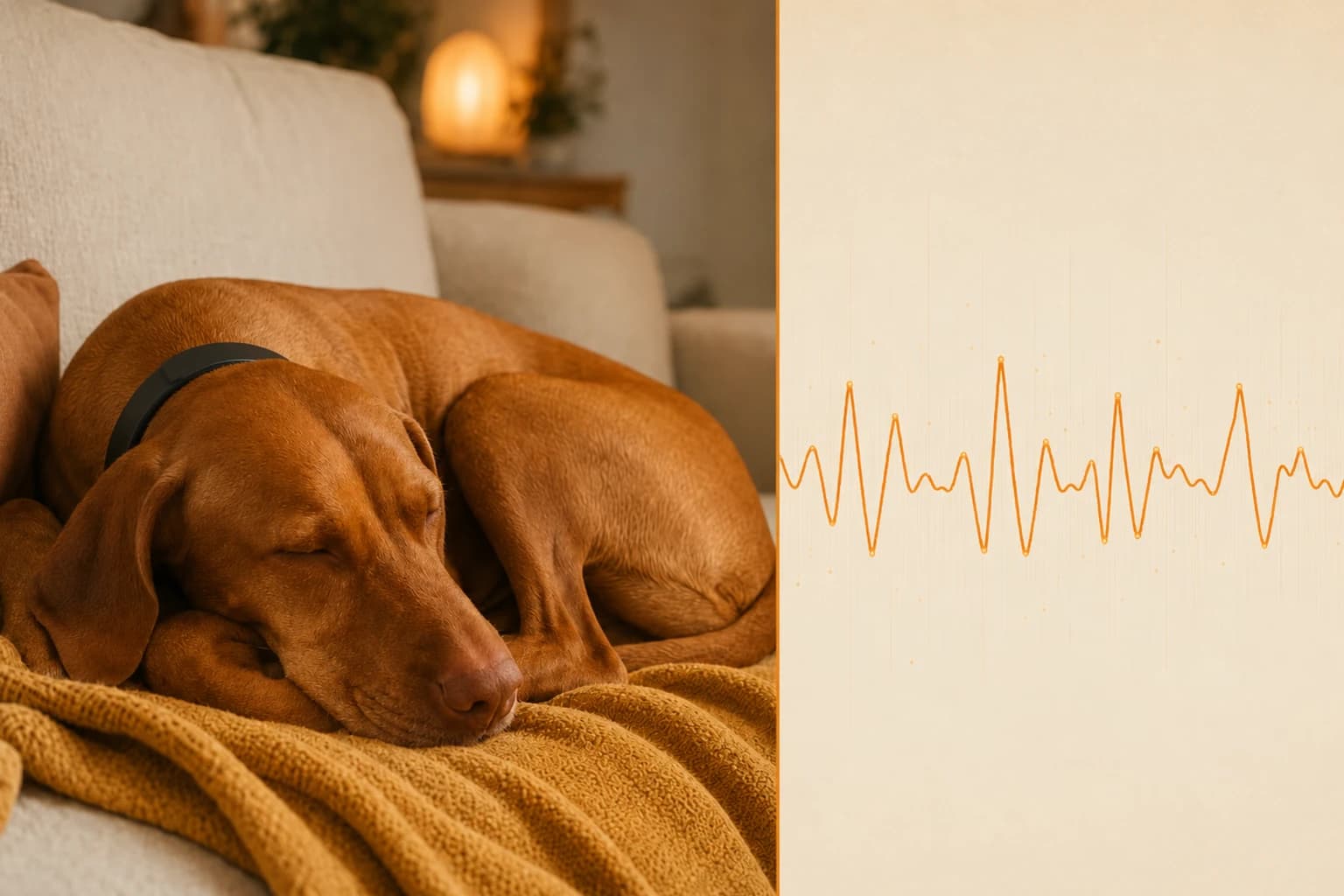
Continuous monitoring sidesteps that gap by starting from today. Prism Insights spends roughly the first three weeks learning what normal looks like for this specific dog in your home, across sleep, activity, heart rate, and breathing. It does not need a shelter file to do that. It just needs time and a collar that reads through fur.
3. The Anxious One and the Calm One
In most multi-dog homes, the stress load is not shared evenly. The Salonen et al. study in Scientific Reports (2020) surveyed owners of 13,700 Finnish pet dogs and found noise sensitivity was the most common anxiety-related trait, at 32%, with large differences between breeds. Put plainly: when the thunder rolls, it is common for one dog to pace while the other keeps snoring.
With per-dog monitoring, Pulse Rhythm can respond on the anxious dog's collar when that dog's heart rate and breathing suggest rising stress. The dog on the couch who could not care less about the storm is left alone.
4. The Big Dog and the Small Dog
Size nudges the numbers, though less than people expect. In the Royal Veterinary College data, healthy dogs' heart rates fell as body weight rose, but a 5 kg dog averaged only about 10.5 beats per minute faster than a 55 kg dog, and Chihuahuas ran higher than other breeds. A smaller Ohio State study (Lamb et al., Journal of Veterinary Cardiology, 2010) put 60 healthy dogs from 2 to 80 kg on a 24-hour ECG and found no correlation between heart rate and body weight at all. A Jack Russell and a Bernese sharing a hallway may or may not run at different rates. You only find out by measuring each one.
Activity is just as lopsided. A Border Collie that needs two hours of work a day and a Basset Hound content with a 15-minute stroll will never fit the same activity goal. If the Collie's activity drops 30%, that is worth a look. If the Basset's drops 30%, it might just be raining.
5. The Household That Changes
Multi-dog homes rarely stay the same for long. A new puppy arrives, an older dog passes, a foster comes and goes. The Dog Aging Project (McCoy et al., Evolution, Medicine, and Public Health, 2023) analyzed survey data on 21,410 dogs and found dogs living with other dogs or pets were rated as healthier by their owners, after controlling for age and weight. Companionship matters.
It also means changes in the pack can show up in each dog's data. Watching each dog's trend, rather than eyeballing the group, makes it easier to tell an adjustment period from something that deserves a call to your vet.