
Key takeaway: Dogs are evolutionarily wired to hide pain, which is why up to 38% of dogs have undiagnosed osteoarthritis and most pain-related behavior changes are missed for weeks or months. Continuous at-home monitoring of heart rate variability, gait, sleep architecture, and resting heart rate can surface pain-related deviations from a dog's personal baseline long before visible symptoms appear.
You know your dog better than anyone. You know the way she greets you at the door, the particular tilt of her head when she wants a treat, and the exact spot on the couch she claims every evening.
So when something feels off, you notice. Maybe she is a little slower getting up in the morning. Maybe she skipped the zoomies after dinner for the first time in months. Maybe she flinched, just barely, when you scratched behind her ear.
You pause. You wonder. And then she wags her tail, nudges your hand, and seems perfectly fine.
So you move on.
Here is the problem: by the time most dog owners recognize pain in their pets, that pain has often been building for weeks, sometimes months. Dogs are not just bad at showing pain. They are hardwired to hide it.
And that instinct, the one that kept their ancestors alive in the wild, is now one of the biggest threats to their health as family pets.

Why Dogs Are Evolutionary Masters at Hiding Pain
In the wild, a wolf that limps is a wolf that gets left behind by the pack, or worse, targeted by predators. Millions of years of evolution have wired canines to suppress visible signs of pain for as long as physically possible. It is a survival mechanism. Show weakness, and you become vulnerable.
The problem is that this instinct did not disappear when dogs moved onto our couches. Your Golden Retriever, your German Shepherd, your Chihuahua, they all carry the same ancient programming: hide the pain, keep moving, act normal.
This is not stubbornness. It is biology.
And it creates a devastating gap in pet healthcare. A landmark review published in Animals examined 100 referred dog behavior cases and found that approximately one-third, and potentially as many as 80%, involved an underlying painful condition. The most critical finding? Behavioral changes like increased fearfulness, reduced interest in play, and prolonged recovery from stressful events appeared before visible physical symptoms like limping or appetite loss.
The signs were there. They were just silent.
The Numbers Are More Alarming Than You Think
If hidden pain were rare, it would be a footnote in veterinary textbooks. But it is not rare. It is an epidemic hiding in plain sight.
Consider osteoarthritis, one of the most common chronic pain conditions in dogs. Most veterinary references estimate that roughly 20% of dogs are affected. But a 2022 study published in the Journal of Small Animal Practice challenged that assumption. Researchers applied a structured screening checklist to 500 dogs that had never been diagnosed with osteoarthritis. The result? Veterinarians confirmed the condition in 38% of them, nearly double the previously accepted rate.
That means more than one in three dogs may be living with chronic joint pain that nobody knows about. Not the owner. Not the vet. Nobody, because the dog never showed enough visible symptoms to trigger a diagnosis.
Now multiply that across every painful condition dogs experience: dental disease, spinal issues, soft tissue injuries, early-stage heart disease, gastrointestinal pain. The true burden of undetected pain in dogs is staggering.
And the cost of missing it is not just emotional. Emergency veterinary visits can quickly run into the thousands of dollars. Conditions caught early through routine monitoring are often treatable for a fraction of that cost.
What Pain Actually Looks Like in Dogs
Here is what most people picture when they think of a dog in pain: whimpering, limping, refusing to eat. Obvious distress.
But those are late-stage signals. By the time your dog is limping, the joint has likely been deteriorating for months. By the time she refuses food, the underlying condition may be advanced.
The early signs of pain in dogs are far more subtle:
- Slightly shorter stride length when walking, so gradual you would never notice day to day
- Hesitation before jumping onto the couch or into the car, where she used to leap without thinking
- Shifting weight off one leg while standing, almost imperceptibly
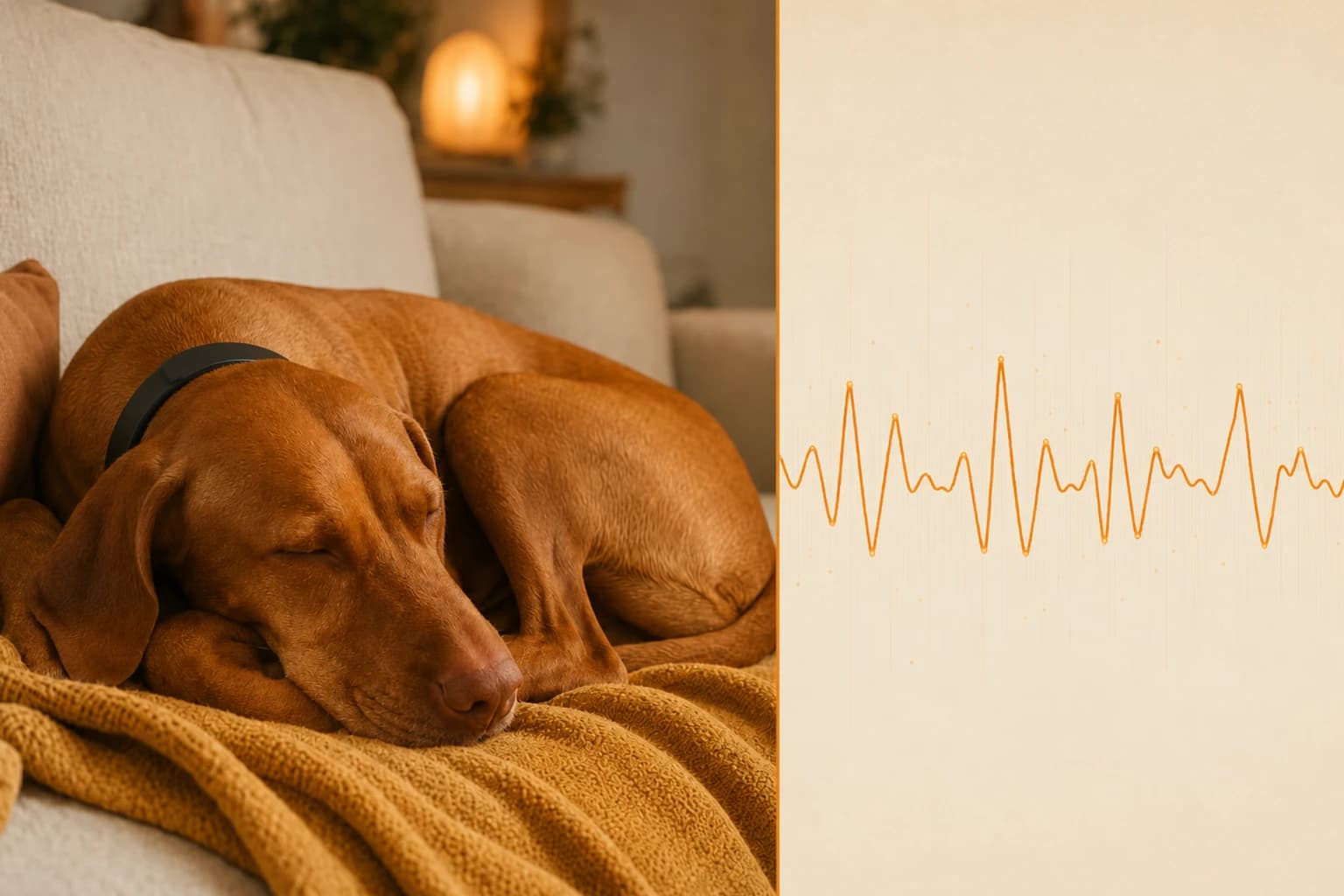
- Changes in sleep architecture, spending less time in deep restorative sleep and more time in light, restless phases
- Elevated resting heart rate while lying still, with no apparent cause
- Decreased heart rate variability, a subtle but measurable shift in how the nervous system regulates the heart
- Reduced play initiation, not refusing play entirely, but no longer starting it
- Micro-changes in posture, a slightly hunched back or lowered head carriage
No human, no matter how attentive, can track all of these signals simultaneously across days and weeks. You see a snapshot each morning and evening. The other 20 hours? You are guessing.
This is precisely the gap that technology was built to close.
Why Your Annual Vet Visit Is Not Enough
Veterinarians are extraordinarily skilled at assessing pain when they can see the dog. Tools like the Glasgow Composite Measure Pain Scale, developed by researchers at the University of Glasgow, give vets a structured framework to evaluate pain across multiple behavioral categories: posture, mobility, response to touch, vocalization, and demeanor.
But even the best pain scale has a fundamental limitation: it only works during the visit.
A typical vet appointment lasts 15 to 20 minutes. During that window, your dog is in a unfamiliar environment, stressed, overstimulated, and flooded with adrenaline. Some dogs mask pain even more aggressively at the vet because the stress response overrides everything else. Others appear more distressed than usual because of the environment itself.
Either way, the vet is working from a single snapshot taken under abnormal conditions. They do not see how your dog moves at 2 AM when she thinks nobody is watching. They do not see the subtle shift in her resting heart rate that started three weeks ago. They do not see that her deep sleep phases have shortened by 40 minutes per night over the past month.
That is not a criticism of veterinarians. It is a limitation of the model. And it is exactly why continuous, at-home monitoring changes everything.
The Science Behind AI Pain Detection
So what would it actually take to detect pain early, before your dog starts limping, before the emergency visit, before the condition becomes advanced?
It takes three things: the right sensors, the right context, and the right intelligence.
Heart Rate Variability: A Window Into the Nervous System
You have probably heard of heart rate monitoring. But heart rate alone tells you surprisingly little. A heart rate of 120 BPM could mean your dog just chased a squirrel. Or it could mean she is lying on her bed, silently experiencing inflammatory pain.
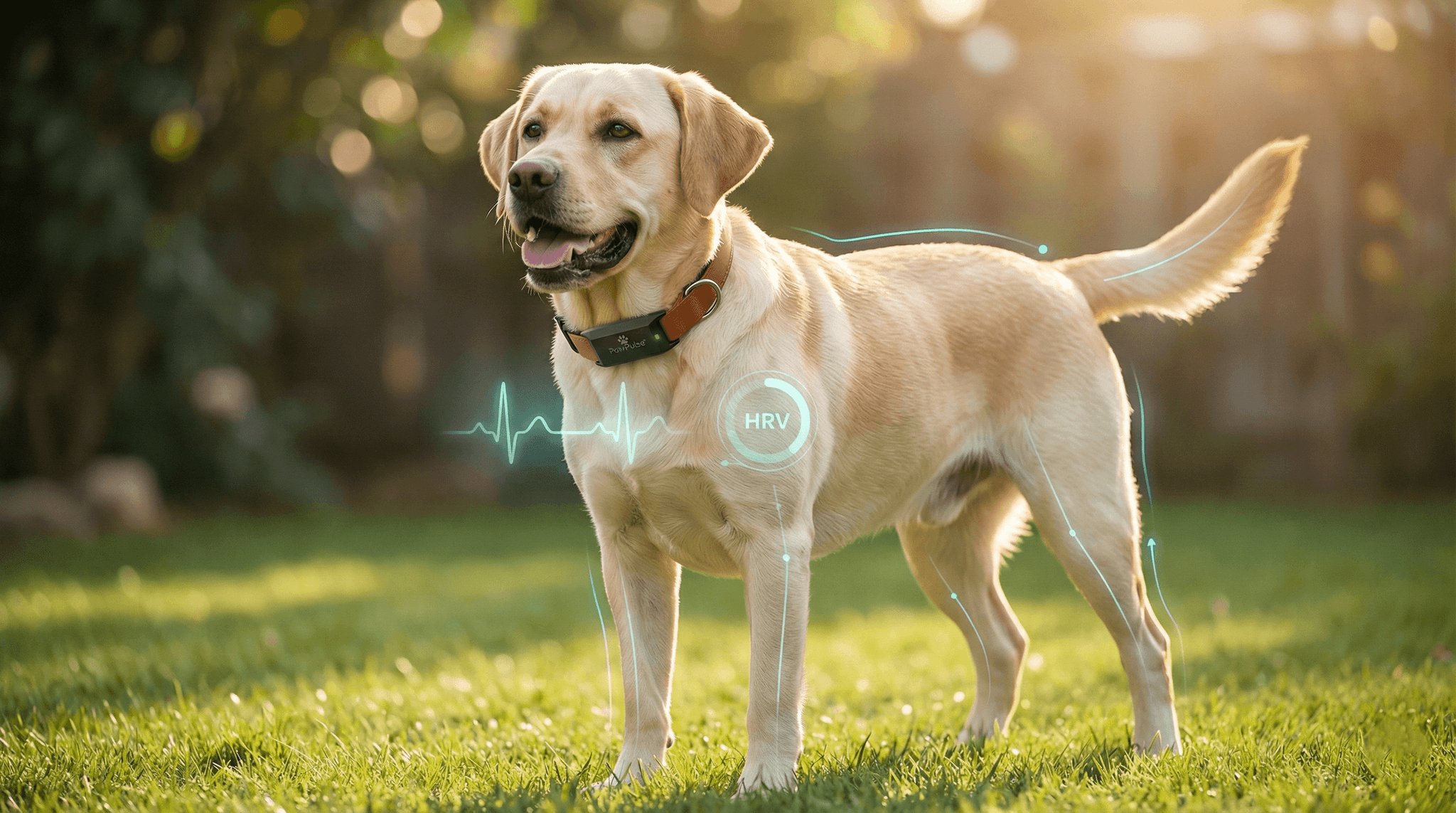
The far more revealing metric is heart rate variability, or HRV, the variation in time between consecutive heartbeats. It sounds subtle, and it is. But it is one of the most powerful biomarkers in medicine.
A systematic review of 71 studies published in Brain Sciences confirmed that significant changes in both sympathetic and parasympathetic nervous system activity occur during painful states. Higher parasympathetic tone, reflected in higher HRV, correlates with better pain regulation. When HRV drops, it signals that the body's stress response is activated, often because something hurts.
A separate meta-analysis of 51 studies published in the journal Pain found a consistent, moderate-to-large effect of decreased high-frequency HRV in chronic pain conditions. The researchers concluded that chronic pain fundamentally disrupts parasympathetic nervous system function, and that HRV monitoring could serve as a non-invasive biomarker for detecting it.
The autonomic nervous system works the same way across mammals. The same HRV patterns that indicate pain in humans indicate pain in dogs. The difference is that nobody has been measuring it continuously in dogs, until now.
Context Is Everything
But HRV alone is still not enough. Just like heart rate, HRV needs context to mean anything.
If your dog's HRV drops during a vigorous play session, that is normal physiology. If her HRV drops while she is lying motionless on her bed at 3 AM, that is a red flag.
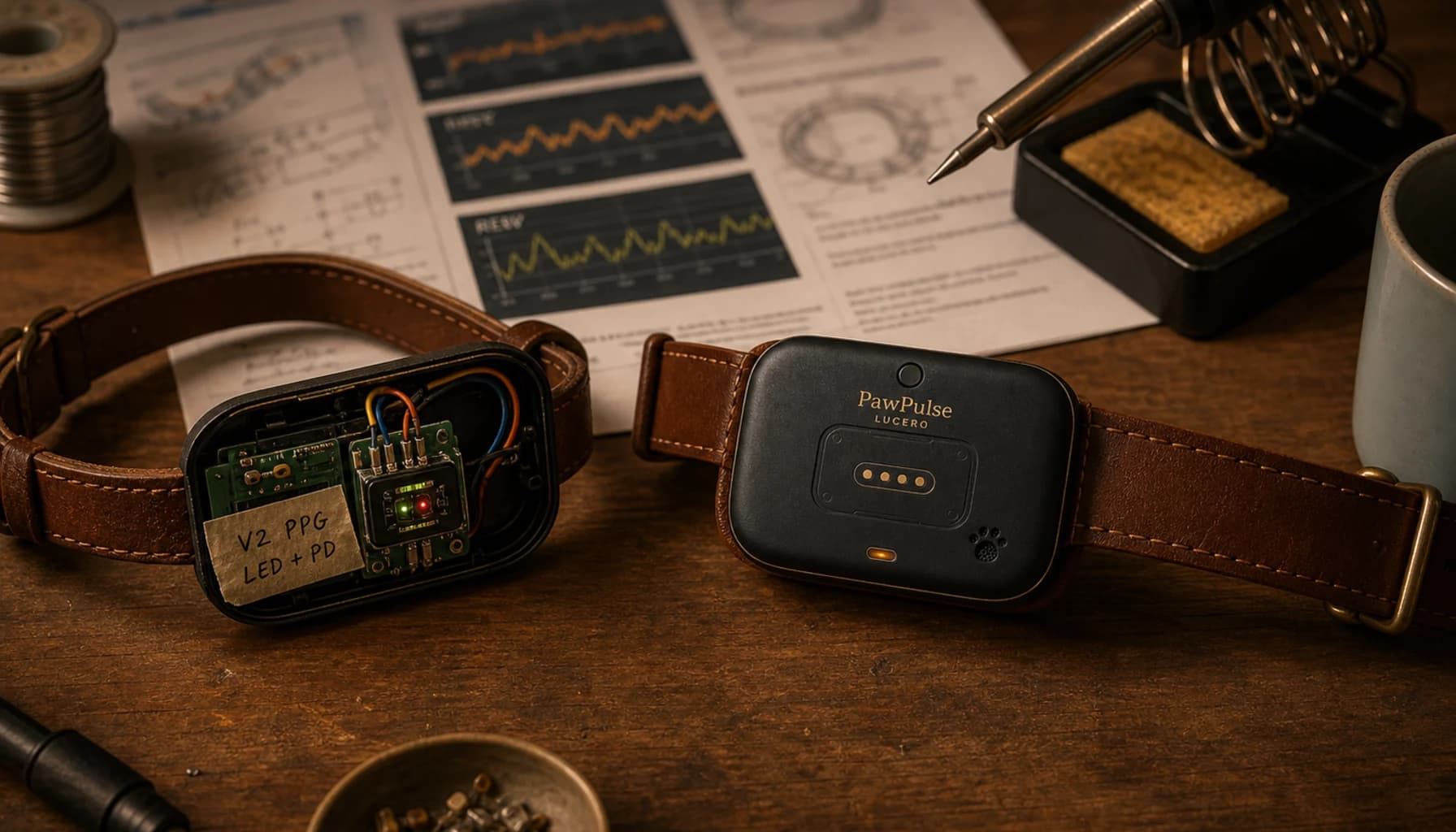
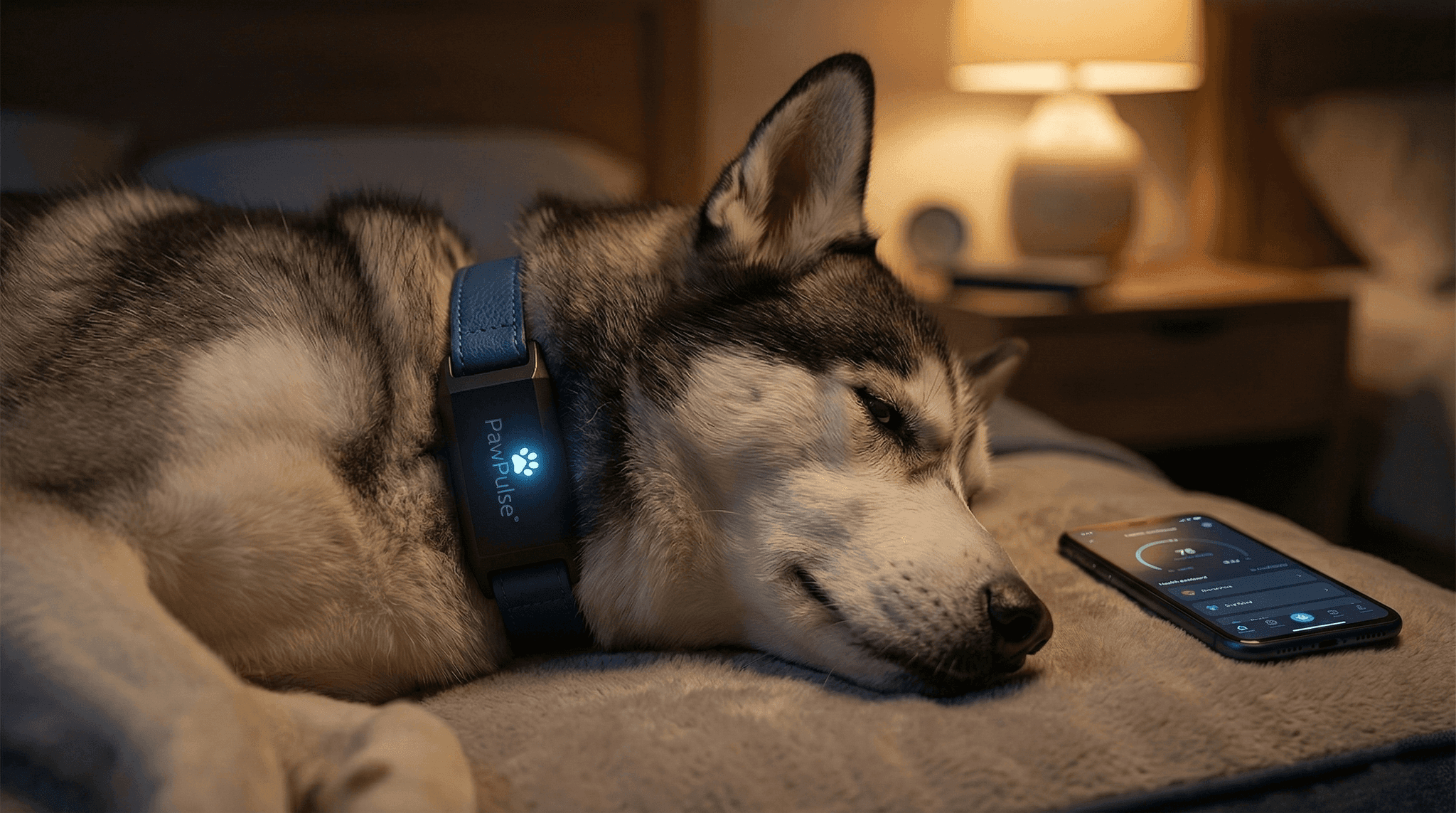
This is where sensor fusion becomes critical. At PawPulse, we do not rely on a single data stream. Our multi-sensor health platform combines multiple inputs simultaneously:
- What is the heart doing? Continuous heart rate and HRV via advanced radar sensing that reads through fur without skin contact
- What is the body doing? High-precision motion sensors tracking activity level, gait patterns, and posture
- What does the environment sound like? Audio analysis detecting pain-related vocalizations, coughs, and wheezes with 95.7% emergency accuracy
- What is the temperature? Continuous body temperature monitoring for fever and inflammation detection
When the collar detects that movement is near zero, the dog is lying still, but HRV is dropping and heart rate is climbing, the system does not just log a number. It flags a potential pain event. Conversely, if movement is high and heart rate matches the activity level, the system recognizes healthy exercise.
This is the difference between a device that collects data and a device that understands your dog.
How PawPulse Detects Pain Before You See It
We explored this concept in our previous post about how AI is helping us understand our dogs' emotions, where we discussed how sensor fusion differentiates anxiety from exercise. Pain detection takes that same foundation and goes deeper.
Prism Insights: AI That Learns Your Individual Dog
Most health monitoring systems use universal thresholds. If a dog's heart rate exceeds 150 BPM, trigger an alert. The problem? A resting Greyhound sits around 50 BPM while a healthy Chihuahua rests at 80 BPM. Universal thresholds can create noisy alerts, which means owners stop trusting the notifications and may miss the real ones.
Prism Insights, our proprietary health AI, takes a fundamentally different approach.
During the first 48 hours on your dog, the system builds a comprehensive digital baseline of your dog's unique patterns. Not breed averages. Not population statistics. Your dog's specific resting heart rate, their normal HRV range, their typical sleep architecture, their activity rhythms, their baseline temperature.
Once that baseline is established, Prism Insights continuously monitors for deviations. A 15% drop in HRV that persists across multiple rest cycles. A gradual increase in resting heart rate over seven days. A shift from three hours of deep sleep to two. A subtle change in stride symmetry detected by the motion sensors.
Individually, each of these shifts might seem insignificant. Together, they paint a picture that says: something is changing beneath the surface.
The result is fewer false alerts. Prism Insights looks for repeatable changes before it notifies you, so the alerts you receive are easier to trust.
Breed-Aware Pain Scoring
Here is something no other smart collar accounts for: dogs express pain differently depending on their breed.
Terriers and small companion breeds tend to be vocal about discomfort. They whimper, they yelp, they let you know. Northern breeds like Huskies and Malamutes? They are stoic. They will run on a torn ligament without making a sound.
PawPulse's database includes over 100 breed-specific profiles, each calibrated for pain expression tendencies. A vocal breed gets a slight downward adjustment on the pain score to account for their expressiveness. A stoic breed gets an upward adjustment because their silence does not mean absence of pain.
This breed-aware calibration means a Husky who shows any behavioral change gets appropriately flagged, because the system understands that for this breed, even a small deviation from normal is significant.
The 0-10 Pain Scale
Veterinarians assess pain on standardized scales. We built ours to speak the same language.
PawPulse will generate a continuous 0-10 pain score based on the convergence of multiple data streams: HRV trends, resting heart rate deviations, activity pattern changes, sleep quality shifts, gait symmetry analysis, temperature fluctuations, and audio analysis.
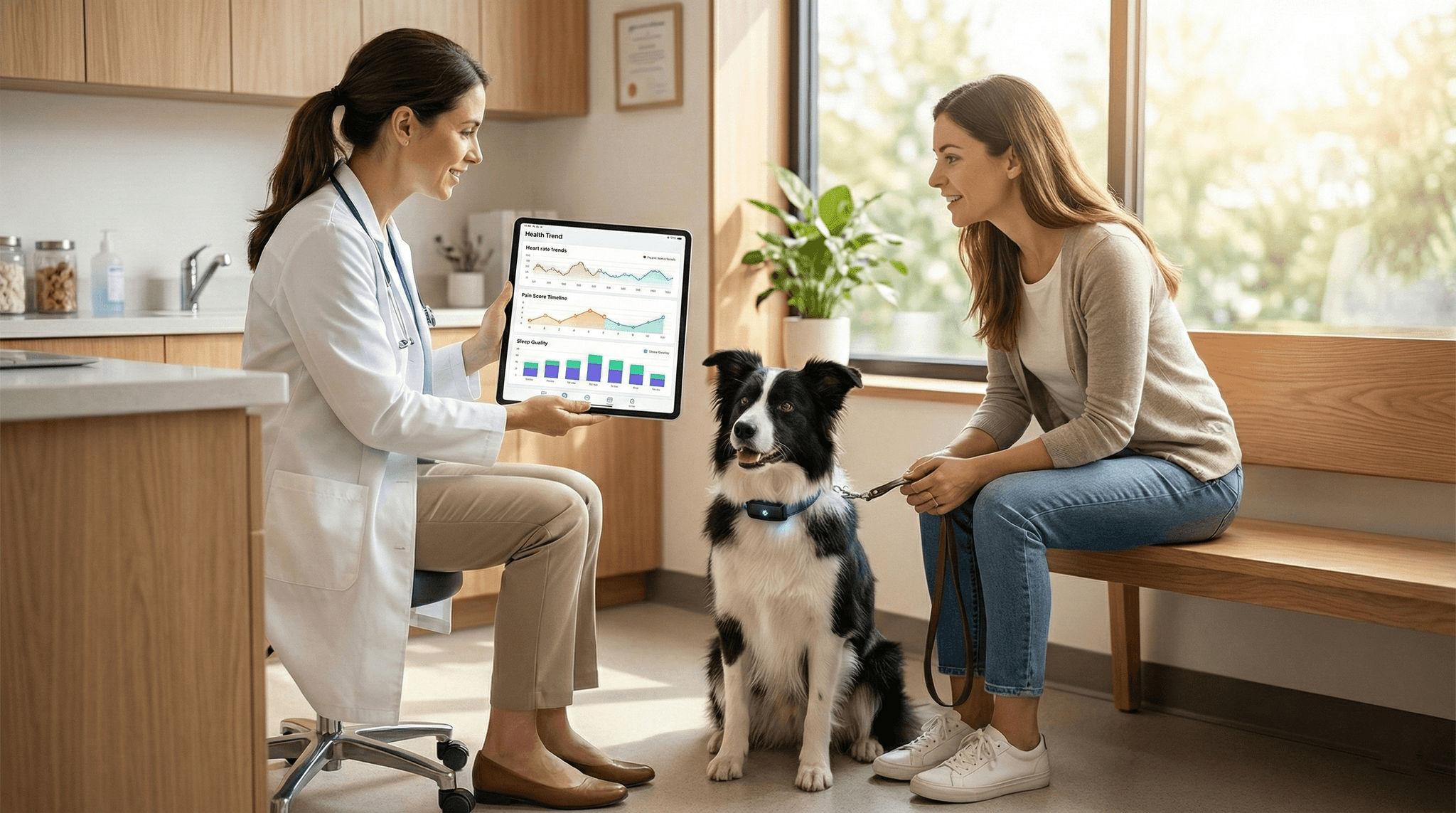
This is not a single measurement. It is a rolling assessment that updates continuously, giving you and your veterinarian an objective, data-driven view of your dog's comfort level over days, weeks, and months.
When you walk into the vet's office, instead of saying "she has been acting a little off," you can show them a timeline: "Her pain score has been climbing from 2 to 5 over the past three weeks, driven primarily by decreasing HRV and reduced deep sleep." As we discussed in our CES 2026 analysis, this is the difference between technology that tracks and technology that truly helps.
That is a conversation that leads to faster diagnosis and better outcomes.
Pain Is Not Anxiety, And Your Collar Should Know the Difference
One of the most overlooked challenges in pet health monitoring is differentiating pain from anxiety. Both can elevate heart rate. Both can disrupt sleep. Both can reduce activity.
But the treatment for each is completely different.
This is why PawPulse built pain detection and anxiety detection as separate, context-aware systems. When the data pattern matches an anxiety profile, elevated heart rate combined with restless pacing, trembling, or environmental triggers like thunderstorms, the system recognizes it as stress and can activate Pulse Rhythm automatically.
When the pattern matches a pain profile, elevated resting heart rate combined with stillness, reduced HRV, subtle gait changes, and no environmental trigger, the system flags it as a potential pain event and alerts you to consult your veterinarian.
Getting this distinction right matters. A dog in pain does not need a calming vibration. They need medical attention. And a dog with anxiety does not need unnecessary diagnostics. They need the right kind of support. PawPulse is designed to know the difference.
The Future of Veterinary Pain Management Is Continuous
The veterinary industry is beginning to recognize what human medicine learned a decade ago: continuous monitoring catches what periodic checkups miss.
A 2025 review in Frontiers in Veterinary Science examined 39 deep learning studies in veterinary medicine and found that AI models are already matching or exceeding veterinarians in specific diagnostic tasks, such as identifying thoracic lesions on radiographs. The review concluded that AI-powered diagnostics are not replacing veterinarians, they are giving them better data to work with.
That is precisely what PawPulse is designed to do. We are not replacing your vet. We are giving them something they have never had before: weeks of continuous, objective health data collected in your dog's natural environment.
No stress from the clinic. No adrenaline masking pain responses. No relying on a single 15-minute snapshot. Just clean, contextualized data that tells the full story.
Through the PawPulse Veterinary Dashboard, your vet will have access to your dog's health trends, including heart rate, HRV, sleep quality, activity patterns, pain scores, and flagged events. When something drifts from baseline, both you and your vet will know, often before your dog shows a single visible symptom.
The Complete Picture
Think back to that moment at the start of this article. Your dog is a little slow getting up. She hesitates before jumping onto the couch. She seems fine a minute later.
Without continuous monitoring, you shrug it off. Six months from now, she is limping. The vet diagnoses advanced osteoarthritis. The treatment is expensive, the damage is done, and you cannot help but wonder: how long was she hurting before I noticed?
With PawPulse, the story ends differently.
Three weeks ago, Prism Insights flagged a subtle but persistent drop in your dog's HRV during rest periods. Her deep sleep decreased by 30 minutes per night. Her pain score drifted from a 1 to a 3. You received a notification: "Luna's comfort trend has shifted. Consider a veterinary consultation."
You bring the data to your vet. They run targeted diagnostics based on the trends. Early-stage joint inflammation, caught months before it would have become visible. Treatment starts immediately. Outcome: managed condition instead of emergency intervention.
That is the difference between reactive care and proactive, AI-driven health monitoring. Between hoping your dog is fine and knowing.
Your dog has been talking to you this whole time. Not with barks or whimpers, but with heartbeats, breath patterns, sleep cycles, and a thousand tiny shifts that only continuous monitoring can hear.
It is time we started listening.
Ready to catch the signs your dog cannot show you? Explore our technology to learn how our radar-based sensors and Prism Insights AI work together, discover how Pulse Rhythm differentiates and treats anxiety, or see how veterinarians are partnering with PawPulse for better patient outcomes.
Early vs. Late-Stage Signs of Pain in Dogs
| Signal | Early / Subtle (Typically Missed) | Late / Obvious (Condition Already Advanced) |
|---|---|---|
| Gait | Slightly shorter stride length; tiny weight shift off one leg | Limping; carrying a leg; refusing to put weight down |
| Movement choices | Hesitation before jumping; slower stair descents | Refuses jumping or stairs entirely |
| Sleep | Reduced deep-sleep minutes; more frequent position shifts | Visible restlessness; whining during sleep |
| Resting heart rate | Slow upward drift of 5-10 BPM over days | Consistently elevated heart rate at rest |
| Heart rate variability | Gradual HRV decline with no activity trigger | Sustained low HRV across rest cycles |
| Play behavior | Stops initiating play; accepts play only briefly | Refuses play entirely |
| Posture | Slightly hunched back; lowered head carriage | Persistently guarded posture |
| Appetite | Eats slower; occasional skipped meals | Consistent appetite loss |
| Vocalization | No change (stoic breeds) or slight change | Whimpering, yelping on touch |
The early-signal column is invisible to a 15-minute vet exam. The late-signal column is usually what finally gets a dog to the clinic, by which point the underlying condition has often been progressing for weeks or months.
Threshold-Based vs. Personalized Baseline Monitoring
| Approach | Threshold-Based | Personalized Baseline (PawPulse) |
|---|---|---|
| Alert trigger | Fixed thresholds (e.g., HR > 150 BPM) | Deviation from the dog's own learned baseline |
| Accounts for breed | Partially (breed averages) | Yes (learns individual resting HR, HRV, sleep) |
| Accounts for age / size | Rarely | Yes (continuously updated) |
| Alert quality | Noisy threshold alerts | Repeatable-change checks |
| Time to useful alerts | Immediate (shallow) | 48 hours to build baseline, then continuously improving |
| Catches gradual drift | No | Yes |
Frequently Asked Questions
What are the earliest signs of pain in dogs? Before limping or appetite loss, dogs typically show subtle signals: shorter stride length, hesitation before jumping, shifted weight distribution while standing, reduced deep-sleep minutes, and small increases in resting heart rate or decreases in HRV. These signs are easy to miss without continuous monitoring because they shift gradually over days.
Why do dogs hide pain? In the wild, visible weakness attracts predators and can cause a pack to leave an injured animal behind. Canines evolved strong instincts to suppress visible pain for as long as possible. That instinct remains in modern dogs, which is why even serious conditions often present with minimal visible symptoms until late stages.
How common is undiagnosed osteoarthritis in dogs? A 2022 study in the Journal of Small Animal Practice applied a structured screening checklist to 500 dogs with no prior diagnosis and found veterinarian-confirmed osteoarthritis in 38% of them-nearly double the historically reported rate. Most cases had been missed because the dogs were not showing enough visible symptoms to trigger diagnosis.
Can heart rate variability really indicate pain? Yes. A meta-analysis of 51 studies in the journal Pain found a consistent moderate-to-large reduction in high-frequency HRV in chronic pain patients. The autonomic nervous system works the same way across mammals, so the same HRV patterns that signal pain in humans signal pain in dogs.
How is AI-based pain detection different from a pet activity tracker? Activity trackers count steps and estimate calories. AI-based pain detection analyzes correlated changes across heart rate, HRV, gait symmetry, sleep architecture, resting heart rate, and body temperature in context. When multiple signals drift from the dog's personal baseline simultaneously, the system generates a rolling 0-10 pain score that updates continuously rather than a single daily summary.
Is a smart collar a replacement for my veterinarian? No. Continuous monitoring is designed to give your vet better data to work with, not to replace clinical judgment. When a pain score climbs or HRV drifts, the system surfaces a timeline you can bring to your vet. They run targeted diagnostics based on specific trends instead of starting from "she's been acting a little off."
How does the collar distinguish pain from anxiety? Pain and anxiety both elevate heart rate, but their contexts differ. Anxiety typically appears with environmental triggers (thunderstorms, departure, fireworks) and is accompanied by restlessness, pacing, or panting. Pain typically appears at rest, shows reduced HRV with stillness, and often correlates with subtle gait or posture changes. The AI evaluates both patterns and routes alerts accordingly: anxiety triggers Pulse Rhythm; pain triggers a veterinary consultation suggestion.
When should I share the data with my vet? Any time the system flags a sustained deviation from baseline, or before routine wellness visits. Giving your vet four weeks of continuous health trends changes the conversation from "she's been acting off" to "her pain score has been climbing from 2 to 5 over the past three weeks, driven mainly by decreasing HRV and reduced deep sleep." That specificity accelerates diagnosis and treatment.
Learn more about PawPulse Lucero, the smart dog collar that uses breed-aware AI to surface the subtle pain signals dogs are wired to hide, with vet-ready data sharing built in.
Related reading: how to know if your dog is in pain after surgery and why dog owners are turning to data-driven care.
-- The PawPulse Team