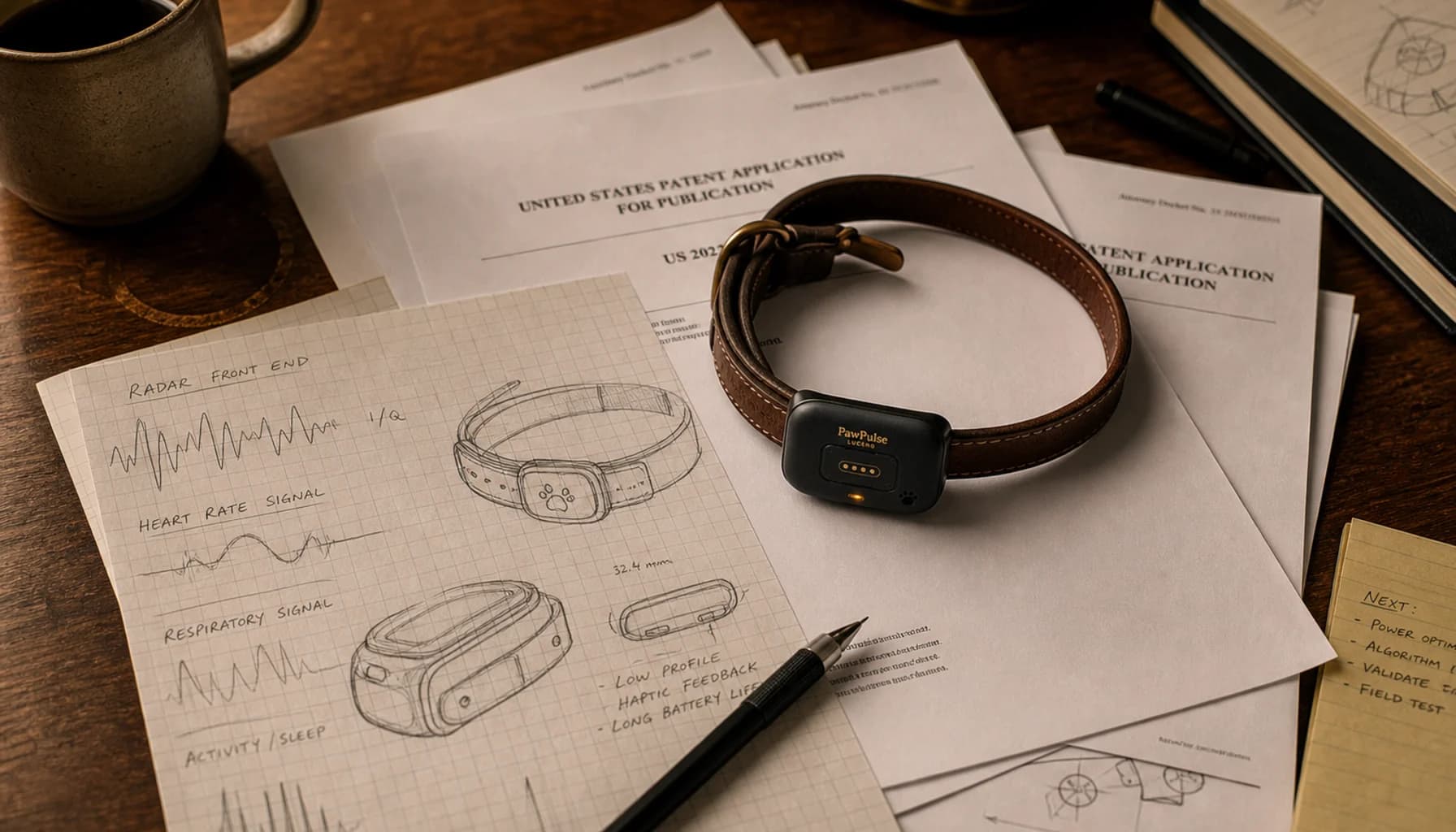


Key takeaway: Up to 40% of dogs experience anxiety disorders, most of which remain hidden because conventional optical health sensors cannot read through fur. AI-driven sensor fusion using advanced radar sensing detects the physiological signs of canine anxiety in real time, then triggers calming vibration therapy automatically-without medication or veterinary intervention.
We have all been there. You come home after a long day at work to find a shredded pillow in the living room or a chewed-up shoe in the hallway. Your dog is sitting in the corner, head down, eyes looking up at you with what looks unmistakably like shame.
We laugh and say, "Look, he knows what he did! He feels guilty."
But science tells us something different. According to a seminal study by Dr. Alexandra Horowitz at Barnard College, that "guilty look" is actually fear or submission in response to your body language. And that destroyed pillow? It wasn't an act of rebellion. It was likely a panic attack.
For decades, we have relied on guesswork to understand our pets. We interpret a wagging tail as happiness and a bark as a warning. But as our understanding of animal psychology evolves, our tools for monitoring them need to evolve, too. We track our own mental health, stress levels, and sleep quality with sophisticated wearables. It is time we extended that same courtesy to our four-legged family members.
Here is why AI for dogs is the next frontier in pet care, and why knowing how your dog feels is just as important as knowing where they are.
The Overlooked Problem: Anxiety in Dogs
Anxiety disorders are among the most common, yet misunderstood, issues in dogs. Research estimates that anywhere from 20% to 40% of dogs suffer from anxiety-related disorders, and the triggers are everywhere:
- Separation anxiety: The panic that sets in when you leave for work
- Thunderstorm phobia: Terror during every storm, sometimes hours before it arrives
- Fireworks fear: July 4th, New Year's Eve, and random neighborhood celebrations
- Noise sensitivity: Construction, sirens, or even household appliances
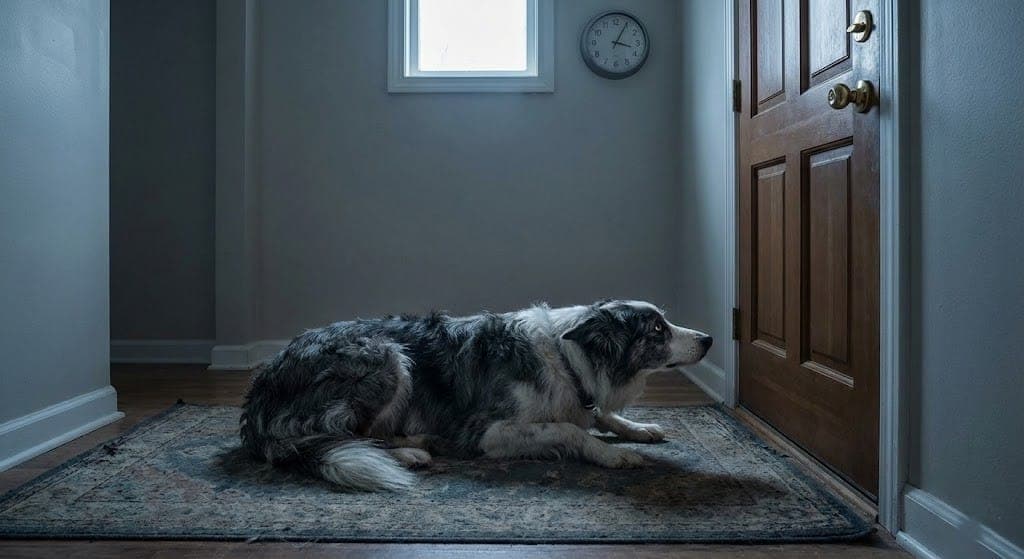
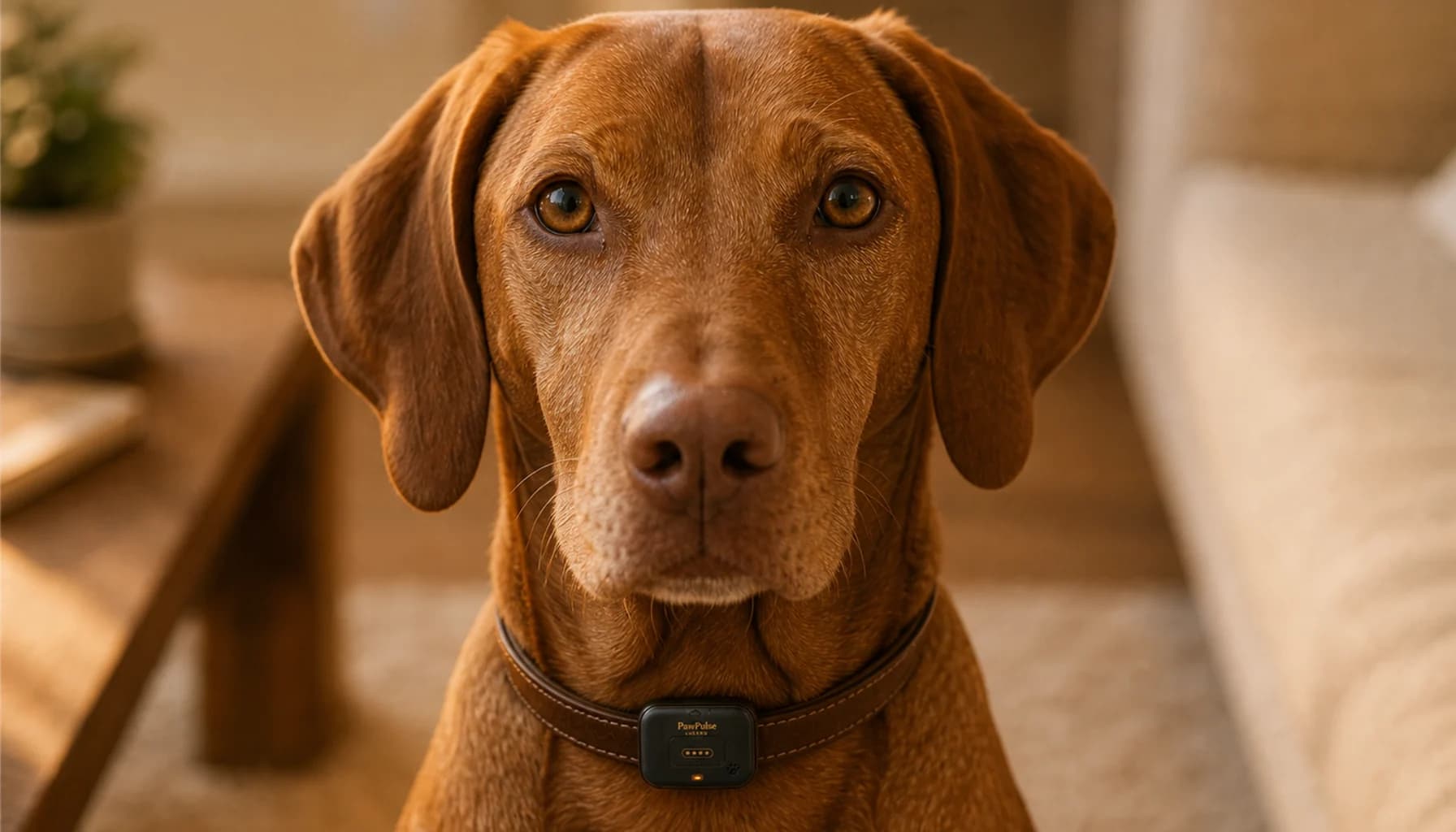
While we easily spot destructive behaviors, many dogs suffer from "silent anxiety." When you leave or when thunder rumbles in the distance, they might not destroy the house. Instead, they might pace endlessly, pant heavily despite a cool temperature, or sit trembling for hours. Without a smart collar to monitor them, you come home to a seemingly calm dog, never knowing they spent the last eight hours in a state of high cortisol stress.
Chronic stress in dogs, just like in humans, leads to long-term health issues. Recognizing these signs early is a critical part of a proactive pet health ecosystem. But to do that, we need technology that can actually "see" what is happening inside the dog.
Why Fur is the Enemy of Tech (And How We Beat It)
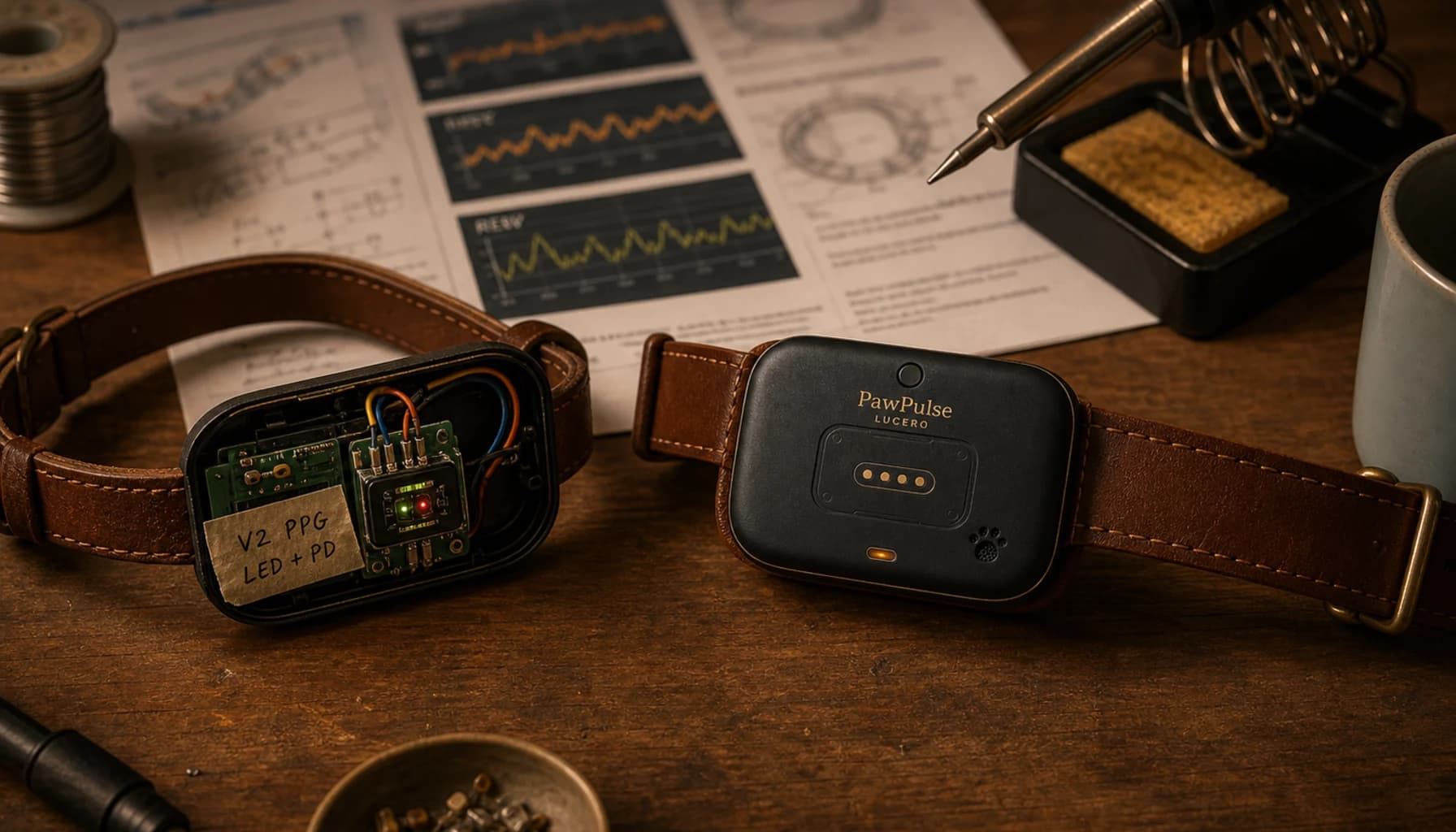
If you wear a smartwatch, you are likely familiar with the little green lights on the back. These are optical sensors (PPG) that shine light into your skin to measure blood flow. They work great on humans because we have relatively hairless wrists.
But for dogs? Fur is a barrier. Those green lights cannot penetrate a thick coat to get an accurate reading. This is why so many "health" collars on the market act more like glorified pedometers: they count steps, but they can't tell you how the dog is feeling.
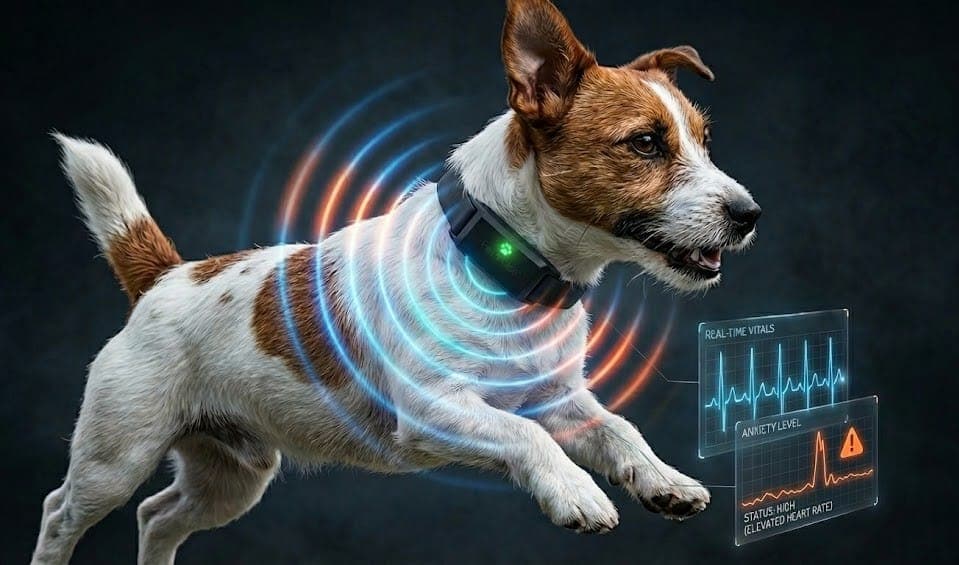
At PawPulse, we took a radically different approach. Instead of light, we use radar.
Think of it like a bat's echolocation, but instead of squeaks, we use invisible radio waves. Our device uses advanced radar health technology, which reads subtle motion from your dog's chest through fur.
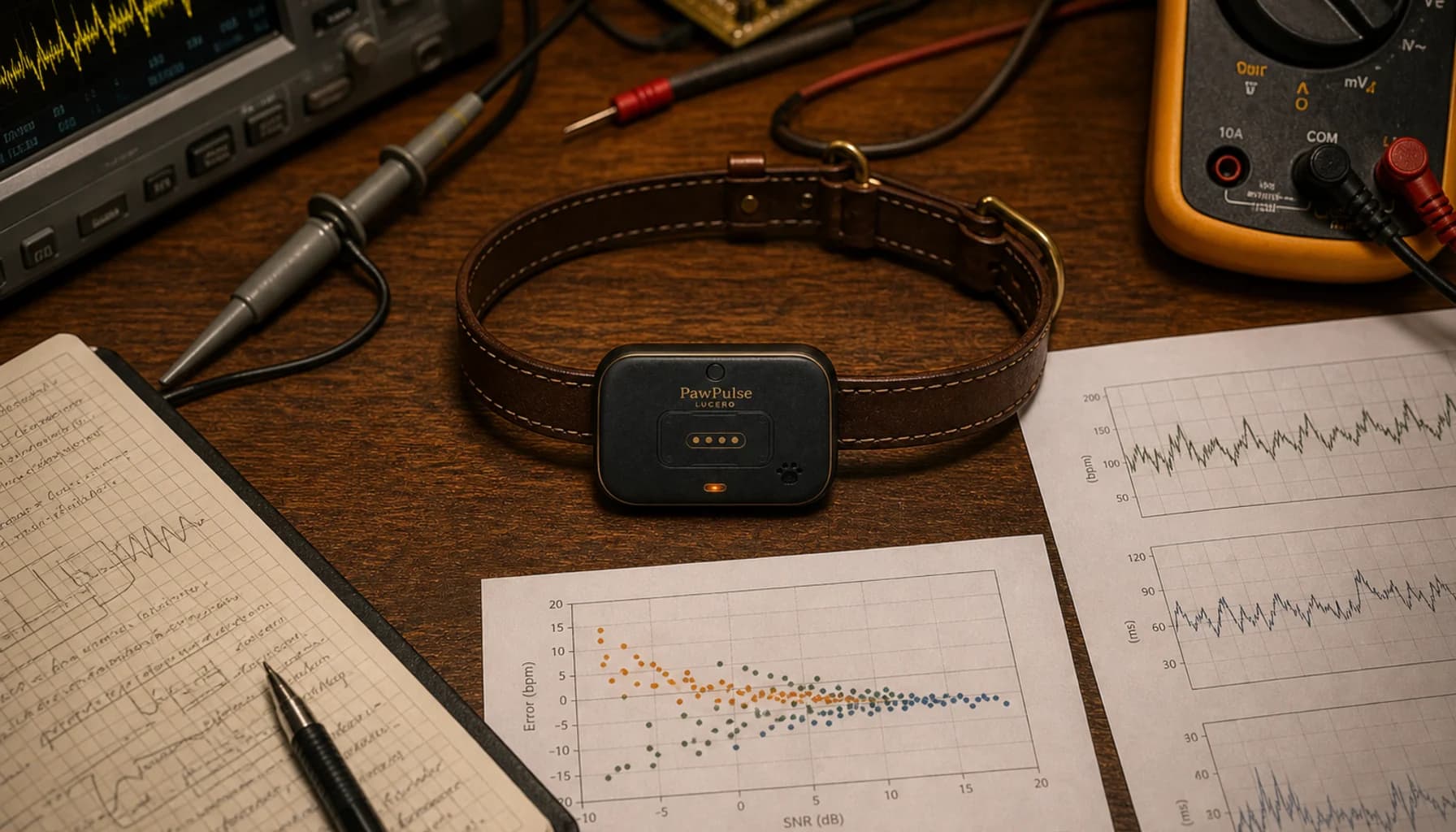
When your dog's heart beats or their lungs expand, their chest wall moves by minute fractions of a millimeter, sometimes as little as 0.1mm. While that is invisible to the naked eye, our radar "sees" these micro-movements clearly. It passes through fur, skin, and even a thick double coat as if they weren't there.
This allows us to capture professional-grade dog biometrics, specifically heart rate and respiration, without ever needing to shave a patch of fur or make the collar uncomfortably tight.
Context is King: The Difference Between Excitement and Anxiety
Collecting data is only half the battle. The real magic happens when you interpret it.
Imagine a heart rate of 150 beats per minute (bpm). Is that bad?
- If your dog is chasing a squirrel at the park, 150 bpm is healthy exercise.
- If your dog is lying on the couch while you are at work, 150 bpm is a major warning sign of distress or pain.
A raw number means nothing without context. This is where PawPulse's "Emotion AI" steps in. We use a sophisticated process called "sensor fusion" that combines the radar data with high-precision motion sensors.
The collar asks two questions simultaneously:
- What is the body doing? (Is the dog running, sleeping, or pacing?)
- What is the heart doing? (Is the rate high or low?)
If the collar detects that movement is ZERO (the dog is lying down) but the heart rate is climbing rapidly, the system flags it as an "Anxiety Event" or a potential pain response. Conversely, if movement is HIGH and the heart rate matches, the system logs it as "Exercise."
By filtering out the noise, we transform raw data into actionable health intelligence. You don't just get a graph; you get a notification saying, "Loki seems anxious," allowing you to intervene. This data can also be shared with your veterinarian to provide a complete picture of your dog's health between visits.
What the Latest Research Says About Reading Dog Emotions
The science here is moving fast, and it keeps pointing back to the body. In 2025, researchers put the newest general-purpose AI to the test in a study in Scientific Reports, evaluating whether large vision-language models like GPT-4o and Gemini could read dog emotions from images. The result was sobering: the models managed only moderate accuracy on tidy web photos and dropped to near-chance levels on experimentally induced emotional states, because a single image of a face strips away the context an emotion actually lives in.
That is exactly why PawPulse does not try to guess feelings from a camera. Emotion is physiological before it is visible, and a racing heart, shallow breathing, or suppressed heart rate variability are signals that do not depend on lighting, breed, or whether your dog happens to be facing a lens. Reading the body, continuously, is what separates a real emotional read from a hopeful guess. You can read the 2025 Scientific Reports analysis here.
Detection Is Only Half the Story
Here is the question nobody was asking: What happens after you detect anxiety?
Most pet technology stops at monitoring. You get a notification that your dog is stressed, and then... nothing. You are 20 miles away at work. A thunderstorm just rolled in. Your dog is panicking. What exactly are you supposed to do with that information?
This is the gap we obsessed over at PawPulse. Detection without intervention is just expensive guilt. You know your dog is suffering, but you are powerless to help.
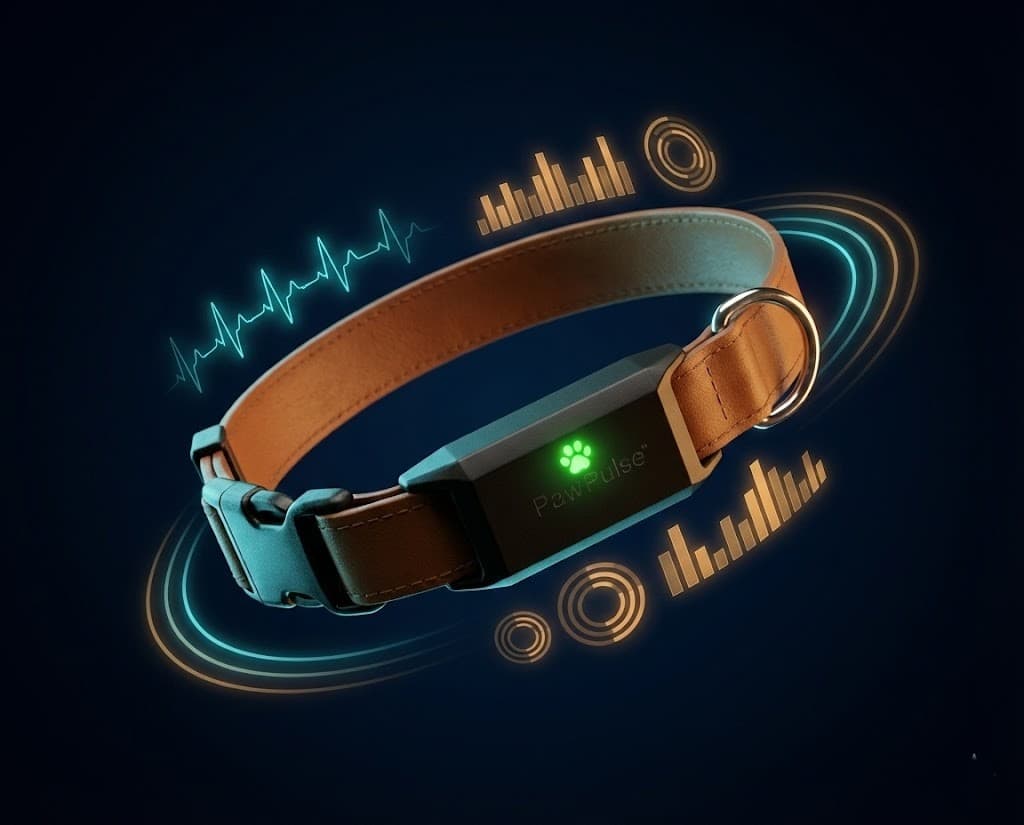
That is why we built Pulse Rhythm, a Pulse Rhythm system built directly into a smart pet collar. It is not an add-on or an accessory. It is a fundamental shift in what pet technology can do: read the stress, then soothe the response.
The Science of Calming: Why Vibration Works
Pulse Rhythm is not a gimmick. It is built on decades of peer-reviewed research about how mammals respond to specific sensory inputs. Here is the science:
Low-Frequency Vibration
Low-frequency tactile input in the sub-60Hz range has been studied for measurable physiological changes across mammalian species. We engineered our calming vibrations to operate in that responsive band.
Heartbeat Rhythm (60 BPM)
A study published in Applied Animal Behaviour Science found that rhythmic auditory cues at resting heartbeat frequencies measurably lowered cortisol and reduced stress-related behaviors in sheltered dogs. Think about it: puppies fall asleep to their mother's heartbeat. That primal comfort does not disappear in adulthood. Our Heartbeat Mode recreates this soothing rhythm for dogs experiencing separation anxiety.
Deep Pressure Activation
The principle behind compression vests and weighted blankets is well documented. Research in the Journal of Veterinary Behavior has explored canine heart rate and stress behaviors when deep-pressure wraps are applied. The mechanism is parasympathetic activation via sustained tactile input. Pulse Rhythm applies that idea through precisely calibrated vibrations, with one practical advantage: you can activate it remotely.
From Reactive to Automatic Intervention
Here is where the magic happens. Remember that "Emotion AI" we discussed earlier? It does not just detect anxiety and send you an alert. It can automatically trigger Pulse Rhythm before a full panic episode begins.
The system works in three stages:
- Read: Advanced sensors continuously monitor heart rate, heart rate variability, respiration, and movement patterns
- Detect: AI algorithms recognize the early signatures of an anxiety event, such as elevated heart rate combined with restless pacing or trembling
- Treat: The collar automatically activates the appropriate therapy mode, delivering calming vibrations before the anxiety spirals
You are at work. A thunderstorm rolls through. Your dog's heart rate spikes. Within seconds, Storm Mode activates, interrupting the anxiety response with a variable-pattern vibration designed specifically for acute stress events.
By the time you check the app, you see a notification: "Anxiety event detected and treated. Luna is now calm." No destroyed furniture. No hours of suffering. No guilt.
Three Modes for Different Triggers
Not all anxiety is the same, so we developed three distinct therapy modes:
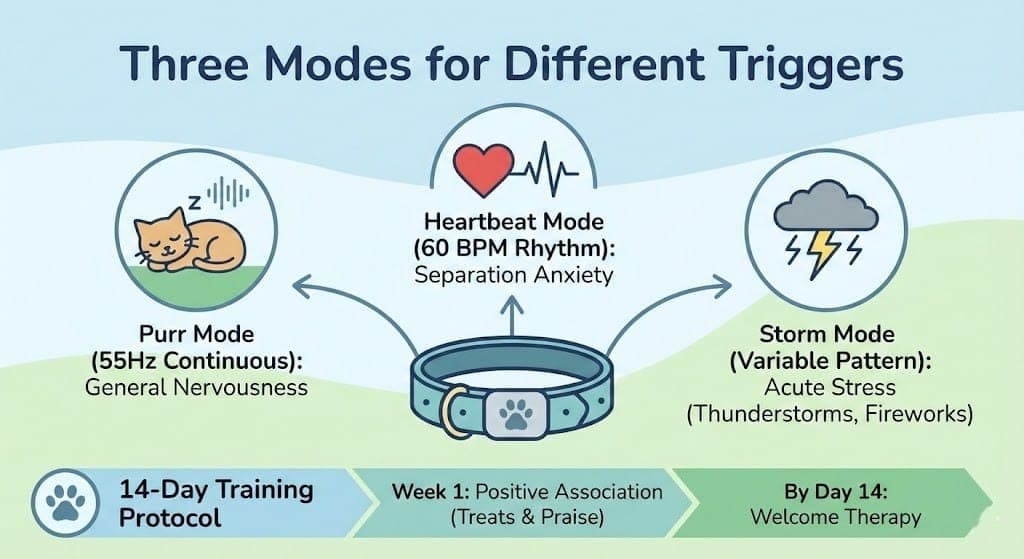
| Mode | Pattern | Best For | Primary Trigger |
|---|---|---|---|
| Deep Calm | 55Hz continuous vibration | General nervousness, everyday stress | Ambient arousal, mild restlessness |
| Heartbeat Mode | 60 BPM rhythmic pulses | Separation anxiety when home alone | Owner departure, extended solo time |
| Storm Mode | Variable-pattern interruption | Acute stress events | Thunderstorms, fireworks, sudden loud noises |
The 14-day training protocol built into the app helps your dog build positive associations with the therapy. By pairing the vibrations with treats and praise during the first week, your dog learns that the gentle sensation means comfort and safety. By day 14, most dogs do not just tolerate the therapy; they welcome it.
Important: Pulse Rhythm is 100% optional. You can turn it off completely at any time from the app. Some owners prefer to use PawPulse purely for health monitoring and GPS tracking, and that is perfectly fine. The feature is there when you need it, invisible when you do not.
Unbroken Bonds: A Safety Net for the Path Less Traveled
We built PawPulse to be a comprehensive guardian, and guardians don't take days off just because the cell signal is weak.
For city dogs, standard cellular tracking works fine. But for those of us who hike in the backcountry, live on rural acreage, or manage working farm dogs, "No Service" bars are a daily reality. If your dog chases a deer into deep woods or wanders past the property line in a dead zone, a standard smart collar becomes a useless piece of plastic. It can't send you their location because it can't find a tower.
That is why we engineered a unique hybrid connectivity system, which allows PawPulse to communicate via both cellular networks and satellite.
It works on a smart priority system:
- Under normal conditions: The collar uses standard cellular data
- In dead zones: If your dog breaches a geofence or goes missing in an area with zero cell coverage, like a ravine or a dense forest trail, the device automatically switches to a satellite connection
It beams their GPS coordinates directly to a satellite overhead, ensuring you can track them down no matter how remote the location. Whether you are miles into a hike or managing a large property, the leash doesn't break just because the coverage map ends.
The Future is Empathetic (And Active)
We are entering a new era of dog ownership. We are moving away from reactive care, waiting for a problem to become obvious, toward proactive, empathetic care that actually does something about the problems it detects.
The old paradigm looked like this:
- See destruction → Feel bad → Visit vet → Get medication → Hope it works
The new paradigm looks like this:
- Detect early signs → Intervene immediately → Prevent escalation → Live better together
By combining advanced radar, context-aware AI, science-based therapy, and satellite connectivity, we can finally bridge the communication gap between species. We can stop guessing what that "guilty look" means and start understanding, and addressing, the real emotions behind it.
When we listen to the silent signals our dogs are sending and respond with real help, we do not just protect their health; we deepen the bond that makes them our best friends.
The Complete Picture
Think back to that destroyed pillow we started with. With PawPulse, the story ends differently:
You leave for work. Your dog starts to feel anxious. The collar detects the rising heart rate and restless pacing. Heartbeat Mode activates automatically, delivering a soothing rhythm that interrupts the anxiety spiral. Your dog settles onto the couch, calmed by the gentle vibration.
You get a notification: "Mild anxiety detected and treated. Max is relaxed."
You come home to an intact pillow, a calm dog, and zero guilt. That is the future we are building.
Ready to understand your dog's emotions and actually help them? Discover Pulse Rhythm, explore our technology, or see how veterinarians partner with us.
Frequently Asked Questions
How common is anxiety in dogs? Peer-reviewed research estimates that 20-40% of dogs suffer from one or more anxiety-related disorders, including separation anxiety, thunderstorm phobia, and noise sensitivity. Because dogs instinctively hide distress, most cases go unreported and untreated.
Can a smart collar actually detect anxiety, or is it guessing? A properly designed collar uses sensor fusion: radar-based sensing measures heart rate and respiration, motion sensors detect movement, and the AI compares the two in context. If the dog is lying still but heart rate is climbing, that physiological mismatch is a reliable signature of anxiety rather than exercise. The system doesn't guess; it measures.
How is vibration-based therapy different from anti-anxiety medication? Pharmacological treatments like fluoxetine modify brain chemistry and require veterinary supervision, come with side effects, and take weeks to reach therapeutic levels. Vibration therapy uses classical conditioning to create a calm response via gentle tactile input. It acts within seconds, has no pharmaceutical interactions, and can be turned off at any time.
Does radar work through thick-coated breeds? Yes. Unlike optical (PPG) sensors that depend on light passing through skin, PawPulse's radar-based sensing detects the micro-movements of the chest wall through fur, skin, and even double coats. This is why it's the sensing technology of choice for professional-grade monitoring of Huskies, Newfoundlands, Golden Retrievers, and other dense-coated breeds.
What happens if my dog doesn't respond to the therapy? Pulse Rhythm is 100% optional and can be disabled in the app at any time. For dogs with severe anxiety disorders that do not respond to behavioral or tactile interventions, the continuous health data can still be shared with a veterinarian or veterinary behaviorist to inform a medication or desensitization plan.
Can the collar treat fireworks or thunderstorm anxiety automatically? Yes. When the AI detects the physiological signature of acute stress (elevated heart rate with restlessness or trembling), Storm Mode activates automatically to interrupt the panic spiral. The owner receives a notification that a therapy session was triggered.
Learn more about PawPulse Lucero, the smart dog collar that pairs continuous emotion monitoring with built-in Pulse Rhythm to read your dog's signals and gently respond when they need it most.
Related reading: drug-free treatment for separation anxiety and the science behind haptic Pulse Rhythm.
-- The PawPulse Team