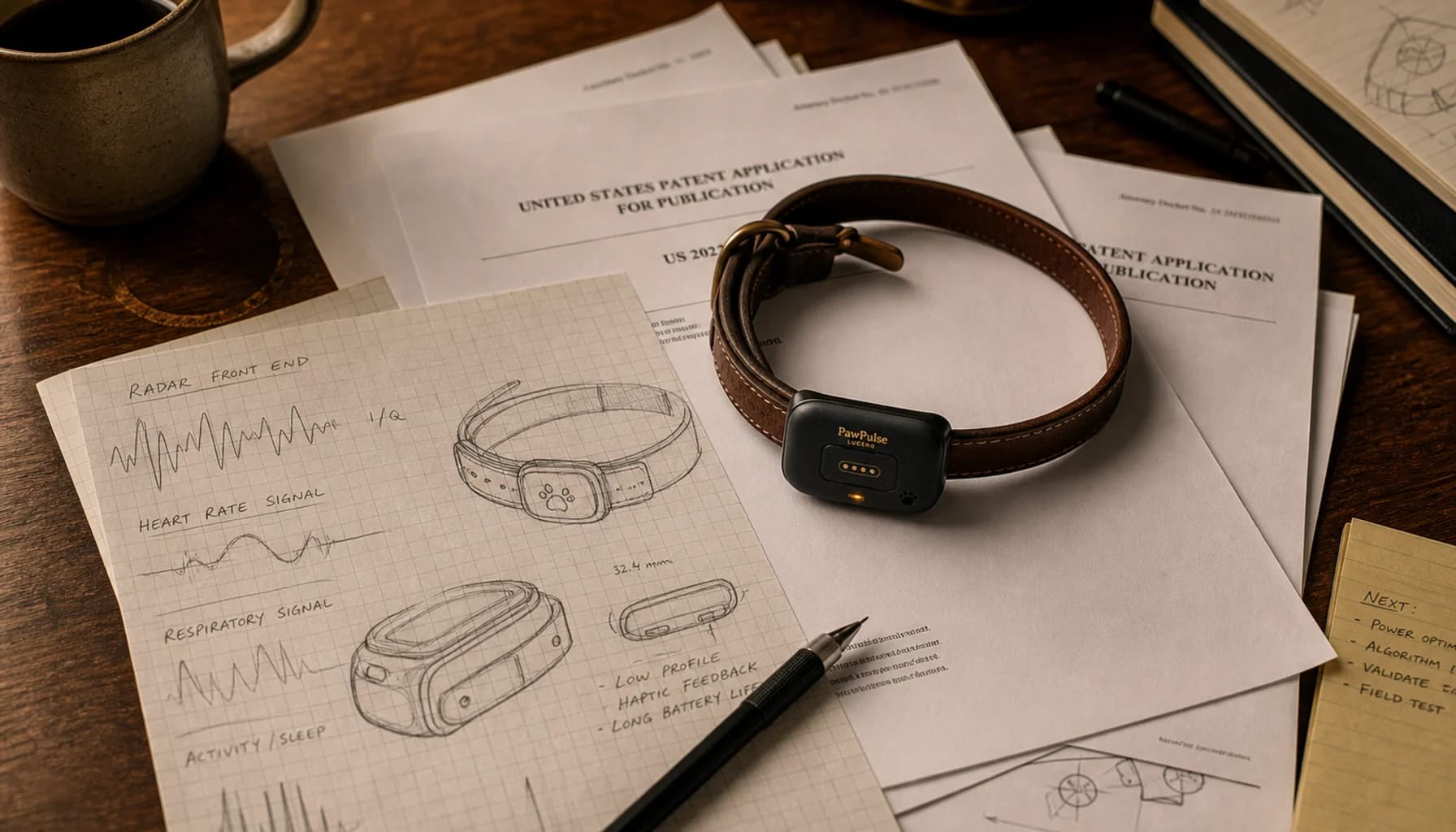
Key takeaway: Optical (PPG) sensors cannot reliably measure heart rate on furred pets. Advanced radar sensing works on every coat, fabric layer, and plastic housing to detect subtle chest-wall movement, making it one of the only sensing approaches that can deliver consistent vitals across dogs with very different coats.
Most smart collars promise to monitor your pet's health. Very few can actually deliver on that promise, because the sensor inside them was never designed for animals with fur.
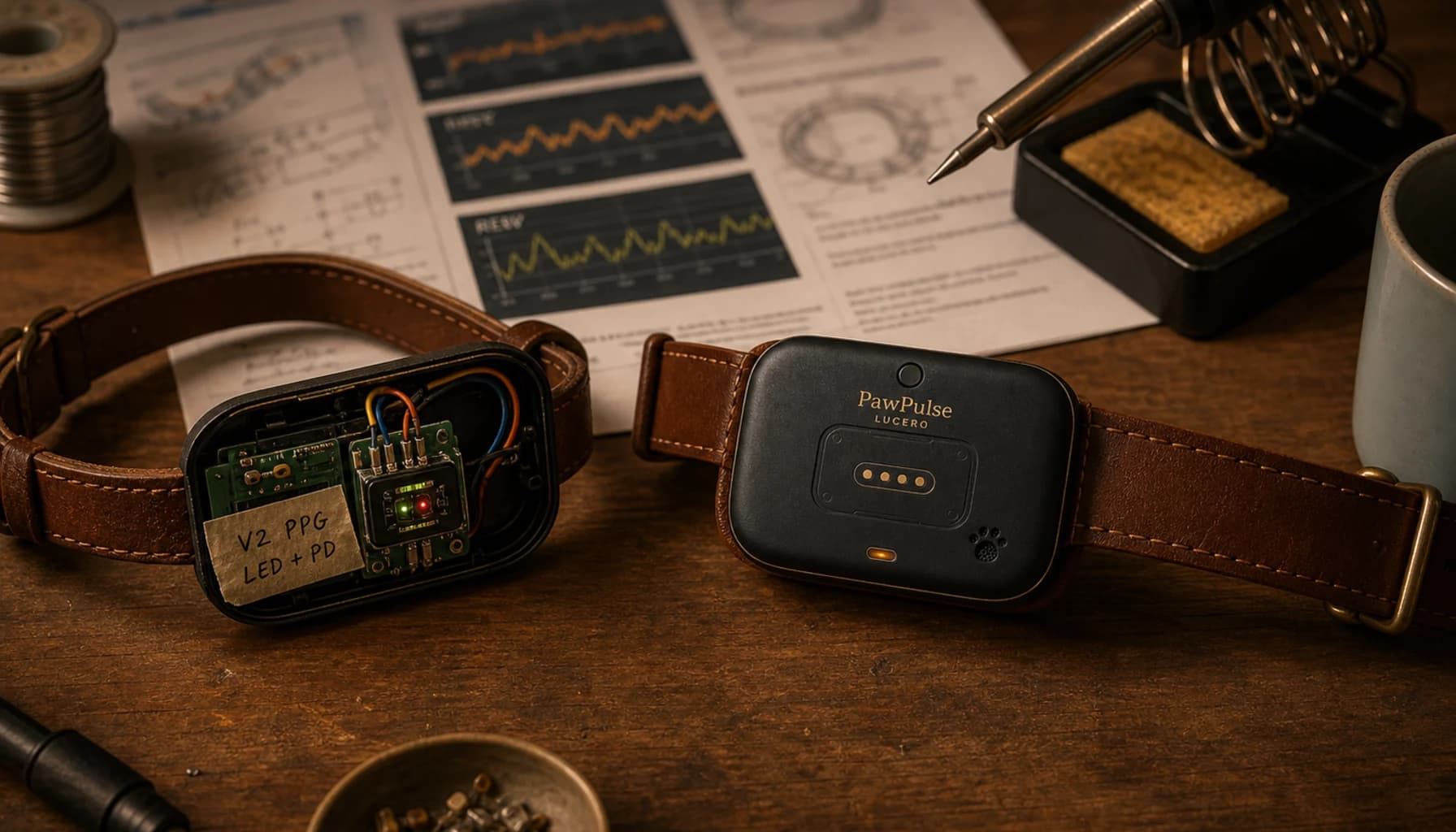
We know this firsthand. Before PawPulse became a radar-based platform, we spent months testing photoplethysmography (PPG), a human health sensor technology that the handful of pet wearables claiming to monitor vitals have borrowed as their only option. On short-haired dogs in a controlled setting, it worked. On a Husky, a Samoyed, or any dog with a real coat? The signal disappeared.
That failure is what led us to advanced radar sensing. For animals with fur, radar isn't just a better option. It's the only one that works. And it's what will reshape how the entire pet wearable industry thinks about health monitoring.
Why Most Smart Collars Can't Monitor Your Pet's Health
How PPG Works (and Where It Breaks Down)
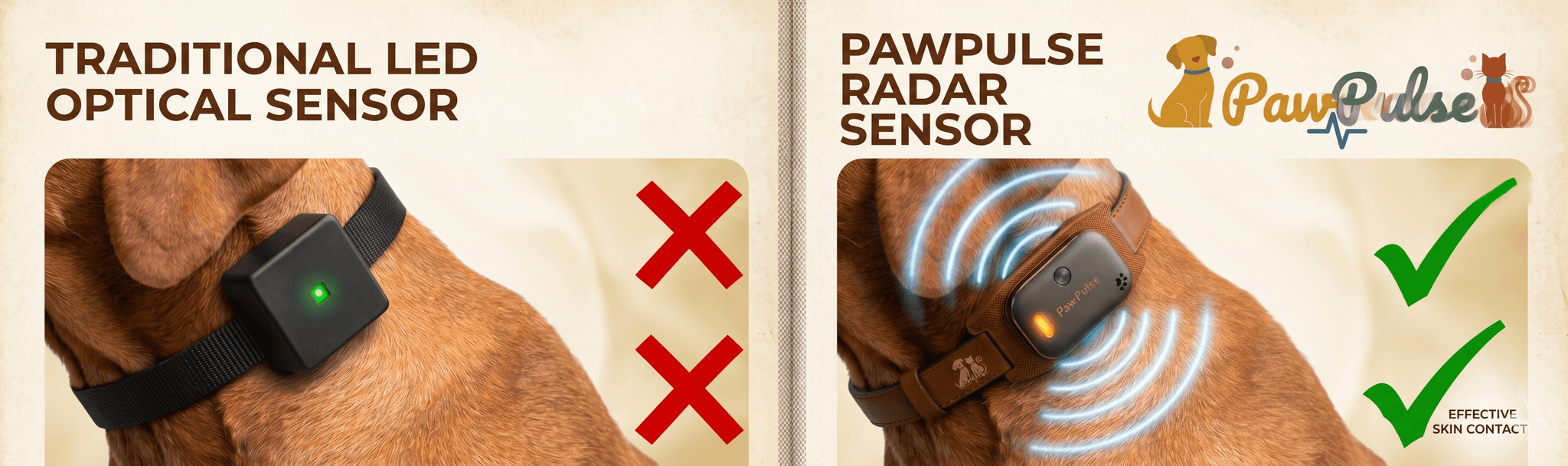
PPG was designed for humans. It's the technology behind fitness trackers, smartwatches, and hospital pulse oximeters. A small LED shines light into tissue, a photodetector measures the light that reflects back, and changes in blood volume produce a pulsing signal that reveals heart rate.
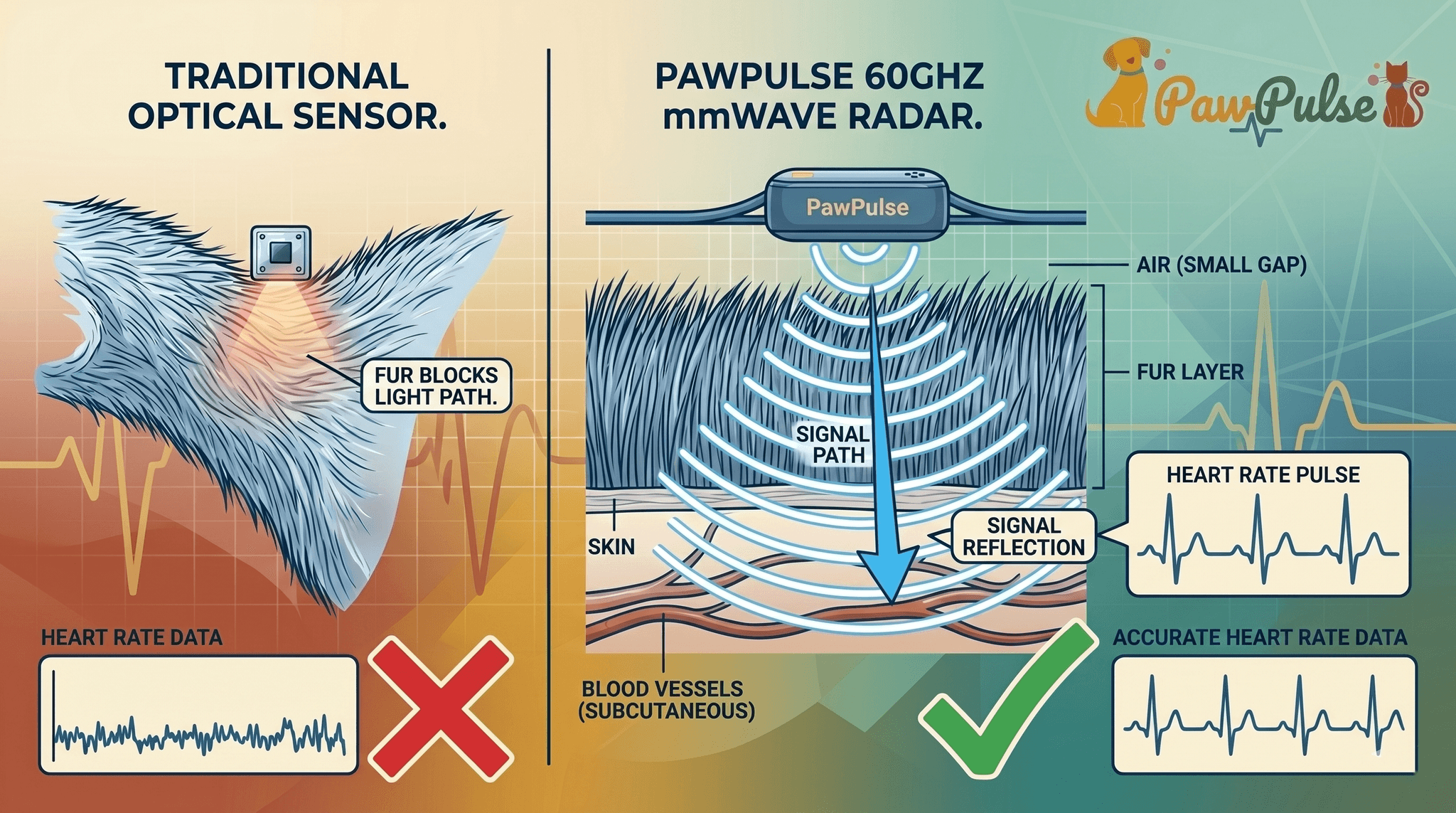
It works on people because human body hair is fine and sparse enough that light passes through to the skin with minimal interference. Dogs are a different story entirely. Many breeds have multiple layers of fur, a topcoat, an undercoat, and sometimes a protective guard layer, that reflect and scatter incoming light before it ever reaches tissue. Only a fraction of the signal makes it through, and what does get through is noisy, inconsistent, and prone to dropout.
What the Research Shows
This isn't just our experience. Researchers at NC State University found that canine fur reflects most incident light from PPG sensors, requiring engineered light guides just to get a readable signal through hair. A study published in Frontiers in Veterinary Science on contactless pet heart rate monitoring confirmed that traditional PPG requires either shaved skin or placement on furless regions like the ear or tongue, neither of which is practical for a collar your pet wears around the clock.
Why PPG Is Still the Only Option on the Market
Only a couple of pet wearable brands even attempt vitals monitoring, and both rely on PPG. Most companies skip heart rate sensing altogether. The ones that include it are using PPG as a marketing line item, not a reliable health tool. The reality is that PPG cannot accurately read heart rate on many dogs, because their fur blocks the signal before it reaches the skin.
It's not because PPG is the right tool for the job. It's because PPG is a mature human technology that's cheap, well-documented, and easy to integrate. Adapting it for pets requires minimal R&D compared to building a fundamentally different sensing platform from scratch.
But putting "heart rate monitoring" on the box and actually delivering accurate heart rate data are two very different things.
How Radar Sensing Works on Every Coat
A Different Sensing Principle
Radar sensing does not rely on light. Instead of measuring optical absorption in blood vessels, it detects the micro-movements of your pet's body: the subtle chest-wall displacement from each heartbeat, the rhythmic expansion of breathing, and the restlessness patterns that signal discomfort.
PawPulse uses a specialized radar sensing stack to capture heart rate, respiratory rate, and heart rate variability (HRV) continuously, regardless of breed or coat type.
A comprehensive dataset study published in Scientific Reports (Nature) validated that commercial radar systems reliably capture both respiratory and cardiac signals in a non-contact configuration. The IEEE's tutorial overview on radar-based vital sign monitoring details how this radar technology achieves the range resolution and sensitivity needed to isolate heartbeat-level displacement from background noise.
What This Means for Your Dog
PawPulse reads heart rate, respiratory rate, and heart rate variability regardless of breed, coat type, or grooming schedule. A Bernese Mountain Dog gets the same data quality as a Whippet. A Samoyed gets the same kind of continuous trend data as a Boxer.
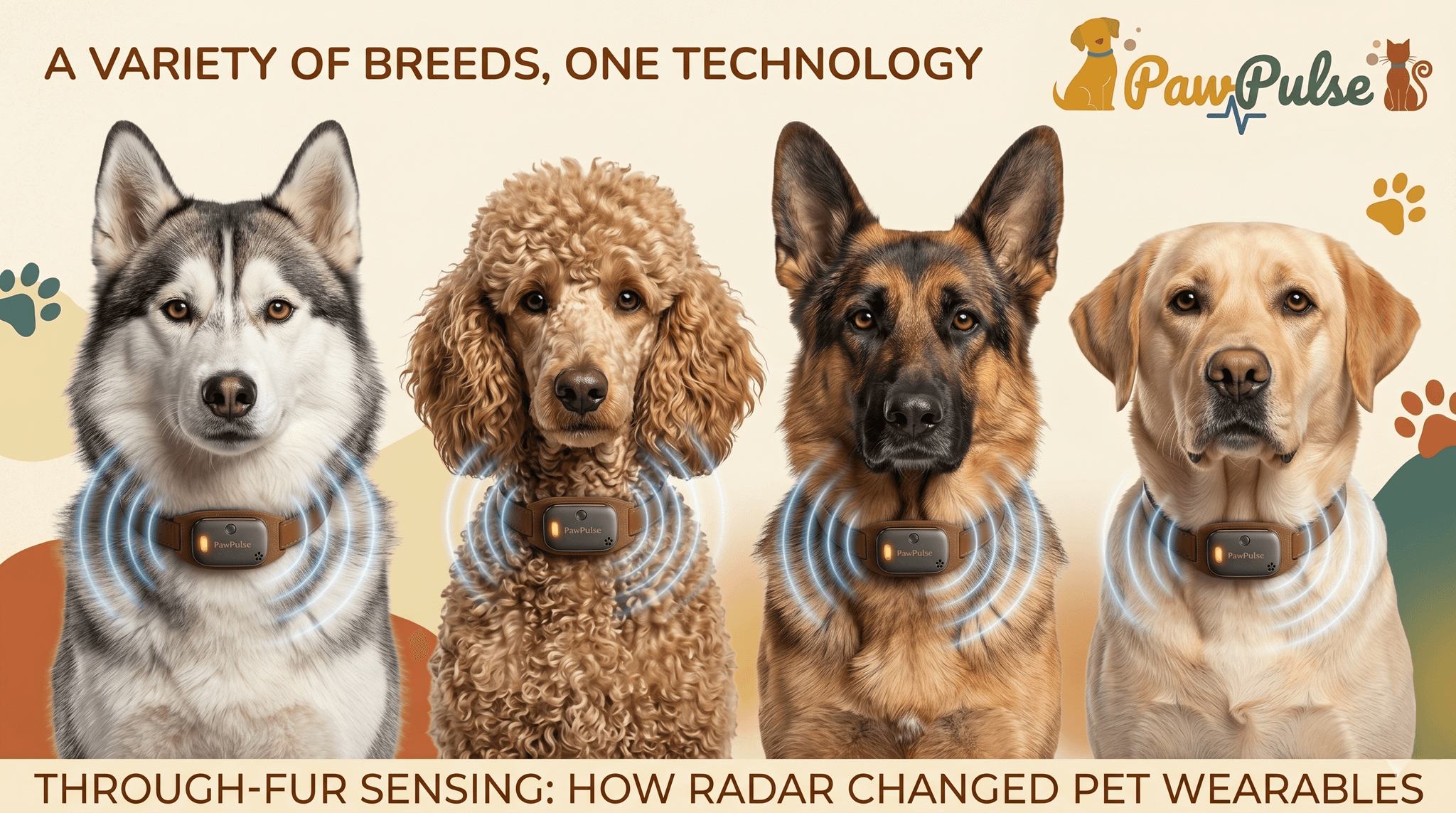
That consistency is critical because the value of continuous health monitoring isn't one heart rate snapshot. It's the trend over days and weeks that tells you how your dog is really doing. If your sensor drops out every time your pet's fur shifts or they roll onto their side, you don't have a health trend. You have scattered data points with gaps too wide to act on.
PPG vs Radar Sensing: Head-to-Head Comparison
| Feature | PPG (Optical) | Radar Sensing |
|---|
| Designed for | Humans (bare skin) | Any surface, including fur |
| Works on every coat | No -- requires skin contact or shaved area | Yes -- penetrates all coat types |
| Short-coat signal reliability | Usable ~70% of the time in still positions (PPG prototype testing) | Consistent signal in all positions |
| Long-coat signal reliability | Often zero signal, usable below 30% of the time | Consistent signal regardless of coat |
| Small-dog compatibility | Inconsistent when fit shifts | Stronger continuity without skin contact |
| Motion tolerance | High dropout during movement | Continuous signal |
| Measurements | Heart rate only | Heart rate, respiratory rate, HRV |
| Contact required | Yes -- firm skin contact needed | No -- non-contact through collar |
| Affected by ambient light | Yes | No |
| Affected by moisture/mud | Yes | No |
| Power consumption | Low | Moderate (optimized for collar battery) |
| Cost | Low (mature supply chain) | Higher (specialized silicon) |
| Data continuity | Gaps and dropouts common | 24/7 continuous stream |
What We Learned by Testing Both Technologies
When we started evaluating sensors for PawPulse, we wanted PPG to work. It's simpler, lower-cost, and the supply chain is mature. We built prototypes with green-light PPG, infrared PPG, and reflective-mode configurations. We tested across 15 dog breeds.
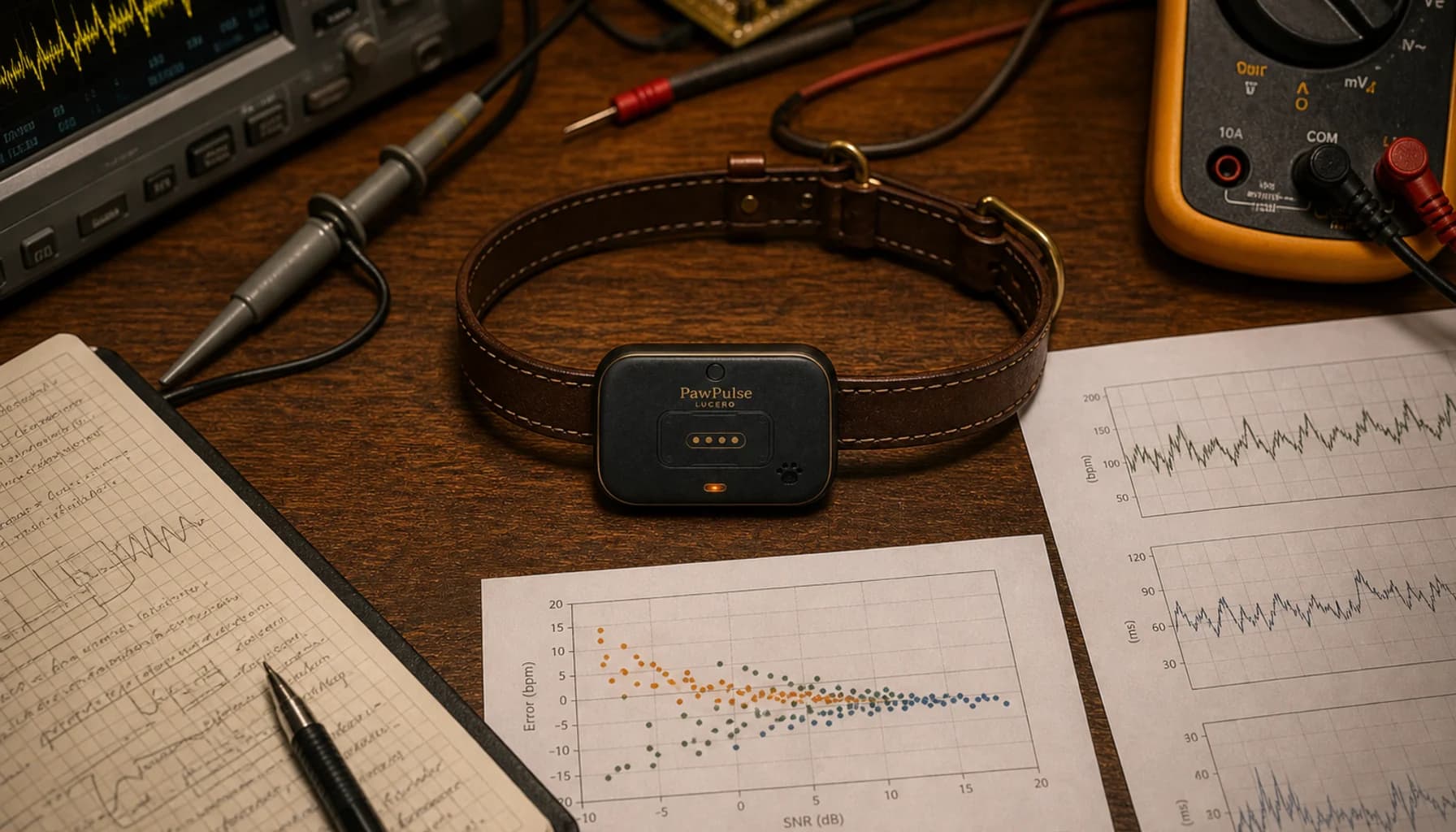
The results were clear. On short-coated breeds in still positions, PPG returned usable heart rate data roughly 70% of the time. On medium and long-coated breeds, that number dropped below 30%. An IEEE Sensors study on wearable canine heart rate systems documented the same fundamental challenge: fur acts as an optical barrier that PPG cannot reliably overcome without modified housings or shaved measurement sites.
Radar, by contrast, returned consistent signal across every breed and coat type we tested. The physics question was answered quickly. The engineering question, packaging radar sensing into a collar form factor at the power budget a pet wearable demands, took considerably longer. But we'd rather solve a hard engineering problem than ship a sensor that only works on some pets some of the time.
Why Continuous Sensing Unlocks Real Health Insights
Building a Baseline That Actually Means Something
This is also why Prism Insights, our onboard AI, can build a reliable behavioral baseline for your individual dog. The AI needs clean, continuous input to learn what "normal" looks like for your specific dog. Radar gives it that input 24 hours a day, without the signal dropout that optical alternatives produce.
From Tracking to Calming Support
Reliable sensing is what makes Pulse Rhythm possible. Because PawPulse can track when your pet's heart rate rises above their resting baseline, it can deliver precisely timed haptic calming patterns through the same collar. That closed loop, from real-time tracking to real-time calming support, only works when the sensor layer never drops out.
How to Evaluate Any Smart Collar's Sensor
If you're comparing pet wearables, ask one question before anything else: does the sensor work on every coat?
If the answer involves caveats about coat type, sensor placement, or shaving, you're looking at human wearable technology repurposed for pets. It may track location well. But for serious health monitoring, the sensor has to work on every pet, in every environment, without requiring owners to hope for ideal conditions.
The Future of Pet Health Starts with Better Sensing
The pet wearable market is still young, and the few products attempting vitals monitoring are built around the same optical sensors designed for human skin. That's about to change.
Radar sensing is not a workaround or an incremental improvement. It is a fundamentally different approach to sensing that solves the core problem optical technology cannot: reading vitals reliably on any breed of dog, regardless of coat, all day and all night.
We believe the next generation of pet health monitoring will be defined not by which collar has the most features listed on the box, but by which one actually collects the data it claims to. Radar is how we get there.
The wider research world is moving in the same direction. A January 2026 review of contactless vital-sign sensing surveyed radar and microwave methods and described the field shifting away from motionless lab subjects toward reading heart rate, respiration, and even heart rate variability while the subject moves through ordinary activity, using millimeter-wave radar and modern signal processing. That is precisely the problem a collar has to solve, because a dog is never perfectly still. The sensing principle PawPulse is built on is now the focus of serious academic and industry research.
Your pet shouldn't need a shave to get reliable health monitoring. With PawPulse, they won't.
Frequently Asked Questions
Does radar sensing work on all dog breeds?
Yes. PawPulse's advanced radar sensing works across fur types and coat lengths, from a Chihuahua's short coat to a Samoyed's dense undercoat. Unlike optical sensors, radar uses contactless sensing, so coat thickness has far less impact on signal quality.
Is radar sensing safe for pets?
Yes. The power levels used in radar-based vital sign monitoring are far below established safety thresholds. PawPulse operates at very low power, comparable to other everyday wireless electronics.
Can radar measure the same things as PPG?
Radar measures more. PPG is limited to heart rate through light absorption. Radar sensing detects heart rate, respiratory rate, and heart rate variability (HRV) simultaneously by measuring micro-movements of the chest wall. HRV is a great window into stress and recovery.
Why don't other smart collars use radar?
Radar requires specialized hardware, custom firmware for signal processing, and significantly more R&D than adapting off-the-shelf PPG modules. Most pet wearable companies lack the engineering resources to develop a radar-based sensing platform from scratch.
How does PawPulse handle motion artifacts?
PawPulse uses adaptive signal processing and sensor fusion algorithms that separate motion artifacts from vital sign signals. While extreme activity (running, jumping) reduces vital sign accuracy on any sensor, radar maintains usable signal through normal daily movement, resting, and sleep, which is where continuous health monitoring matters most.
What powers PawPulse's radar sensing?
PawPulse uses a specialized radar sensing system for non-contact vital sign detection. It measures chest-wall displacement small enough to support heart-rate and respiratory-rate extraction without skin contact.
Will PawPulse work on my thick-coated breed like a Husky or Samoyed?
Yes. PawPulse's radar sensing is designed to work on double coats, guard hair, and dense undercoat. A Samoyed in full winter coat can still deliver the same kind of continuous trend data as a short-haired Boxer.
What is the difference between contact and non-contact vital sign monitoring?
Contact sensors (PPG) must press directly against skin to function. Non-contact sensors (radar) sense vitals across air gaps, clothing, and any coat type without touching skin. For pets, non-contact sensing is the only approach that works reliably across every coat type.
Learn more about PawPulse Lucero, the smart dog collar powered by the radar sensing stack built specifically for continuous, contactless heart rate and breathing monitoring.
Related reading: why sensor accuracy transparency matters and 25+ patents and what we are protecting.
-- The PawPulse Team